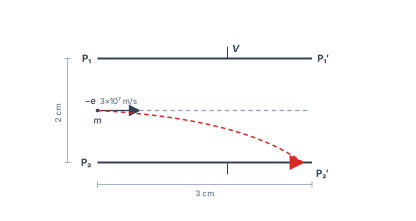
Q.Figure shows a narrow beam of electrons entering with a velocity of , symmetrically through the space between two parallel horizontal plates and kept apart. If each plate is long, calculate the potential difference applied between the plates so that the beam just strikes the end .
You're viewing a preview — the full solution, concept, methods & PYQ mapping are locked.
Start your 14-day free trial to unlock the full solution →The electron beam behaves like a projectile in a uniform electric field. The time to cross the plates is , and the required vertical deflection is . Using with , the potential difference comes out to .
The key here is to recognise that the electron beam, once it enters the region between the plates, experiences a constant vertical force due to the uniform electric field. There is no horizontal force, so the horizontal velocity stays constant. This is exactly the same physics as a projectile thrown horizontally under gravity — except here the "gravity" is electric, and the acceleration is , where is the plate separation.
The problem says the beam "just strikes the end ". That means the electron enters exactly midway between the plates (1 cm from each plate) and, after travelling the full length of the plates, just grazes the lower plate at its far end. So the vertical deflection needed is exactly half the gap: .
Let's work through the numbers step by step.
- Find the time the electron spends between the plates. The horizontal velocity is constant at , and the plate length is . Time of flight:
- Relate vertical deflection to acceleration. Starting from rest vertically, the displacement in time under constant acceleration is:
Here , so:
- Connect acceleration to the electric field and potential difference. The electric field between parallel plates is , where . The force on an electron is , so acceleration is:
Rearranging for :
- Substitute the numbers. We have , , and the charge-to-mass ratio for an electron is , so . …
Unlock everything free for 14 days
- Full step-by-step solutions
- Concept-first explanations
- Methods, shortcuts & mistakes
- PYQ mapping + timed mock tests
Full access for 14 days. No credit card required.