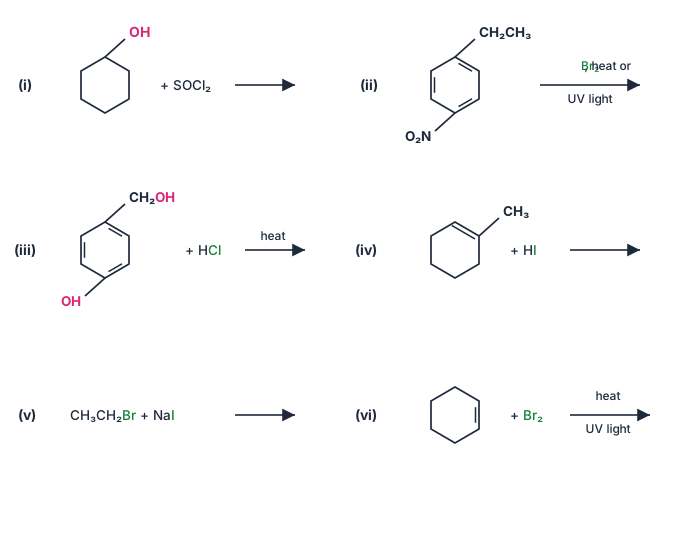
Q.Draw the structures of major monohalo products in each of the following reactions:
🔒You're viewing a preview — the full solution, concept, methods & PYQ mapping are locked.
🔒 Start your 14-day free trial to unlock the full solution →Concept understanding — Markovnikov Addition
The Intuition First
Imagine you have an alkene — a carbon-carbon double bond. That double bond is like a crowded room with two doors. When a molecule like HBr comes along, it wants to break that double bond and add across it. The question is: which carbon gets the hydrogen, and which gets the bromine?
You might think it doesn't matter — after all, the two carbons look similar. But they aren't. One carbon usually has more alkyl groups (methyl, ethyl, etc.) attached to it than the other. That carbon is more "electron-rich" — it has more friends pushing electrons toward it.
The hydrogen, being small and positively charged, is picky. It goes to the carbon that already has more hydrogens. Why? Because that carbon is less crowded and can stabilise the positive charge that forms temporarily during the reaction. The bromine, being large and negatively charged, goes to the other carbon — the one with more alkyl groups.
That's the intuition: the rich get richer. The carbon with more hydrogens gets another hydrogen. The carbon with more alkyl groups gets the halogen.
The Precise Statement
Markovnikov's Rule: When an unsymmetrical reagent (like HX, H₂O, etc.) adds to an unsymmetrical alkene, the hydrogen atom attaches to the carbon of the double bond that already has the greater number of hydrogen atoms.
In other words, for an alkene like CH3CH=CH2 (propene) reacting with HBr:
- Carbon 1 (the CH₂ end) has 2 hydrogens.
- Carbon 2 (the CH end) has 1 hydrogen.
- The H goes to carbon 1 (more hydrogens).
- The Br goes to carbon 2 (fewer hydrogens).
So the product is CH3CHBrCH3 (2-bromopropane), not CH3CH2CH2Br (1-bromopropane).
Why Does This Happen? The Real Chemistry
The reaction proceeds through a carbocation intermediate. When the H⁺ attacks the double bond, it can form one of two possible carbocations:
- A primary carbocation (if H⁺ goes to the more substituted carbon) — unstable.
- A secondary carbocation (if H⁺ goes to the less substituted carbon) — more stable.
The reaction chooses the path that gives the more stable carbocation. Alkyl groups stabilise carbocations through hyperconjugation and inductive effect — they donate electron density to the positively charged carbon.
The stability order of carbocations is: tertiary > secondary > primary > methyl. Markovnikov addition always proceeds through the most stable carbocation possible.
A Common Misconception
Many students think Markovnikov's rule means "hydrogen goes to the carbon with more hydrogens" because that carbon already has more hydrogens. That's backwards. The hydrogen goes there because that path leads to a more stable carbocation — the number of hydrogens is just a convenient way to predict the outcome, not the cause.
The One Big Exception …
Why this formula?
Markovnikov Addition: Why the Rule Holds
Markovnikov's rule is not a formula in the algebraic sense — it's a predictive principle for electrophilic addition to unsymmetrical alkenes. The "why" comes from carbocation stability and reaction mechanism.
The Rule in Words
When H–X adds to an unsymmetrical alkene, the hydrogen attaches to the carbon with more hydrogen atoms already attached, and the halogen (or X group) attaches to the carbon with fewer hydrogen atoms.
Example:
Propene (CHX3−CH=CHX2) + HBr → 2-bromopropane (major product), not 1-bromopropane.
Why This Happens: The Step-by-Step Reasoning
1. The Mechanism (Electrophilic Addition)
The reaction proceeds in two steps:
- Slow step (rate-determining): The alkene's π bond attacks the electrophilic HX+ from H–X, forming a carbocation intermediate.
- Fast step: The carbocation is attacked by the nucleophilic XX−.
2. The Key: Carbocation Stability
The more stable carbocation intermediate forms faster and determines the major product.
| Carbocation Type | Stability Order | Reason |
|---|---|---|
| Tertiary (3∘) | Most stable | +3 alkyl groups donate electron density via hyperconjugation and inductive effect |
| Secondary (2∘) | Intermediate | +2 alkyl groups |
| Primary (1∘) | Least stable | +1 alkyl group |
| Methyl (CHX3X+) | Unstable | No alkyl stabilization |
3. Applying to Propene + HBr
Propene: CHX3−CH=CHX2
Two possible protonation sites:
- Path A (Markovnikov): HX+ adds to CHX2 (terminal carbon) → forms secondary carbocation:
CHX3−CHX+−CHX3(2∘)
- Path B (Anti-Markovnikov): HX+ adds to CH (middle carbon) → forms primary carbocation:
CHX3−CHX2−CHX2X+(1∘)
Result: The secondary carbocation is more stable (by ~25–30 kJ/mol), so Path A is faster. The BrX− then attacks the positively charged carbon, giving 2-bromopropane.
The "Formula" — A Stability-Based Prediction
There is no algebraic formula, but a decision rule:
Major product=Product from the more stable carbocation
For alkenes with alkyl substituents, the stability order is:
Tertiary>Secondary>Primary>Methyl …
- Cyclohexanol + SOCl₂ →
SOCl₂ converts alcohols to alkyl chlorides. With pyridine the reaction follows an SN₂-type path (inversion of configuration); without pyridine it proceeds through the SNi mechanism (internal nucleophilic substitution, retention of configuration). The major product is chlorocyclohexane.
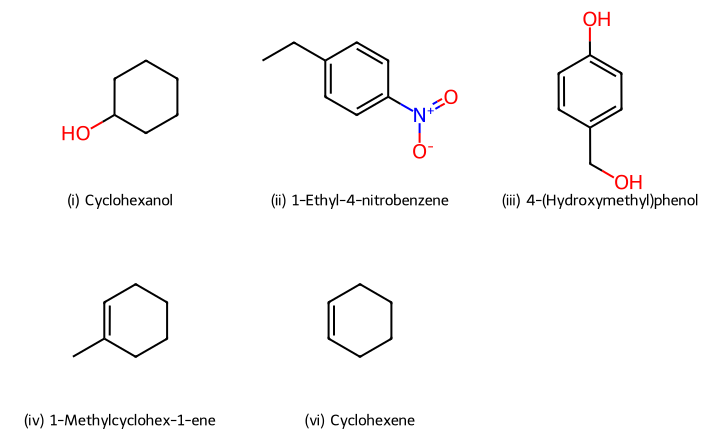
Ring structures for Intext Q6.5's five ring-based starting materials - 1-Ethyl-4-nitrobenzene + Br₂ → heat/UV Heat/UV light promotes free-radical benzylic bromination. The benzylic C–H bond (CH₂ group) is selectively brominated. Major product: 1-(1-bromoethyl)-4-nitrobenzene (p-O2NC6H4CHBrCH3).
- 4-(Hydroxymethyl)phenol + HCl → heat The benzylic –OH is more reactive than the phenolic –OH. Under acidic conditions, the benzylic alcohol undergoes SN₁ to give the benzylic chloride. Major product: 4-(chloromethyl)phenol (p-HOC6H4CH2Cl).
- 1-Methylcyclohex-1-ene + HI → Concept: Markovnikov Addition — the proton adds to the less substituted carbon of the double bond, placing the iodide on the more substituted carbon. The tertiary carbocation intermediate is more stable. Major product: 1-iodo-1-methylcyclohexane.
- CH₃CH₂Br + NaI → NaI in acetone drives an SN₂ reaction (Finkelstein reaction). Iodide is a better nucleophile and more soluble in acetone. Major product: CH₃CH₂I (ethyl iodide).
- Cyclohexene + Br₂ → heat/UV light …
Identify the reactive site in each substrate and apply the correct mechanism (SNi/SN2, free-radical substitution, Markovnikov addition, or halogen exchange) to predict the major monohalo product. Structures for the ring-containing products are drawn below.
(i) Cyclohexanol + SOCl2→
Thionyl chloride converts an alcohol's −OH into a chloride. With no pyridine present (as here), the reaction proceeds through the SNi (internal nucleophilic substitution) pathway: the alcohol first forms a chlorosulfite ester, and the chloride ion that is released stays associated with the same face of the carbon it left from, delivering the chlorine back to that same face — giving retention of configuration. (With pyridine added, the freed chloride ion instead attacks from the opposite face for a clean SN2-style inversion.) Since cyclohexanol's C1 is not a stereocentre, retention or inversion makes no visible difference to the product here — either way the product is chlorocyclohexane.
(ii) 1-Ethyl-4-nitrobenzene (p-O2NC6H4CH2CH3) + Br2heat or UV light
Heat/UV light homolyses Br2 into bromine radicals, favouring free-radical substitution at the most stabilised C–H bond. The benzylic C–H (on the ethyl group's carbon directly attached to the ring) gives a radical stabilised by resonance into the ring, so bromination occurs there rather than anywhere else on the chain. The nitro group's directing effect governs electrophilic aromatic substitution, not this radical pathway, so it plays no role in where the Br ends up. Major product: 1-(1-bromoethyl)-4-nitrobenzene.
(iii) 4-(Hydroxymethyl)phenol (p-HOC6H4CH2OH) + HClheat
Two −OH groups are present: a phenolic −OH directly on the ring, and a benzylic −CH2OH on the side chain. The phenolic C–O bond has partial double-bond character from resonance with the ring and resists substitution under these mild conditions. The benzylic alcohol, by contrast, readily protonates and loses water to form a benzylic carbocation (stabilised by the ring), which chloride then attacks. Major product: 4-(chloromethyl)phenol — the phenolic −OH is untouched.
(iv) 1-Methylcyclohex-1-ene + HI→ …
Here is the solution method for each reaction, following the concept-first approach.
Method: Functional Group Transformation & Regioselectivity Analysis
This method involves identifying the functional group, predicting the reaction mechanism (SN1, SN2, E2, electrophilic addition, free radical substitution), and applying the relevant rule (Markovnikov, anti-Markovnikov, Zaitsev, etc.) to determine the major product.
(i) Cyclohexanol + SOCl2→
- Step 1: Identify the functional group. Alcohol (−OH).
- Step 2: Identify the reagent. SOCl2 (thionyl chloride) is a classic reagent for converting alcohols to alkyl chlorides.
- Step 3: Determine the mechanism. This proceeds via an SN2 mechanism (with inversion of configuration if the carbon is chiral). For cyclohexanol, the OH is on a secondary carbon.
- Step 4: Draw the product. The OH is replaced by Cl.
- Major product: Chlorocyclohexane
(ii) 1-Ethyl-4-nitrobenzene + Br2heat or UV light
- Step 1: Identify the functional group. Alkyl side chain (ethyl group) attached to an aromatic ring with a nitro (−NO2) group.
- Step 2: Identify the reagent and conditions. Br2 with heat or UV light indicates free radical substitution (not electrophilic aromatic substitution).
- Step 3: Determine the site of reaction. The reaction occurs on the benzylic carbon (the carbon directly attached to the benzene ring) because the benzylic radical is highly stabilized by resonance with the ring.
- Step 4: Draw the product. One hydrogen on the benzylic carbon is replaced by bromine.
- Major product: 1-Bromo-1-(4-nitrophenyl)ethane (p-O2NC6H4CHBrCH3)
(iii) 4-(Hydroxymethyl)phenol + HClheat
- Step 1: Identify the functional groups. Two OH groups: one is phenolic (on the ring), one is benzylic (on the side chain).
- Step 2: Identify the reagent and conditions. HCl with heat.
- Step 3: Determine reactivity. The benzylic alcohol is much more reactive than the phenolic OH. The benzylic carbocation is highly stabilized by resonance with the ring, making it an excellent candidate for SN1 reaction.
- Step 4: Draw the product. The benzylic OH is replaced by Cl. The phenolic OH remains unchanged.
- Major product: 4-(Chloromethyl)phenol (p-HOC6H4CH2Cl)
(iv) 1-Methylcyclohex-1-ene + HI→
- Step 1: Identify the functional group. Alkene (C=C).
- Step 2: Identify the reagent. HI (hydrogen halide).
- Step 3: Apply Markovnikov's rule. In the addition of HX to an unsymmetrical alkene, the hydrogen atom adds to the carbon with the greater number of hydrogen atoms, and the halogen adds to the carbon with the fewer hydrogen atoms.
- Step 4: Determine the product. The double bond is between C1 (with a methyl group, no H) and C2 (with one H). H adds to C2, I adds to C1.
- Major product: 1-Iodo-1-methylcyclohexane
(v) CH3CH2Br+NaI→
- Step 1: Identify the functional group. Alkyl halide (bromide).
- Step 2: Identify the reagent. NaI (sodium iodide) in acetone.
- Step 3: Determine the mechanism. This is a classic Finkelstein reaction, an SN2 process. Iodide is a good nucleophile and a good leaving group. Acetone is a polar aprotic solvent that favors SN2.
- Step 4: Draw the product. Bromine is replaced by iodine.
- Major product: Iodoethane (CH3CH2I)
--- …
This set of reactions tests your ability to distinguish between substitution, addition, and free-radical mechanisms. The most common mistakes come from misidentifying the reaction type or misapplying Markovnikov’s rule.
Here’s a breakdown of each reaction, the typical errors, and how to avoid them.
(i) Cyclohexanol + SOCl2→
Common mistake:
Students treat this as an elimination or oxidation. They draw cyclohexene or cyclohexanone.
Why it happens:
SOCl2 is often associated with dehydration or chlorination, but the exact mechanism matters.
Correct approach:
SOCl2 converts alcohols to alkyl chlorides. Without pyridine, the reaction proceeds through the internal SNi pathway (the alcohol forms a chlorosulfite ester, and the released chloride delivers the chlorine back to the SAME face it left from — retention of configuration). With pyridine present, the freed chloride instead attacks from the opposite face, giving a clean SN2-style inversion.
- Product: Chlorocyclohexane
- Since C1 of cyclohexanol is not a stereocentre, retention vs. inversion makes no visible difference to the product here — either pathway gives the same chlorocyclohexane.
How to avoid the mistake:
- Memorize: SOCl2 + alcohol → alkyl chloride, via SNi (retention, no pyridine) or an SN2-style inversion (with pyridine).
- Do not assume elimination unless a strong base is present.
(ii) 1-Ethyl-4-nitrobenzene + Br2heat or UV light
Common mistake:
Students draw electrophilic aromatic substitution (bromination on the ring).
Why it happens:
Br2 with a catalyst (FeBr3) gives ring bromination. But here, heat/UV light changes the mechanism.
Correct approach:
- Heat/UV light initiates free-radical substitution at the benzylic position (the carbon next to the ring).
- The nitro group is meta-directing and deactivates the ring, but that is irrelevant here — the reaction is not on the ring.
- Product: 1-(1-Bromoethyl)-4-nitrobenzene (p-O2NC6H4CHBrCH3)
How to avoid the mistake:
- Always check the reaction conditions:
- Br2 + catalyst → aromatic substitution
- Br2 + heat/UV → free-radical at benzylic or allylic position
- The benzylic radical is highly stabilized, so it is the preferred site.
(iii) 4-(Hydroxymethyl)phenol + HClheat
Common mistake:
Students replace the phenolic −OH with Cl, or replace both −OH groups.
Why it happens:
Phenol −OH does not undergo substitution easily because of resonance stabilization.
Correct approach:
- The benzylic alcohol (−CH2OH) reacts via SN1 (benzylic carbocation is stable).
- The phenolic −OH remains unchanged.
- Product: 4-(Chloromethyl)phenol (p-HOC6H4CH2Cl)
How to avoid the mistake:
- Remember: Phenolic −OH is not a good leaving group under acidic conditions.
- Only the side-chain −OH (alcoholic) reacts.
(iv) 1-Methylcyclohex-1-ene + HI→
Common mistake:
Students add H and I randomly, or place I on the less substituted carbon.
Why it happens:
Misapplication of Markovnikov’s rule — they think “H goes to the carbon with more H’s” but forget that the more substituted carbon gets the positive charge.
Correct approach:
- Markovnikov addition: H+ adds to the less substituted alkene carbon (to form the more stable tertiary carbocation).
- I− then attacks the carbocation.
- Product: 1-Iodo-1-methylcyclohexane
How to avoid the mistake:
- Always draw the carbocation intermediate.
- The more stable carbocation (tertiary > secondary > primary) determines where the nucleophile (I−) goes.
(v) CH3CH2Br+NaI→
Common mistake:
Students think no reaction occurs, or draw elimination.
Why it happens:
NaI is a weak base, so elimination is unlikely. But students sometimes forget the Finkelstein reaction.
Correct approach:
- This is an SN2 reaction: I− displaces Br− (iodide is a better nucleophile).
- Product: CH3CH2I (ethyl iodide) + NaBr …
- CBSE 2025Set ANNUAL1 markQ.Draw the structure of the major monohalo product: 1-methylcyclohexene (a cyclohexene ring with a CH3 substituent on one of the double-bond carbons) +HI→?
›Reveal solutionSolution
Markovnikov addition of HI to 1-methylcyclohexene puts I on the more substituted carbon (C-1, which already bears –CH3), via the more stable tertiary carbocation, giving 1-iodo-1-methylcyclohexane.
In 1-methylcyclohexene the double bond is between ring carbons C-1 and C-2, with a –CH3 group on C-1. Electrophilic addition of HI proceeds in two steps:
Step 1 (protonation): H+ adds to the alkene carbon that gives the more stable carbocation. Adding H+ to C-2 places the positive charge on C-1, which is a tertiary carbocation (bonded to the ring's C-2 and C-6, plus the –CH3 group). Adding H+ instead to C-1 would place the charge on C-2, only a secondary carbocation. Since 3° carbocations are more stable (greater hyperconjugation/inductive stabilisation from three alkyl groups) than 2°, the reaction proceeds through the C-1 cation — this is Markovnikov's rule (the H goes to the carbon already bearing more hydrogens, i.e. C-2).
1-methylcyclohexene+H+→1-methylcyclohexan-1-yl cation (3°, at C-1)
…
- CBSE 2024Set ANNUAL1 markQ.Complete the following reaction: 1-methylcyclohexene (a cyclohexene ring with a CH3 substituent on one of the double-bond carbons) +HI→?
›Reveal solutionSolution
Markovnikov's rule: with unsymmetrical alkenes, H+ from HX adds to the carbon that generates the more stable (here, tertiary) carbocation, and the halide ion then bonds to that carbon.
1-Methylcyclohexene has its ring double bond between C1 (bearing the CH3 substituent) and C2 (bearing only H). Protonation of the alkene can occur in two ways:
- H+ adds to C1 ⇒ carbocation forms at C2, a secondary carbocation (flanked by C1 and C3, both ring carbons).
- H+ adds to C2 ⇒ carbocation forms at C1, a tertiary carbocation (bonded to CH3, C2 and C6 — three carbon substituents). …
- CBSE 2020Set NC1 markQ.Write the reaction with conditions for conversion of 2-methylpropene into 1-bromo-2-methylpropane.
›Reveal solutionSolution
Ordinary Markovnikov addition of HBr to 2-methylpropene would put Br on the more-substituted carbon; getting the anti-Markovnikov product (Br on the terminal carbon) needs the peroxide-initiated free-radical mechanism (Kharasch/peroxide effect).
Target: 2-methylpropene, (CH3)2C=CH2 (isobutylene), converted into 1-bromo-2-methylpropane, (CH3)2CH–CH2Br — i.e. Br ends up on the terminal (less substituted) carbon, which is the opposite regiochemistry to normal Markovnikov addition (which would instead place Br on the more substituted carbon, giving 2-bromo-2-methylpropane).
…
- CBSE 2019Set ANNUAL1 markQ.Identify the products A and B formed in the following reaction: CH3–CH2–CH=CH–CH3+HCl→A+B
›Reveal solutionSolution
CH3–CH2–CH=CH–CH3 is pent-2-ene; electrophilic addition of HCl proceeds via protonation to give whichever secondary carbocation is more stabilised, so the products are a mixture of 2-chloropentane (major) and 3-chloropentane (minor).
The alkene CH3–CH2–CH=CH–CH3 is pent-2-ene, numbered C1H3–C2H2–C3H=C4H–C5H3, with the double bond between C3 and C4 (equivalently C2–C3 counting from the other end). Since this alkene is unsymmetrically substituted but both carbons of the double bond are internal, protonation of either carbon gives a secondary carbocation, so a mixture of two constitutional isomers is obtained:
- H+ adds to C3: leaves the cation at C4, giving CH3–CH2–CH2–CH+–CH3 — this secondary cation is flanked by a −CH2CH2CH3 (propyl) group on one side and a −CH3 on the other, i.e. more hyperconjugating α-hydrogens overall, making it the somewhat more stabilised carbocation. Cl− then attacks here, giving CH3–CH2–CH2–CHCl–CH3, i.e. 2-chloropentane (major). …
🎓Unlock everything free for 14 days
- ✓Full step-by-step solutions
- ✓Concept-first explanations
- ✓Methods, shortcuts & mistakes
- ✓PYQ mapping + timed mock tests
Full access for 14 days. No credit card required.