Placentation Types – From Intuition to Precision
Think of the ovary as a room where seeds are going to be made. The ovules are the raw material — the future seeds. Placentation is simply the arrangement of these ovules inside the ovary. Where are they attached? How are they placed? That's all.
Why does it matter? Because this arrangement is remarkably consistent within a plant family. If you cut open a flower's ovary and see how the ovules sit, you can often name the family. It's a powerful identification tool.
The Five Types
Let's build each one from a mental picture.
1. Marginal Placentation
Imagine a single long sofa against one wall of a room. The ovules sit along the edge of that sofa — the margin of the carpel. This is the simplest type: one chamber, one line of attachment.
Marginal placentation is the ancestral type. It's what you get from a single, folded carpel. Think pea flowers (Fabaceae).
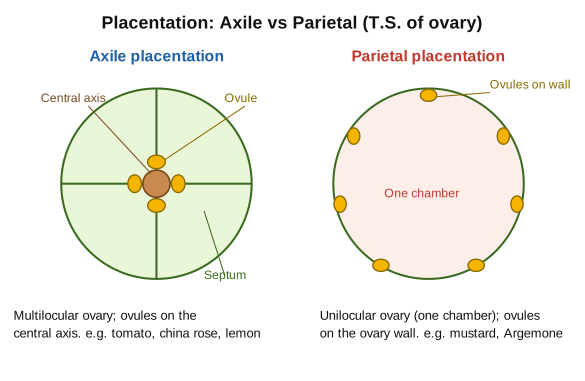
2. Axile Placentation
Now picture a multi-room apartment. The ovules are attached to the central pillar — the axis — where all the walls meet. The ovary is divided into chambers (locules), and ovules sit in the centre of each chamber, on the central column.
Cut a tomato or a lemon crosswise. You'll see the central core with seeds radiating outward. That's axile placentation.
3. Parietal Placentation
Imagine the ovules attached to the outer wall of the ovary, not the centre. The ovary may be one-chambered, or it may have false partitions. The key: ovules are on the periphery, not the axis.
Don't confuse parietal with axile. In parietal, the ovules are on the wall; in axile, they're on the central axis. A cross-section of a mustard fruit shows parietal placentation clearly — seeds along the walls.
4. Free Central Placentation
Here, the ovules sit on a central column that rises from the base of the ovary — but this column is not connected to the ovary wall by any partitions. It stands free. The ovary is one-chambered.
Free central often develops from axile: the partitions dissolve, leaving the central column with ovules. Think Dianthus (carnation) or Primula.
5. Basal Placentation
The simplest of all: a single ovule (or a small group) sits at the very base of the ovary. No fancy arrangement — just one seed at the bottom.
Quick reference:
| Type | Ovary chambers | Ovule attachment | Example |
|---|
| Marginal | One | Along fused edge of one carpel | Pea |
| Axile | Multiple | Central axis | Tomato, lemon |
| Parietal | One (or falsely partitioned) | Ovary wall | Mustard, poppy |
| Free central | One | Free-standing central column | Dianthus |
| Basal | One | Base of ovary | Sunflower, marigold |
How to Identify in an Exam
When you see a diagram or a real flower:
- Count the chambers. One chamber? You're looking at marginal, parietal, free central, or basal. Multiple chambers? Axile.
- If one chamber: Where are the ovules? …