Q.Draw a vector diagram to show that: (A+B)+C=A+(B+C)
🔒You're viewing a preview — the full solution, concept, methods & PYQ mapping are locked.
🔒 Start your 14-day free trial to unlock the full solution →Concept understanding — Triangle Inequality
Triangle Inequality (Bounding the Resultant of Two Vectors)
When you combine two displacements, two velocities, or two forces in "Motion in a Plane," you add them as vectors using the triangle law: place the tail of the second vector at the head of the first, and the resultant runs from the start to the finish. The triangle inequality is simply the statement that this resultant can never be longer than the two vectors laid end to end, and can never be shorter than their difference.
The Intuition
Suppose you walk 3 m in one direction, then 4 m in some other direction. Could you end up 8 m from where you started? No — the farthest you can possibly get is 3+4=7 m, and that only happens if both walks point the same way, so there's no bend at all (a "flat" triangle). The moment the second walk points in a different direction, a real corner appears, and cutting across that corner (the direct path) is always shorter than going via the corner. That's the geometric heart of every triangle: any one side is shorter than the sum of the other two, unless the triangle collapses onto a straight line.
The Precise Statement
For two vectors A and B added by the triangle law, the magnitude of the resultant R=A+B is bounded on both sides:
∣A∣−∣B∣≤∣A+B∣≤∣A∣+∣B∣
- The upper bound ∣A+B∣≤∣A∣+∣B∣ is reached only when A and B point in exactly the same direction (the angle between them is 0∘) — the triangle flattens out.
- The lower bound ∣A+B∣≥∣A∣−∣B∣ is reached only when A and B point in exactly opposite directions (the angle is 180∘).
- For any angle in between, the resultant magnitude lies strictly between these two limits.
This is the vector form of the ordinary triangle inequality ∣x+y∣≤∣x∣+∣y∣ you may already know for numbers: here x and y become vectors, and "the sides of a triangle" become "a vector, another vector, and their sum."
Why It Matters in Kinematics
This bound is genuinely useful when combining physical quantities in the plane:
- Relative velocity: if a boat has speed 5 m/s relative to water and the river flows at 3 m/s, the boat's speed relative to the ground must lie between ∣5−3∣=2 m/s and 5+3=8 m/s, depending on the angle the boat is steered — it can never be less than 2 or more than 8.
- Combining forces or displacements: if you know only the magnitudes of two vectors, not the angle between them, this inequality instantly tells you the range of possible resultant magnitudes without doing any trigonometry. …
This is the associative law of vector addition; a diagram using head-to-tail addition shows that grouping the vectors either way leads to the same resultant. …
By head-to-tail (polygon) addition, both groupings of A,B,C give the same closing vector, so (A+B)+C=A+(B+C).
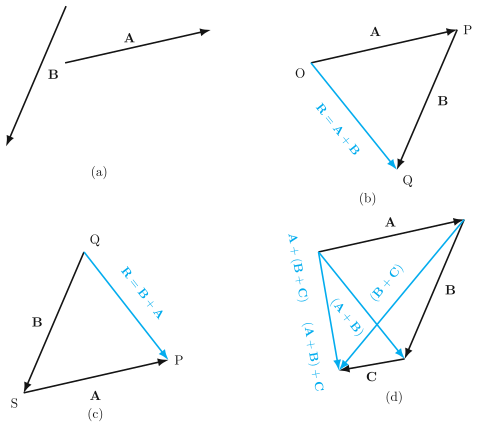
Draw the three vectors head-to-tail:
- Place A from point O to P.
- From P draw B to Q.
- From Q draw C to R.
Now interpret the two sides:
- (A+B) is the vector O→Q; adding C (Q→R) gives (A+B)+C= O→R.
- (B+C) is the vector P→R; adding it to A (O→P) gives A+(B+C)= O→R. …
- CBSE 2026Set ANNUAL1 markMCQQ.If two vectors have the same direction, their resultant is equal to(a) the sum of their magnitudes(b) the difference of their magnitudes(c) zero(d) indeterminate
›Reveal solutionSolution
For two vectors along the same direction (angle between them = 0 degrees), the parallelogram/triangle law of vector addition gives a resultant equal to the sum of magnitudes.
By the law of vector addition, for two vectors A and B with angle theta between them:
|R| = sqrt(A^2 + B^2 + 2AB cos(theta))
If theta = 0 degrees (same direction), cos(theta) = 1: …
- CBSE 2025Set ANNUAL1 markMCQQ.If the magnitude to the resultant force of two forces F and F applied on a body is also F, then the angle between these two will be(a) 0 degrees(b) 60 degrees(c) 90 degrees(d) 120 degrees
›Reveal solutionSolution
Using the parallelogram law of vector addition with equal-magnitude forces and resultant equal to either force, the angle between them works out to 120 degrees.
Let both forces have magnitude F, and the resultant also have magnitude F.
The law of vector addition gives:
R^2 = F1^2 + F2^2 + 2 F1 F2 cos(theta)
Substituting F1 = F2 = F and R = F: …
- CBSE 2024Set ANNUAL1 markMCQQ.If two vectors are equal in magnitude and opposite in direction, their resultant is(a) Maximum(b) Minimum(c) Zero(d) Indeterminate
›Reveal solutionSolution
Vectors of equal magnitude but opposite direction always add to a zero resultant.
Let the two vectors be A and -A (same magnitude |A|, opposite direction). Their vector sum is A + (-A) = 0.
…
- CBSE 2019Set ANNUAL1 markMCQQ.Two forces of 5 Newton each act at a point inclined at 120° with each other. The magnitude of vector addition of these forces is:(a) Zero(b) 5 Newton(c) 5√3 Newton(d) 10 Newton
›Reveal solutionSolution
For two equal forces F at angle θ, the resultant is R = 2F cos(θ/2); at 120° this gives R = F, so R = 5 N.
The magnitude of the resultant of two vectors F1 and F2 of magnitudes F each, inclined at angle θ, is given by the parallelogram law:
R=F12+F22+2F1F2cosθ
Here F1=F2=5 N and θ=120°, so cos120°=−21.
R=52+52+2(5)(5)(−21)=25+25−25=25=5 N
…
- CBSE 2017Set ANNUAL1 markQ.50N and 60N forces are acting in opposite directions at a point. Find out their resultant force.
›Reveal solutionSolution
For two forces acting in opposite directions, the resultant equals the difference of their magnitudes and points along the larger force; here R = 10 N.
When two forces F1 and F2 act at a point with an angle θ between them, their resultant is found using the parallelogram law:
R = sqrt(F1^2 + F2^2 + 2 F1 F2 cos θ)
Here F1 = 50 N, F2 = 60 N and the forces act in opposite directions, so θ = 180° and cos θ = -1.
R = sqrt(50^2 + 60^2 + 2(50)(60)(-1))
R = sqrt(2500 + 3600 - 6000)
R = sqrt(100) = 10 N
…
🎓Unlock everything free for 14 days
- ✓Full step-by-step solutions
- ✓Concept-first explanations
- ✓Methods, shortcuts & mistakes
- ✓PYQ mapping + timed mock tests
Full access for 14 days. No credit card required.