Question of 110
Q.Answer either
(a) and
(b) :
(a) Draw the structure of α-D(+) glucose.
(1)
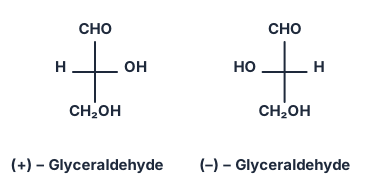
(b) Draw the structure of D and L glyceraldehyde. (2)
Assam AhsecAHSEC Higher Secondary (HS) Final Examination 2026Subjective· 3mImportance★★★★★
0% · 0/110 Questions
You're viewing a preview — the full solution, concept, methods & PYQ mapping are locked.
Start your 14-day free trial to unlock the full solution →α-D(+)-glucose = pyranose ring with C1-OH down; D/L-glyceraldehyde differ in the C2 –OH side (right = D, left = L); glycosidic linkage joins monosaccharides (sucrose: glucose–fructose 1,2; maltose: glucose–glucose α-1,4).
- α-D(+)-Glucose (described, drawing not possible here honestly). In its cyclic (Haworth) form glucose is a six-membered pyranose ring (five C + one O). Numbering clockwise, C1 is the anomeric carbon; in the α-anomer its –OH lies below the ring plane (on the same side as, and trans to, the CH₂OH at C5). C2–OH and C4–OH point down, C3–OH up, and C6 is the –CH₂OH attached to C5.
- D- and L-glyceraldehyde. Glyceraldehyde, OHC–CHOH–CH₂OH, has one chiral carbon (C2). In the Fischer projection with –CHO at top and –CH₂OH at bottom:
- D-glyceraldehyde: –OH on the right of C2.
- L-glyceraldehyde: –OH on the left of C2. The two are non-superimposable mirror images (enantiomers).
OR (c) Glycosidic linkage. When two monosaccharides join, the –OH of the anomeric carbon of one reacts with an –OH of the other, eliminating water and forming a C–O–C bridge called a glycosidic linkage. …
Unlock everything free for 14 days
- Full step-by-step solutions
- Concept-first explanations
- Methods, shortcuts & mistakes
- PYQ mapping + timed mock tests
Full access for 14 days. No credit card required.