Q.Which of the following contains both covalent and ionic bonds?
🔒You're viewing a preview — the full solution, concept, methods & PYQ mapping are locked.
🔒 Start your 14-day free trial to unlock the full solution →Concept understanding — Lewis Dot Structures
Why do we need Lewis dot structures?
Atoms are held together in molecules by chemical bonds — but what exactly is a bond? In the early 20th century, Gilbert N. Lewis realised that the key lies in the valence electrons (the outermost electrons). He noticed that atoms of noble gases (like Ne, Ar) are extremely stable and unreactive, and they all have 8 electrons in their outermost shell (except helium, which has 2). This led to the octet rule: atoms tend to gain, lose, or share electrons to achieve a full outer shell of 8 electrons (or 2 for hydrogen).
Lewis dot structures are simply a shorthand picture of this idea. They show:
- Which atoms are connected to which
- How many valence electrons each atom contributes
- How those electrons are arranged as bonding pairs (shared) or lone pairs (unshared)
The precise statement
A Lewis dot structure (or electron dot structure) represents the valence electrons of an atom or molecule using dots placed around the element's symbol. Each dot stands for one valence electron. Shared pairs (bonds) are shown as lines, and unshared pairs as pairs of dots.
For a single atom, you write the element symbol and place dots on its four sides (top, bottom, left, right) — up to 8 dots. The order of filling doesn't matter for the final picture, but conventionally you place one dot on each side first, then pair them up.
For example:
- Carbon (group 14, 4 valence electrons): ⋅C⋅ (four single dots)
- Oxygen (group 16, 6 valence electrons): ⋅O¨⋅ (two single dots and two pairs)
How to draw a Lewis structure for a molecule
Here's the step-by-step method you'll use in exams:
-
Count total valence electrons — add up valence electrons from all atoms. For ions, add 1 electron for each negative charge, subtract 1 for each positive charge.
-
Identify the central atom — usually the least electronegative element (not hydrogen or fluorine). Place it in the centre.
-
Connect atoms with single bonds — each bond uses 2 electrons. Subtract these from your total.
-
Complete octets of outer atoms — place remaining electrons as lone pairs on terminal atoms (except hydrogen, which only needs 2).
-
Place leftover electrons on the central atom — if any remain.
-
If the central atom has fewer than 8 electrons, form multiple bonds — move lone pairs from outer atoms to create double or triple bonds until the central atom has an octet.
A common mistake: forgetting that hydrogen only needs 2 electrons (a duet), not 8. Never put more than 2 electrons around H.
A concrete example: water (H₂O)
- Total valence electrons: O has 6, each H has 1 → 6+1+1=8 electrons.
- Central atom: oxygen (least electronegative after H).
- Connect: O—H bonds (2 bonds × 2 electrons = 4 electrons used).
- Remaining: 8−4=4 electrons → place as two lone pairs on oxygen.
- Check: O has 2 bonds (4 electrons) + 2 lone pairs (4 electrons) = 8. Each H has 1 bond (2 electrons) = 2. Done.
The structure: H−O¨−H
What the structure tells you
Once drawn, a Lewis structure reveals:
- Bond order (single, double, triple)
- Lone pairs (which affect molecular shape and reactivity)
- Formal charge (a bookkeeping tool to check which structure is most stable) …
A compound can contain both ionic and covalent bonds if it has both an ionic lattice and a polyatomic ion held together by covalent bonds. …
NH4Cl contains both covalent bonds (within the NH4+ ion) and an ionic bond (between NH4+ and Cl-).
In NH4Cl, the four N-H bonds within the ammonium ion (NH4+) are covalent (electron sharing), while the bond between the NH4+ cation and the Cl- anion is ionic (el …
- CBSE 2026Set ANNUAL1 markMCQQ.Lewis dot structure of CO, NO2⁻ and CO3²⁻ are I, II and III respectively (see figure). Which of the above structure(s) is/are wrong?(a) Only I(b) Only II(c) Only III(d) None of these
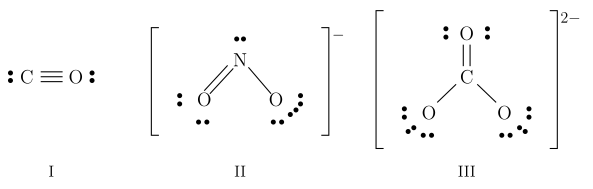
›Reveal solutionSolution
Checking the electron count for CO, NO2− and CO32− shows each structure described is a standard, chemically valid Lewis dot structure (using the common convention of showing only the overall ionic charge rather than individual formal charges).
I — CO: Total valence electrons =4(C)+6(O)=10. A triple bond uses 6 electrons, leaving 4 electrons = one lone pair on C and one on O, exactly as shown. This is the accepted Lewis structure of carbon monoxide (giving formal charges −1 on C, +1 on O, consistent with its known triple-bond character).
II — NO2−: Total valence electrons =5(N)+2(6)(O)+1=18. One N=O double bond + one N–O single bond uses 6 electrons; the remaining 12 electrons distribute as lone pairs to complete octets on both oxygens (and a lone pair on N, which also accounts for the ion's bent shape) — consistent with the standard resonance form of nitrite drawn in the figure.
…
- CBSE 2026Set ANN1 markMCQQ.Identify the incorrect Lewis structure.(a) O=C=O (each O with two lone pairs)(b) N=O (N with a single unpaired electron, O with lone pairs)(c) N(triple bond)N: (with lone pair on one N)(d) H-C(triple bond)C-H
›Reveal solutionSolution
N2 must show a lone pair on both nitrogens; the option with a lone pair on only one N is the incorrect Lewis structure. Answer: (c).
Check each structure:
- (a) O=C=O with two lone pairs on each oxygen: correct Lewis structure of CO2 (carbon has 4 bonds, each O has 2 lone pairs).
- (b) N=O with an unpaired electron on N and lone pairs on O: nitric oxide (NO) is an odd-electron molecule, so this is acceptable. …
- CBSE 2025Set ANNUAL1 markMCQQ.Which of the following contains both covalent and ionic bonds?(a) CCl4(b) CaCl2(c) NH4Cl(d) H2O
›Reveal solutionSolution
NH4Cl contains both covalent bonds (within the NH4+ ion) and an ionic bond (between NH4+ and Cl-).
In NH4Cl, the four N-H bonds within the ammonium ion (NH4+) are covalent (electron sharing), while the bond between the NH4+ cation and the Cl- anion is ionic (el …
- CBSE 2025Set ANNUAL1 markQ.Answer in one word/sentence: Draw the Lewis structure for H2S.
›Reveal solutionSolution
Sulfur (Group 16, 6 valence electrons) forms one single bond to each hydrogen, using 4 of its 6 electrons for 2 lone pairs.
Step 1: Count total valence electrons.
- S: 6 valence electrons
- 2 H: 1 electron each = 2
- Total = 8 electrons = 4 electron pairs.
Step 2: Sulfur is the central atom (less electronegative than... well H is bonded terminally); place the 2 H atoms around S and form one single (2-electron) bond to each:
H−S−H
This uses 2 bond pairs (4 electrons).
Step 3: The remaining 8−4=4 electrons are placed as 2 lone pairs on sulfur (satisfying the octet: 2 bond pairs + 2 lone pairs = 8 electrons around S).
Lewis structure:
H−⋅⋅S⋅⋅−H
…
- CBSE 2023Set ANNUAL1 markQ.Draw the Lewis structure of CO3^2- ion.
›Reveal solutionSolution
CO3^2- Lewis structure: C double-bonded to one O and single-bonded to two O⁻ atoms, with the negative charge and double-bond character delocalized over all three C–O bonds by resonance.
Total valence electrons in CO3^2-: C(4)+3×O(6)+2(extra for charge)=4+18+2=24 electrons (12 pairs).
One Lewis (contributing) structure: place carbon at the centre bonded to three oxygen atoms.
- One C–O bond is a double bond (C=O); that oxygen carries 2 lone pairs.
- The other two C–O bonds are single bonds; each of those oxygens carries 3 lone pairs and an overall −1 formal charge.
- This uses all 24 electrons: 4 bonding pairs (1 double + 2 single = 4 shared pairs = 8 electrons) + 8 lone pairs on the three oxygens (16 electrons) = 24 electrons. ✓
This structure has a net charge of −2 (each singly-bonded O is −1, the doubly bonded O and C are neutral), matching the ion's charge.
…
- CBSE 2023Set ANNUAL1 markQ.Match the column: Column I item 'Covalent Bond' is to be matched with the correct term from Column II:(a) Sharing of electron,(b) increasing,(c) To find out molecular mass of organic compound,(d) SF6,(e) Transition element,(f) Molarity,(g) Mulliken,(h) Heisenberg,(i) Molality. Which Column II term matches this Column I item?
›Reveal solutionSolution
A covalent bond is defined by the sharing of an electron pair between two atoms (option a), unlike an ionic bond which involves electron transfer.
According to the Lewis theory of bonding, a covalent bond forms when two atoms share one or more pairs of electrons so that both atoms attain a stable (often octet) electron configuration. For example, in H2, each hydrogen atom contributes one electron to the shared pair; in Cl2, each chlorine atom contributes one electron of the shar …
🎓Unlock everything free for 14 days
- ✓Full step-by-step solutions
- ✓Concept-first explanations
- ✓Methods, shortcuts & mistakes
- ✓PYQ mapping + timed mock tests
Full access for 14 days. No credit card required.