Q.Give the structure of diamond, graphite and fullerenes.
You're viewing a preview — the full solution, concept, methods & PYQ mapping are locked.
Start your 14-day free trial to unlock the full solution →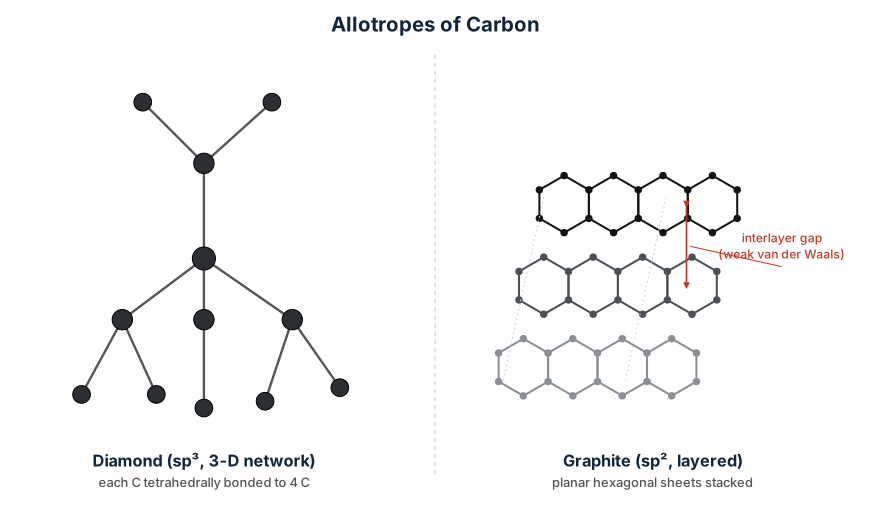
Diamond = sp³ 3D tetrahedral network; graphite = sp² hexagonal layers with delocalised electrons; fullerene (C₆₀) = sp² closed cage of hexagons and pentagons.
From NCERT Class 11 Chemistry (p-Block Elements — allotropes of carbon):
- Diamond:
-
Each carbon atom is sp³ hybridised and covalently bonded to four other carbons at the corners of a regular tetrahedron (bond angle 109.5°).
-
This gives a rigid, three-dimensional covalent network throughout the crystal.
-
Because all four valence electrons are used in strong σ-bonds, diamond is the hardest natural substance, has a very high melting point, and is a non-conductor of electricity.
- Graphite:
-
Each carbon atom is sp² hybridised and bonded to three other carbons in the same plane, forming flat sheets of fused hexagonal rings.
-
These layers are held together by weak van der Waals forces, so they can slide over one another — graphite is soft and used as a lubricant and in pencils.
-
The fourth (unhybridised p) electron of each carbon is delocalised over the layer, so graphite conducts electricity along the sheets.
- Fullerenes: …
Unlock everything free for 14 days
- Full step-by-step solutions
- Concept-first explanations
- Methods, shortcuts & mistakes
- PYQ mapping + timed mock tests
Full access for 14 days. No credit card required.