Q.What do you mean by potential energy, kinetic energy and total mechanical energy of a particle performing simple harmonic motion ? Draw the graph of kinetic energy, potential energy and total energy as functions of time. What will be the effect on total mechanical energy for motions under non-conservative forces ? Write your thoughts on it.
You're viewing a preview — the full solution, concept, methods & PYQ mapping are locked.
Start your 14-day free trial to unlock the full solution →In SHM, PE and KE interconvert but total energy (1/2)m omega^2 A^2 is constant; non-conservative forces make total energy decay (damping).
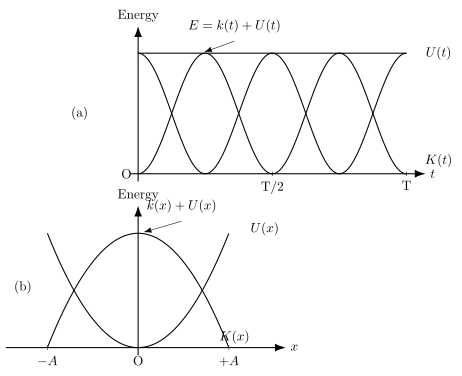
Consider a particle of mass m in SHM with amplitude A and angular frequency omega, displacement x = A sin(omega t).
Kinetic energy: as the particle moves, KE = (1/2)m v^2 = (1/2)m omega^2 (A^2 - x^2). It is maximum at the mean position (x = 0) and zero at the extremes.
Potential energy: PE = (1/2)m omega^2 x^2. It is zero at the mean position and maximum at the extremes (x = A).
Total mechanical energy: E = KE + PE = (1/2)m omega^2 A^2, which is CONSTANT (independent of x and t). Energy merely converts back and forth between kinetic and potential forms.
Graphs as functions of time (with x = A sin(omega t)):
- KE varies as cos^2(omega t): starts maximum at t = 0 (particle at mean position), and oscillates between 0 and E with twice the frequency of the displacement.
- PE varies as sin^2(omega t): starts at 0, and oscillates between 0 and E, exactly out of step with KE.
- Total energy E is a horizontal straight line (constant) at height (1/2)m omega^2 A^2. At every instant the KE and PE curves add up to this constant line. …
Unlock everything free for 14 days
- Full step-by-step solutions
- Concept-first explanations
- Methods, shortcuts & mistakes
- PYQ mapping + timed mock tests
Full access for 14 days. No credit card required.