Q.Draw a ray diagram to show the refraction of light through glass prism. Derive the formula for the determination of refractive index of the material of the prism.
You're viewing a preview — the full solution, concept, methods & PYQ mapping are locked.
Start your 14-day free trial to unlock the full solution →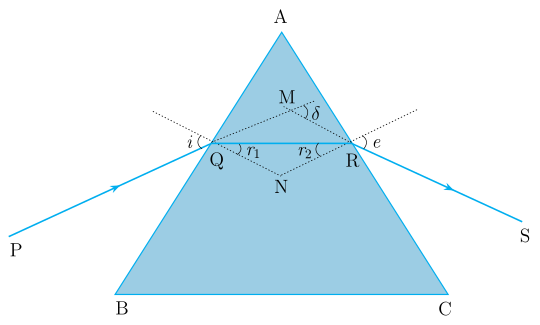
Tracing a ray through a prism and using minimum deviation gives the prism formula .
Ray diagram (described). A ray of light PQ is incident on the first face AB of a glass prism (refracting angle at the apex). It refracts at Q, bending towards the normal, travels inside the prism as QR, then strikes the second face AC at R where it refracts again, bending away from the normal, and emerges as RS. The incident ray PQ and the emergent ray RS, when produced, meet and the angle between them is the angle of deviation . Let the angles of incidence and refraction at the two faces be (at Q) and (at R).
Step 1 — geometry of the prism. In quadrilateral AQOR (O being where the normals meet), the normals at Q and R make angle and with QR. Using the geometry of the triangle QOR and the fact that the exterior angle of the triangle equals the refracting angle,
Step 2 — angle of deviation. The total deviation is the sum of deviations at the two faces:
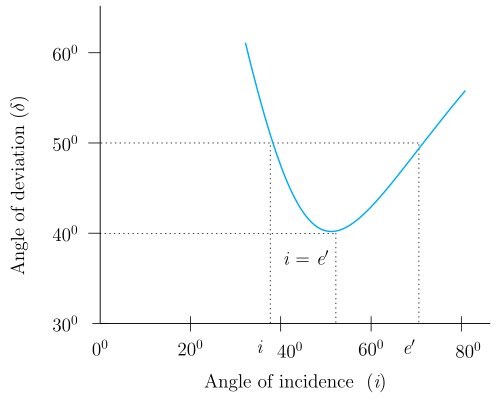
Step 3 — condition of minimum deviation. As the angle of incidence is varied, the deviation first decreases, reaches a minimum value , then increases. At minimum deviation the ray passes symmetrically through the prism, so …
Unlock everything free for 14 days
- Full step-by-step solutions
- Concept-first explanations
- Methods, shortcuts & mistakes
- PYQ mapping + timed mock tests
Full access for 14 days. No credit card required.