Skip to content
← 2019

Physics · 2019 · Set 55/5/1

CBSE Class 12 Physics 2019 — Set 55/5/1

CBSE Class XII Board 2019 · Set 55/5/1

Real board examination⚠ Old pattern · pre-2020 syllabus
Sets

About the 2019 exam: The 2019 exam used CBSE's older pattern — 27 questions for 70 marks, all subjective (Section A was very-short-answer, no MCQs). All three series (55/1/1, 55/2/1, 55/5/1) are here in full (27/27), each verified against the official CBSE paper. Topics since removed from the syllabus are badged and filterable above.

This paper has 7 questions on a topic removed in CBSE’s 2023-24 syllabus update (each marked Not in syllabus). It’s kept for historical accuracy — the exam really asked it that year — but isn’t in the current syllabus and doesn’t count toward a concept’s importance. Switch to to focus on what’s still examinable.

About this paper

The real Class-12 board examination held in 2019. Every question below is solved the concept-first way. Sample papers are labelled honestly — never shown as a past exam.

Total marks
70
Questions
27
Duration
180 min
Sections
4

The marks / questions / duration above are the official exam pattern. We currently have 27 of this paper’s questions (100% of the full paper), with 27 fully solved. Questions we couldn’t yet extract or verify are held — never shown as complete.

Sections & marks

SectionTypeQuestionsMarks eachTotal
ASection AVery short answer515
BSection BShort answer7214
CSection CLong answer12336
DSection DLong answer3515
Total2770

The question paper

The questions we hold for this paper, laid out by section. Solutions are on the Answers tab.

Board Examination

Physics

CBSE Class XII Board 2019 · Set 55/5/1

Series/Set: 55/5/1Roll No. ________
Time Allowed: 3 hoursMaximum Marks: 70

General Instructions

  1. This question paper contains 27 questions divided into 4 sections — A, B, C, D.
  2. Section A comprises 5 questions of 1 mark each (Very short answer).
  3. Section B comprises 7 questions of 2 marks each (Short answer).
  4. Section C comprises 12 questions of 3 marks each (Long answer).
  5. Section D comprises 3 questions of 5 marks each (Long answer).

Above is the official exam pattern. The questions printed below are those we currently hold for this paper.

Section A

Very short answer · 1 mark each · 5 of 5 shown

Q1.
Why is the electrostatic potential inside a charged conducting shell constant throughout the volume of the conductor?
[1]
Q2.
Write one important property of a paramagnetic material.
(OR)
Do the diamagnetic substances have resultant magnetic moment in an atom in the absence of external magnetic field?
⚠ This question is not in the current syllabus — para-/dia-/ferromagnetic substances (removed 2023-24)
[1]
Q3.
Plot a graph of the de-Broglie wavelength associated with a proton versus its momentum.
[1]
Q4.
Draw the output signal in a p-n junction diode when a square input signal of 10 V as shown in the figure is applied across it. Figure — CBSE 2019 55/5/1 Q4
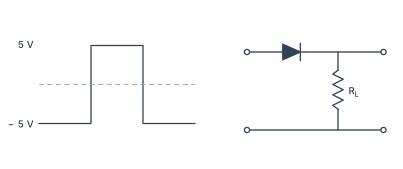
[1]
Q5.
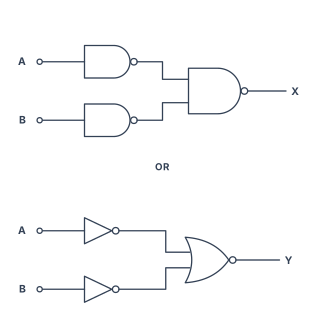
Identify the equivalent gate for the circuit of a combination of gates shown in the figure. Write its symbol.
(OR)
Draw the logic symbol of the gate shown by the combination of gates and write its name. Figure — CBSE 2019 55/5/1 Q5
[1]
Page 1 of 5
Section B

Short answer · 2 marks each · 7 of 7 shown

Q1.
Derive an expression for the torque acting on an electric dipole of dipole moment vecp placed in a uniform electric field vecE. Write the direction along which the torque acts. OR Derive an expression for the electric field at a point on the axis of an electric dipole of dipole moment vecp. Also write its expression when the distance r gg the length 'a' of the dipole.
[2]
Q2.
Two identical capacitors of 12 pF each are connected in series across a 50 V battery. Calculate the electrostatic energy stored in the combination. If these were connected in parallel across the same battery, find out the value of the energy stored in this combination.
[2]
Q3.
A set of 'n' identical resistors, each of resistance 'R' when connected in series have an effective resistance 'X'. When they are connected in parallel, their effective resistance becomes 'Y'. Find out the product of X and Y.
⚠ This question is not in the current syllabus — series/parallel combinations of resistors (removed 2023-24)
[2]
Q4.
Two identical coils P and Q each of radius R are lying in perpendicular planes such that they have a common centre. Find the magnitude and direction of the magnetic field at the common centre when they carry currents equal to I and √(3)I respectively.
[2]
Q5.
(a) Obtain the conditions under which an electron does not suffer any deflection while passing through a magnetic field. (b) Two protons P and Q moving with the same speed pass through the magnetic fields vecB₁ and vecB₂ respectively, at right angles to the field directions. If |vecB₂| > |vecB₁|, which of the two protons will describe the circular path of smaller radius? Explain.
[2]
Q6.
The frequencies of two side bands in an amplitude modulated wave are 640 kHz and 660 kHz respectively. Find the frequencies of the carrier and the modulating signals. Also obtain the value of the bandwidth required in amplitude modulation. OR A sinusoidal carrier voltage is amplitude modulated by a sinusoidal voltage of 10 kHz with modulation index 0·3. If the carrier frequency is 10 MHz and its amplitude is 40 V, calculate the frequency and amplitude of the two sidebands.
⚠ This question is not in the current syllabus — Communication Systems (Amplitude Modulation) (removed 2023-24)
[2]
Q7.
Draw a block diagram of a generalized communication system and write the functions of (i) a transmitter, and (ii) a receiver.
⚠ This question is not in the current syllabus — Communication Systems (removed 2023-24)
[2]
Page 2 of 5
Section C

Long answer · 3 marks each · 12 of 12 shown

Q1.
A charge Q is distributed over the surfaces of two concentric hollow spheres of radii r and R (R gg r), such that their surface charge densities are equal. Derive the expression for the potential at the common centre. OR Three concentric metallic shells A, B and C of radii a, b and c (a < b < c) have surface charge densities +σ, -σ and +σ respectively as shown. (a) Obtain the expressions for the potential of three shells A, B and C. (b) If shells A and C are at the same potential, obtain the relation between a, b and c.
[3]
Q2.
State the principle of a moving coil galvanometer. Explain its working and obtain the expression for the deflection produced due to the current passed through the coil. Define current sensitivity. OR Explain how a galvanometer can be converted into an ammeter of a given range. Derive an expression for shunt resistance and current for full scale deflection. Find the effective resistance of the ammeter.
[3]
Q3.
A voltage v = vm sinω t applied to a series LCR circuit, drives a current in the circuit given i = im sin(ω t + φ). Deduce the expression for the instantaneous power supplied by the source. Hence, obtain the expression for the average power. Define the terms 'power factor' and 'wattless current', giving the examples where power factor is maximum and the circuit where there is wattless current.
[3]
Q4.
Define displacement current. What role does it play while charging a capacitor by dc source? Is the value of displacement current same as that of the conduction current? Explain.
[3]
Q5.
A screen is placed 90 cm from an object. The image of the object on the screen is formed by a convex lens at two different positions separated by 20 cm. Calculate the focal length of the lens. OR A convex lens of focal length 20 cm and a concave lens of focal length 15 cm are kept 30 cm apart with their principal axes coincident. When an object is placed 30 cm in front of the convex lens, calculate the position of the final image formed by the combination. Would this result change if the object were placed 30 cm in front of the concave lens? Give reason.
[3]
Page 3 of 5
Q6.
(a) Define a wavefront. Using Huygens' geometrical construction, explain with the help of a diagram how the plane wavefront travels from the instant t₁ to t₂ in air. (b) A plane wavefront is incident on a convex lens. Explain, with the help of the diagram, the shape of the refracted wavefront formed.
[3]
Q7.
(a) Good quality sunglasses made of polaroids are preferred over ordinary coloured glasses. Explain why. (b) How is plane polarized light defined? (c) A beam of plane polarised light is passed through a polaroid. Show graphically, variation of the intensity of the transmitted light with angle of rotation of the polaroid.
⚠ This question is not in the current syllabus — polarisation (removed 2023-24)
[3]
Q8.
When a given photosensitive material is irradiated with light of frequency nu, the maximum speed of the emitted photoelectrons equals Vmax. The graph shown in the figure gives a plot of Vmax² varying with frequency nu. Obtain an expression for (a) Planck's constant, and (b) The work function of the given photosensitive material in terms of the parameters 'l', 'n' and the mass 'm' of the electron. (c) How is threshold frequency determined from the plot?
[3]
Q9.
Obtain the first Bohr's radius and the ground state energy of a muonic hydrogen atom i.e. an atom where the electron is replaced by a negatively charged muon (μ^-) of mass about 207 me that orbits around a proton. (Given for hydrogen atom, radius of first orbit and ground state energy are 0·53×10⁻¹⁰ m and -13·6 eV respectively.)
[3]
Q10.
(a) Distinguish between isotopes and isobars, giving one example for each. (b) Why is the mass of a nucleus always less than the sum of the masses of its constituents? Write one example to justify your answer. OR (a) Classify the following six nuclides into (i) isotones, (ii) isotopes, and (iii) isobars: ¹²₆C, ³₂He, ¹⁹⁸₈₀Hg, ³₁H, ¹⁹⁷₇₉Au, ¹⁴₆C (b) How does the size of a nucleus depend on its mass number? Hence explain why the density of nuclear matter should be independent of the size of the nucleus.
[3]
Q11.
The figure shows the V-I characteristic of a semiconductor diode designed to operate under reverse bias. (a) Identify the semiconductor diode used. (b) Draw the circuit diagram to obtain the given characteristics of this device. (c) Briefly explain one use of this device.
⚠ This question is not in the current syllabus — Zener diode and its use as a voltage regulator (removed 2023-24)
[3]
Page 4 of 5
Q12.
(a) Differentiate between three segments of an n-p-n transistor on the basis of their size and level of doping. (b) Draw a plot of transfer characteristic and show which portion of the characteristic is used in amplification and why.
[3]
Section D

Long answer · 5 marks each · 3 of 3 shown

Q1.
(a) Derive a relation between the internal resistance, emf and terminal potential difference of a cell from which current I is drawn. Draw V vs I graph for a cell and explain its significance. (b) A voltmeter of resistance 998 Ω is connected across a cell of emf 2 V and internal resistance 2 Ω. Find the potential difference across the voltmeter and also across the terminals of the cell. Estimate the percentage error in the reading of the voltmeter. OR (a) Two cells of different emfs and internal resistances are connected in parallel with one another. Derive the expression for the equivalent emf and equivalent internal resistance of the combination. (b) Two identical cells of emf 1·5 V and internal resistance r are each connected in parallel providing a supply to an external circuit consisting of two resistances of 17 Ω each joined in parallel. A very high resistance voltmeter reads the terminal voltage of the cell to be 1·4 V. Calculate the internal resistance of each cell.
[5]
Q2.
(a) A metallic rod of length 'l' and resistance 'R' is rotated with a frequency 'v' with one end hinged at the centre and the other end at the circumference of a circular metallic ring of radius 'l', about an axis passing through the centre and perpendicular to the plane of the ring. A constant and uniform magnetic field 'B' parallel to the axis is present everywhere. (i) Derive the expression for the induced emf and the current in the rod. (ii) Due to the presence of current in the rod and of the magnetic field, find the expression for the magnitude and direction of the force acting on this rod. (iii) Hence, obtain an expression for the power required to rotate the rod. (b) A copper coil is taken out of a magnetic field with a fixed velocity. Will it be easy to remove it from the same field if its ohmic resistance is increased? OR (a) A rectangular coil rotates in a uniform magnetic field. Obtain an expression for induced emf and current at any instant. Also find their peak values. Show the variation of induced emf versus angle of rotation (ω t) on a graph. (b) An iron bar falling through the hollow region of a thick cylindrical shell made of copper experiences a retarding force. What can you conclude about the nature of the iron bar? Explain.
⚠ This question is not in the current syllabus — eddy currents (removed 2023-24)
[5]
Q3.
(a) Draw a labelled ray diagram of compound microscope, when final image forms at the least distance of distinct vision. (b) Why is its objective of short focal length and of short aperture, compared to its eyepiece? Explain. (c) The focal length of the objective is 4 cm while that of eyepiece is 10 cm. The object is placed at a distance of 6 cm from the objective lens. (i) Calculate the magnifying power of the compound microscope, if its final image is formed at the near point. (ii) Also calculate length of the compound microscope. OR (a) With the help of a labelled ray diagram, explain the construction and working of a Cassegrain reflecting telescope. (b) An amateur astronomer wishes to estimate roughly the size of the Sun using his crude telescope consisting of an objective lens of focal length 200 cm and an eyepiece of focal length 10 cm. By adjusting the distance of the eyepiece from the objective, he obtains an image of the Sun on a screen 40 cm behind the eyepiece. The diameter of the Sun's image is measured to be 6·0 cm. Estimate the Sun's size, given that the average Earth-Sun distance is 1·5×10¹¹ m.
[5]
Page 5 of 5