Skip to content
← 2023

Physics · 2023 · Set 55/1/1

CBSE Class 12 Physics 2023 — Set 55/1/1

CBSE Class XII Board 2023 · Set 55/1/1

Real board examination
Sets

This paper has 2 questions on a topic removed in CBSE’s 2023-24 syllabus update (each marked Not in syllabus). It’s kept for historical accuracy — the exam really asked it that year — but isn’t in the current syllabus and doesn’t count toward a concept’s importance. Switch to to focus on what’s still examinable.

About this paper

The real Class-12 board examination held in 2023. Every question below is solved the concept-first way. Sample papers are labelled honestly — never shown as a past exam.

Total marks
70
Questions
35
Duration
180 min
Sections
5

The marks / questions / duration above are the official exam pattern. We currently have 35 of this paper’s questions (100% of the full paper), with 35 fully solved. Questions we couldn’t yet extract or verify are held — never shown as complete.

Sections & marks

SectionTypeQuestionsMarks eachTotal
ASection AMCQ / Assertion-Reason18118
BSection BVery short answer7214
CSection CShort answer5315
DSection DLong answer3515
ESection ECase-based248
Total3570

The question paper

The questions we hold for this paper, laid out by section. Solutions are on the Answers tab.

Board Examination

Physics

CBSE Class XII Board 2023 · Set 55/1/1

Series/Set: 55/1/1Roll No. ________
Time Allowed: 3 hoursMaximum Marks: 70

General Instructions

  1. This question paper contains 35 questions divided into 5 sections — A, B, C, D, E.
  2. Section A comprises 18 questions of 1 mark each (MCQ / Assertion-Reason).
  3. Section B comprises 7 questions of 2 marks each (Very short answer).
  4. Section C comprises 5 questions of 3 marks each (Short answer).
  5. Section D comprises 3 questions of 5 marks each (Long answer).
  6. Section E comprises 2 questions of 4 marks each (Case-based).

Above is the official exam pattern. The questions printed below are those we currently hold for this paper.

Section A

MCQ / Assertion-Reason · 1 mark each · 18 of 18 shown

Q1.
A point charge, situated at a distance rr from a short electric dipole on its axis, experiences a force FF. If the distance of the charge is doubled, the force acting on the charge will be :
  • (a) F16\dfrac{F}{16}
  • (b) F8\dfrac{F}{8}
  • (c) F4\dfrac{F}{4}
  • (d) F2\dfrac{F}{2}
[1]
Q2.
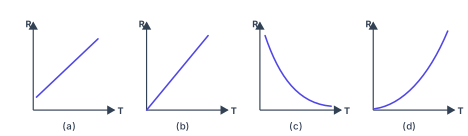
For a metallic conductor, the correct representation of variation of resistance RR with temperature TT is :
  • (a)
  • (b)
  • (c)
  • (d) Figure — CBSE 2023 55/1/1 Q2
[1]
Q3.
The potential difference across a cell in an open circuit is 8 V8\ \text{V}. It falls to 4 V4\ \text{V} when a current of 4 A4\ \text{A} is drawn from it. The internal resistance of the cell is :
  • (a) 4 Ω4\ \Omega
  • (b) 3 Ω3\ \Omega
  • (c) 2 Ω2\ \Omega
  • (d) 1 Ω1\ \Omega
[1]
Q4.
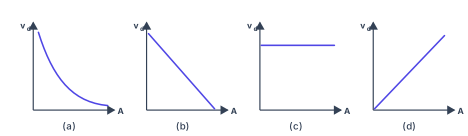
A steady current flows through a metallic wire whose area of cross-section (A)(A) increases continuously from one end of the wire to the other. The magnitude of drift velocity (vd)(v_d) of the free electrons as a function of AA can be represented by :
  • (a)
  • (b)
  • (c)
  • (d) Figure — CBSE 2023 55/1/1 Q4
[1]
Q5.
A diamagnetic substance is brought near the north or south pole of a bar magnet. It will be :
  • (a) repelled by both the poles.
  • (b) attracted by both the poles.
  • (c) repelled by the north pole and attracted by the south pole.
  • (d) attracted by the north pole and repelled by the south pole.
⚠ This question is not in the current syllabus — para-/dia-/ferromagnetic substances with examples (removed 2023-24)
[1]
Page 1 of 6
Q6.
A circular coil of radius 8.0cm and 40 turns is rotated about its vertical diameter with an angular speed of (25)/(π)rad s⁻¹ in a uniform horizontal magnetic field of magnitude 3.0×10⁻²T. The maximum emf induced in the coil is : (a) 0.12V (b) 0.15V (c) 0.19V (d) 0.22V
[1]
Q7.
Figure shows a rectangular conductor PSRQ in which the movable arm PQ has resistance r and the resistance of PSRQ is negligible. When PQ is moved with a velocity v, the magnitude of the emf induced does not depend on : (a) magnetic field (B) (b) velocity (v) (c) resistance (r) (d) length of PQ
[1]
Q8.
In the process of charging of a capacitor, the current produced between the plates of the capacitor is : (a) -varepsilon₀(dPhiE)/(dt) (b) -(1)/(varepsilon₀)(dPhiE)/(dt) (c) varepsilon₀(dPhiE)/(dt) (d) (1)/(varepsilon₀)(dPhiE)/(dt) where symbols have their usual meanings.
[1]
Q9.
For a concave mirror of focal length f, the minimum distance between an object and its real image is : (a) zero (b) f (c) 2f (d) 4f
[1]
Q10.
The radius of the nth orbit in Bohr model of hydrogen atom is proportional to : (a) (1)/(n²) (b) (1)/(n) (c) n² (d) n
[1]
Q11.
Hydrogen atom initially in the ground state, absorbs a photon which excites it to n = 5 level. The wavelength of the photon is : (a) 975nm (b) 740nm (c) 523nm (d) 95nm
[1]
Q12.
The mass density of a nucleus of mass number A is : (a) proportional to A1/3 (b) proportional to A2/3 (c) proportional to A³ (d) independent of A
[1]
Q13.
An ac source of voltage is connected in series with a p-n junction diode and a load resistor. The correct option for output voltage across the load resistance will be : (a) (b) (c) (d)
[1]
Q14.
When an intrinsic semiconductor is doped with a small amount of trivalent impurity, then : (a) its resistance increases. (b) it becomes a p-type semiconductor. (c) there will be more free electrons than holes in the semiconductor. (d) dopant atoms become donor atoms.
[1]
Page 2 of 6
Q15.
In the energy-band diagram of n-type Si, the gap between the bottom of the conduction band EC and the donor energy level ED is of the order of : (a) 10eV (b) 1eV (c) 0.1eV (d) 0.01eV
[1]
Q16.
Two statements are given – one labelled Assertion (A) and the other labelled Reason (R). Select the correct answer from the codes (a), (b), (c) and (d) as given below : (a) Both Assertion (A) and Reason (R) are true and Reason (R) is the correct explanation of the Assertion (A). (b) Both Assertion (A) and Reason (R) are true, but Reason (R) is not the correct explanation of the Assertion (A). (c) Assertion (A) is true, but Reason (R) is false. (d) Assertion (A) is false and Reason (R) is also false. Assertion (A) : When a bar of copper is placed in an external magnetic field, the field lines get concentrated inside the bar. Reason (R) : Copper is a paramagnetic substance.
⚠ This question is not in the current syllabus — para-/dia-/ferromagnetic substances with examples (removed 2023-24)
[1]
Q17.
Two statements are given – one labelled Assertion (A) and the other labelled Reason (R). Select the correct answer from the codes (a), (b), (c) and (d) as given below : (a) Both Assertion (A) and Reason (R) are true and Reason (R) is the correct explanation of the Assertion (A). (b) Both Assertion (A) and Reason (R) are true, but Reason (R) is not the correct explanation of the Assertion (A). (c) Assertion (A) is true, but Reason (R) is false. (d) Assertion (A) is false and Reason (R) is also false. Assertion (A) : The phase difference between any two points on a wavefront is zero. Reason (R) : All points on a wavefront are at the same distance from the source and thus oscillate in the same phase.
[1]
Q18.
Two statements are given – one labelled Assertion (A) and the other labelled Reason (R). Select the correct answer from the codes (a), (b), (c) and (d) as given below : (a) Both Assertion (A) and Reason (R) are true and Reason (R) is the correct explanation of the Assertion (A). (b) Both Assertion (A) and Reason (R) are true, but Reason (R) is not the correct explanation of the Assertion (A). (c) Assertion (A) is true, but Reason (R) is false. (d) Assertion (A) is false and Reason (R) is also false. Assertion (A) : Photoelectric effect demonstrates the particle nature of light. Reason (R) : Photoelectric current is proportional to intensity of incident radiation for frequencies more than the threshold frequency.
[1]
Section B

Very short answer · 2 marks each · 7 of 7 shown

Q1.
An alpha particle is projected with velocity vecv = (3.0×10⁵m/s)hati into a region in which magnetic field vecB = [(0.4T)hati + (0.3T)hatj] exists. Calculate the acceleration of the particle in the region. hati, hatj and hatk are unit vectors along the x, y and z axes respectively and the charge-to-mass ratio for the alpha particle is 4.8×10⁷C/kg.
[2]
Q2.
Consider an induced magnetic field due to a changing electric field and an induced electric field due to a changing magnetic field. Which one is more easily observed? Justify your answer.
[2]
Q3.
(a) Using Huygens' principle, draw a ray diagram showing the propagation of a plane wave refracting at a plane surface separating two media. Also verify Snell's law of refraction. OR (b) Why is a reflecting telescope preferred over a refracting telescope? Justify your answer giving two reasons.
[2]
Page 3 of 6
Q4.
Two coherent monochromatic light beams of intensities I and 4I superpose each other. Find the ratio of the maximum and minimum intensities in the resulting beam.
[2]
Q5.
The ground state energy of hydrogen atom is -13.6eV. What is the potential energy and kinetic energy of an electron in the third excited state?
[2]
Q6.
(a) Differentiate between intrinsic and extrinsic semiconductors. OR (b) Draw the circuit arrangement for studying the V–I characteristics of a p-n junction diode in forward bias and reverse bias. Show the plot of the V–I characteristic of a silicon diode.
[2]
Q7.
Briefly explain how the diffusion and drift currents contribute to the formation of the potential barrier in a p-n junction diode.
[2]
Section C

Short answer · 3 marks each · 5 of 5 shown

Q1.
(a) Twelve negative charges of same magnitude are equally spaced and fixed on the circumference of a circle of radius R as shown in Fig. (i). Relative to potential being zero at infinity, find the electric potential and electric field at the centre C of the circle. (b) If the charges are unequally spaced and fixed on an arc of 120^° of radius R as shown in Fig. (ii), find the electric potential at the centre C.
[3]
Q2.
(a) How does resistance differ from impedance? With the help of a suitable phasor diagram, obtain an expression for the impedance of a series LCR circuit connected to a source v = vm sinω t. OR (b) Find the condition for resonance in a series LCR circuit connected to a source v = vm sinω t, where ω can be varied. Give the factors on which the resonant frequency of a series LCR circuit depends. Plot a graph showing the variation of electric current with frequency in a series LCR circuit.
[3]
Page 4 of 6
Q3.
A long solenoid of radius r consists of n turns per unit length. A current I = I₀ sinω t flows in the solenoid. A coil of N turns is wound tightly around it near its centre. What is : (a) the induced emf in the coil? (b) the mutual inductance between the solenoid and the coil?
[3]
Q4.
How does Einstein's photoelectric equation explain the emission of electrons from a metal surface? Explain briefly. Plot the variation of photocurrent with : (a) collector plate potential for different intensities of incident radiation, and (b) intensity of incident radiation.
[3]
Q5.
(a) Draw the energy level diagram for the hydrogen atom. Mark the transitions corresponding to the series lying in the ultraviolet region, visible region and infrared region. OR (b) Draw a diagram to show the variation of binding energy per nucleon with mass number for different nuclei and mention its two features. Why do lighter nuclei usually undergo nuclear fusion?
[3]
Section D

Long answer · 5 marks each · 3 of 3 shown

Q1.
(a) (i) State Coulomb's law in electrostatics and write it in vector form for two charges. (ii) Gauss's law is based on the inverse-square dependence on distance contained in Coulomb's law. Explain. (iii) Two charges A (charge q) and B (charge 2q) are located at points (0, 0) and (a, a) respectively. Let hati and hatj be the unit vectors along the x-axis and y-axis respectively. Find the force exerted by A on B, in terms of hati and hatj. OR (b) (i) Derive an expression for the electric field at a point on the equatorial plane of an electric dipole consisting of charges q and -q separated by a distance 2a. (ii) The distance of a far-off point on the equatorial plane of an electric dipole is halved. How will the electric field be affected for the dipole? (iii) Two identical electric dipoles are placed along the diagonals of a square ABCD of side √(2) m as shown in the figure. Obtain the magnitude and direction of the net electric field at the centre (O) of the square.
[5]
Page 5 of 6
Q2.
(a) (i) State Biot-Savart's law for the magnetic field due to a current-carrying element. Use this law to obtain an expression for the magnetic field at the centre of a circular loop of radius a carrying current I. Draw the magnetic field lines indicating the direction of the magnetic field for a current loop. (ii) An electron is revolving around the nucleus in a circular orbit with a speed of 10⁷m s⁻¹. If the radius of the orbit is 10⁻¹⁰m, find the current constituted by the revolving electron in the orbit. OR (b) (i) Derive an expression for the force acting on a current-carrying straight conductor kept in a magnetic field. State the rule used to find the direction of this force. Give the condition under which this force is (1) maximum, and (2) minimum. (ii) Two long parallel straight wires A and B are 2.5cm apart in air. They carry 5.0A and 2.5A currents respectively in opposite directions. Calculate the magnitude of the force exerted by wire A on a 10cm length of wire B.
[5]
Q3.
(a) (i) (1) Write two points of difference between an interference pattern and a diffraction pattern. (2) Name any two factors on which the fringe width in a Young's double-slit experiment depends. (ii) In a Young's double-slit experiment, the separation between the two slits is 100 times the wavelength of the light passing through the slits. Calculate : (1) the angular separation (in radians) between the central maximum and the adjacent maximum. (2) the distance between these two maxima on a screen 50cm from the slits. OR (b) (i) A spherical surface of radius of curvature R separates two media of refractive indices n₁ and n₂. A point object is placed in front of the surface at distance u in the medium of refractive index n₁ and its image is formed by the surface at distance v in the medium of refractive index n₂. Derive a relation between u and v. (ii) A solid glass sphere of radius 6.0cm has a small air bubble trapped at a distance 3.0cm from its centre C as shown in the figure. The refractive index of the material of the sphere is 1.5. Find the apparent position of this bubble when seen through the surface of the sphere from an outside point E in air.
[5]
Section E

Case-based · 4 marks each · 2 of 2 shown

Q1.
Case Study : The following figure shows a circuit diagram. We can find the currents through and potential differences across the different resistors using Kirchhoff's rules. Answer the following questions based on the above : (a) Which points are at the same potential in the circuit? (b) What is the current through arm bg? (c) Find the potential difference across resistance R₃. OR (c) What is the power dissipated in resistance R₂?
[4]
Q2.
Case Study : Strontium titanate is a rare oxide — a natural mineral found in Siberia. It is used as a substitute for diamond because its refractive index and critical angle are 2.41 and 24.5^° respectively, which are approximately equal to the refractive index and critical angle of diamond. It has all the properties of diamond. Even an expert jeweller is unable to differentiate between diamond and strontium titanate. A ray of light is incident normally on one face of an equilateral triangular prism ABC made of strontium titanate. Answer the following questions based on the above : (a) Trace the path of the ray showing its passage through the prism. (b) Find the velocity of light through the prism. (c) Briefly explain two applications of total internal reflection. OR (c) Define total internal reflection of light. Give two conditions for it.
[4]
Page 6 of 6