Skip to content
← 2023

Physics · 2023 · Set 55/3/1

CBSE Class 12 Physics 2023 — Set 55/3/1

CBSE Class XII Board 2023 · Set 55/3/1

Real board examination
Sets

About this paper

The real Class-12 board examination held in 2023. Every question below is solved the concept-first way. Sample papers are labelled honestly — never shown as a past exam.

Total marks
70
Questions
35
Duration
180 min
Sections
5

The marks / questions / duration above are the official exam pattern. We currently have 35 of this paper’s questions (100% of the full paper), with 35 fully solved. Questions we couldn’t yet extract or verify are held — never shown as complete.

Sections & marks

SectionTypeQuestionsMarks eachTotal
ASection AMCQ / Assertion-Reason18118
BSection BVery short answer7214
CSection CShort answer5315
DSection DLong answer3515
ESection ECase-based248
Total3570

The question paper

The questions we hold for this paper, laid out by section. Solutions are on the Answers tab.

Board Examination

Physics

CBSE Class XII Board 2023 · Set 55/3/1

Series/Set: 55/3/1Roll No. ________
Time Allowed: 3 hoursMaximum Marks: 70

General Instructions

  1. This question paper contains 35 questions divided into 5 sections — A, B, C, D, E.
  2. Section A comprises 18 questions of 1 mark each (MCQ / Assertion-Reason).
  3. Section B comprises 7 questions of 2 marks each (Very short answer).
  4. Section C comprises 5 questions of 3 marks each (Short answer).
  5. Section D comprises 3 questions of 5 marks each (Long answer).
  6. Section E comprises 2 questions of 4 marks each (Case-based).

Above is the official exam pattern. The questions printed below are those we currently hold for this paper.

Section A

MCQ / Assertion-Reason · 1 mark each · 18 of 18 shown

Q1.
An electron experiences a force (1.6×10⁻¹⁶ N)i^(1.6\times10^{-16}\ \text{N})\hat{i} in an electric field E⃗\vec{E}. The electric field E⃗\vec{E} is :
  • (a) (1.0×10³ NC)i^\left(1.0\times10^{3}\ \dfrac{\text{N}}{\text{C}}\right)\hat{i}
  • (b) −(1.0×10³ NC)i^-\left(1.0\times10^{3}\ \dfrac{\text{N}}{\text{C}}\right)\hat{i}
  • (c) (1.0×10⁻³ NC)i^\left(1.0\times10^{-3}\ \dfrac{\text{N}}{\text{C}}\right)\hat{i}
  • (d) −(1.0×10⁻³ NC)i^-\left(1.0\times10^{-3}\ \dfrac{\text{N}}{\text{C}}\right)\hat{i}
[1]
Q2.
Which one of the following is not a scalar quantity ?
  • (a) Electric field
  • (b) Voltage
  • (c) Resistivity
  • (d) Power
[1]
Q3.
The current density due to drift of electrons in a conductor is given by : (symbols have their usual meanings)
  • (a) neAvdneAv_d
  • (b) nAvde\dfrac{nAv_d}{e}
  • (c) nvdeA\dfrac{nv_d}{eA}
  • (d) nevdnev_d
[1]
Q4.
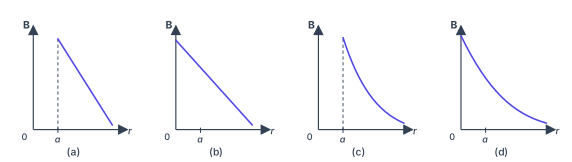
Which of the following graphs correctly represents the variation of the magnitude of the magnetic field outside a straight infinite current-carrying wire as a function of the distance rr from the centre of the wire ?
  • (a)
  • (b)
  • (c)
  • (d) Figure — CBSE 2023 55/3/1 Q4
[1]
Q5.
A particle of mass mm and charge qq moving with a uniform velocity v⃗=v0xi^+v0yj^\vec v = v_{0x}\hat{i} + v_{0y}\hat{j} enters a region with a magnetic field B⃗=B0j^\vec B = B_0\hat{j}. After some time, an electric field E⃗=E0j^\vec E = E_0\hat{j} is also switched on in the region. The resulting path described by the particle will be :
  • (a) a circle in xx-zz plane
  • (b) a parabola in xx-yy plane
  • (c) a helix with constant pitch
  • (d) a helix with increasing pitch
[1]
Q6.
An inductor, a capacitor and a resistor are connected in series across an ac source of voltage. If the frequency of the source is decreased gradually, the reactance of :
  • (a) both the inductor and the capacitor decreases.
  • (b) inductor decreases and the capacitor increases.
  • (c) both the inductor and the capacitor increases.
  • (d) inductor increases and the capacitor decreases.
[1]
Page 1 of 6
Q7.
The electromagnetic radiations used to kill germs in water purifiers are called : (a) Infrared waves (b) X-rays (c) Gamma rays (d) Ultraviolet rays
[1]
Q8.
In the wave picture of light, the intensity I of light is related to the amplitude A of the wave as : (a) Ipropto√(A) (b) Ipropto A (c) Ipropto A² (d) Iproptodfrac1A²
[1]
Q9.
In a single-slit diffraction experiment, the width of the slit is halved. The width of the central maximum, in the diffraction pattern, will become : (a) half (b) twice (c) four times (d) one-fourth
[1]
Q10.
A graph is plotted between the stopping potential (on y-axis) and the frequency of incident radiation (on x-axis) for a metal. The product of the slope of the straight line obtained and the magnitude of charge on an electron is equal to : (a) h (b) (h)/(c) (c) (2h)/(c) (d) (h)/(2c)
[1]
Q11.
Light of frequency 6.4×10¹⁴Hz is incident on a metal of work function 2.14eV. The maximum kinetic energy of the emitted electrons is about : (a) 0.25eV (b) 0.51eV (c) 1.02eV (d) 0.10eV
[1]
Q12.
In Bohr's model of the hydrogen atom, the ratio of the maximum frequency to the minimum frequency of light emitted in the Balmer series of the hydrogen spectrum is : (a) (11)/(9) (b) (9)/(5) (c) (11)/(7) (d) (16)/(7)
[1]
Q13.
At a certain temperature in an intrinsic semiconductor, the electron and hole concentration is 1.5×10¹⁶m⁻³. When it is doped with a trivalent dopant, the hole concentration increases to 4.5×10²²m⁻³. In the doped semiconductor, the concentration of electrons (ne) will be : (a) 3×10⁶m⁻³ (b) 5×10⁷m⁻³ (c) 5×10⁹m⁻³ (d) 6.75×10³⁸m⁻³
[1]
Q14.
If a p-n junction diode is reverse biased, (a) the potential barrier is lowered. (b) the potential barrier remains unaffected. (c) the potential barrier is raised. (d) the current is mainly due to majority carriers.
[1]
Q15.
A voltage signal is described by : v = V₀ for 0 ≤ t ≤ (T)/(2) v = 0 for (T)/(2) ≤ t ≤ T for a cycle. Its rms value is : (a) dfracV₀√(2) (b) V₀ (c) (V₀)/(2) (d) √(2)V₀
[1]
Page 2 of 6
Q16.
Two statements are given – one labelled Assertion (A) and the other labelled Reason (R). Select the correct answer from the codes (a), (b), (c) and (d) below. (a) Both Assertion (A) and Reason (R) are true and Reason (R) is the correct explanation of the Assertion (A). (b) Both Assertion (A) and Reason (R) are true, but Reason (R) is not the correct explanation of the Assertion (A). (c) Assertion (A) is true, but Reason (R) is false. (d) Assertion (A) is false and Reason (R) is also false. Assertion (A) : The internal resistance of a cell is constant. Reason (R) : Ionic concentration of the electrolyte remains same during use of a cell.
[1]
Q17.
Two statements are given – one labelled Assertion (A) and the other labelled Reason (R). Select the correct answer from the codes (a), (b), (c) and (d) below. (a) Both Assertion (A) and Reason (R) are true and Reason (R) is the correct explanation of the Assertion (A). (b) Both Assertion (A) and Reason (R) are true, but Reason (R) is not the correct explanation of the Assertion (A). (c) Assertion (A) is true, but Reason (R) is false. (d) Assertion (A) is false and Reason (R) is also false. Assertion (A) : When the radius of a circular loop carrying a steady current is doubled, its magnetic moment becomes four times. Reason (R) : The magnetic moment of a circular loop carrying a steady current is proportional to the area of the loop.
[1]
Q18.
Two statements are given – one labelled Assertion (A) and the other labelled Reason (R). Select the correct answer from the codes (a), (b), (c) and (d) below. (a) Both Assertion (A) and Reason (R) are true and Reason (R) is the correct explanation of the Assertion (A). (b) Both Assertion (A) and Reason (R) are true, but Reason (R) is not the correct explanation of the Assertion (A). (c) Assertion (A) is true, but Reason (R) is false. (d) Assertion (A) is false and Reason (R) is also false. Assertion (A) : The nucleus ⁷₃X is more stable than the nucleus ⁴₃Y. Reason (R) : ⁷₃X contains more number of protons.
[1]
Section B

Very short answer · 2 marks each · 7 of 7 shown

Q1.
A wire of length l is in the form of a circular loop A of one turn. This loop is reshaped into loop B of three turns. Find the ratio of the magnetic fields at the centres of loop A and loop B for the same current through them.
[2]
Q2.
What is displacement current ? Explain briefly how this current is different from a conduction current.
[2]
Q3.
(a) State Huygens' principle. How did Huygens explain the absence of the back wave ? OR (b) Using Huygens' principle, show the reflection/refraction of a plane wave by (i) a concave mirror, and (ii) a convex lens.
[2]
Q4.
The refractive indices of two media A and B are 2 and √(2) respectively. What is the critical angle for their interface ?
[2]
Page 3 of 6
Q5.
(a) Draw a graph showing the variation of binding energy per nucleon as a function of mass number A. The binding energy per nucleon for heavy nuclei (A>170) decreases with the increase in mass number. Explain. OR (b) Using Bohr's postulates, obtain the expression for the radius of the nth stable orbit in a hydrogen atom.
[2]
Q6.
Explain the roles of diffusion current and drift current in the formation of the depletion layer in a p-n junction diode.
[2]
Q7.
Explain the property of a p-n junction which makes it suitable for rectifying alternating voltages. Differentiate between a half-wave and a full-wave rectifier.
[2]
Section C

Short answer · 3 marks each · 5 of 5 shown

Q1.
A potential difference V is applied across a conductor of length l and uniform cross-section area A. How will the (i) electric field E, (ii) drift velocity vd, and (iii) current density j be affected when (a) V is doubled and (b) l is halved (keeping other factors constant) ?
[3]
Q2.
What is mutual inductance ? Obtain an expression for the mutual inductance of two long coaxial solenoids, each of length l but having different number of turns N₁ and N₂ and radii r₁ and r₂ (r₂ > r₁).
[3]
Q3.
(a) An ac source v = vm sinω t is connected across an ideal capacitor. Derive the expression for (i) the current flowing in the circuit, and (ii) the reactance of the capacitor. Plot a graph of current i versus ω t. OR (b) A series combination of an inductor L, a capacitor C and a resistor R is connected across an ac source of voltage in a circuit. Obtain an expression for the average power consumed by the circuit. Find the power factor for (i) a purely inductive circuit, and (ii) a purely resistive circuit.
[3]
Page 4 of 6
Q4.
Calculate the wavelength of de Broglie waves associated with a proton having (500)/(1.673)eV energy. How will the wavelength be affected for an alpha particle having the same energy ?
[3]
Q5.
(a) (i) Prove that the nuclear density is same for all nuclei. (ii) Draw a plot of the potential energy of a pair of nucleons as a function of their separation. Draw two inferences from this plot. OR (b) (i) Draw a graph to show the variation of the number of scattered particles detected (N) in the Geiger-Marsden experiment as a function of the scattering angle (θ). (ii) Discuss briefly two conclusions that can be drawn from this graph and how they lead to the discovery of the nucleus in an atom.
[3]
Section D

Long answer · 5 marks each · 3 of 3 shown

Q1.
(a) (i) Define electric flux and write its SI unit. (ii) Using Gauss's law, obtain the expression for the electric field due to a uniformly charged infinite plane sheet. (iii) A cube of side L is kept in space, as shown in the figure. An electric field vecE = (Ax + B)hatidfracNC exists in the region. Find the net charge enclosed by the cube. OR (b) (i) Define electric potential at a point and write its SI unit. (ii) Two capacitors are connected in series. Derive an expression for the equivalent capacitance of the combination. (iii) Two point charges +q and -q are located at points (3a, 0) and (0, 4a) respectively in the x-y plane. A third charge Q is kept at the origin. Find the value of Q, in terms of q and a, so that the electrostatic potential energy of the system is zero.
[5]
Q2.
(a) (i) Write the principle and explain the working of a moving coil galvanometer. A galvanometer as such cannot be used to measure the current in a circuit. Why ? (ii) Why is the magnetic field made radial in a moving coil galvanometer ? How is it achieved ? OR (b) (i) Derive an expression for the magnetic field on the axis of a current-carrying circular loop. (ii) Write any two points of difference between a diamagnetic and a paramagnetic substance.
[5]
Page 5 of 6
Q3.
(a) (i) Draw a ray diagram showing the formation of a real image of an object placed at a distance u in front of a concave mirror of radius of curvature R. Hence, obtain the relation for the image distance v in terms of u and R. (ii) A 1.8m tall person stands in front of a convex lens of focal length 1m, at a distance of 5m. Find the position and height of the image formed. OR (b) (i) Draw a ray diagram showing the refraction of a ray of light through a triangular glass prism. Hence, obtain the relation for the refractive index (n) in terms of the angle of prism (A) and the angle of minimum deviation (δm). (ii) The radii of curvature of the two surfaces of a concave lens are 20cm each. Find the refractive index of the material of the lens if its power is -5.0D.
[5]
Section E

Case-based · 4 marks each · 2 of 2 shown

Q1.
A beam of electrons moving horizontally with a velocity of 3×10⁷m/s enters a region between two plates as shown in the figure. A suitable potential difference is applied across the plates such that the electron beam just strikes the edge of the lower plate. Answer the following questions based on the above : (a) How long does an electron take to strike the edge ? (b) What is the shape of the path followed by the electron and why ? (c) Find the potential difference applied. OR (c) Find the magnitude and direction of the magnetic field which should be created in the space between the plates so that the electron beam goes straight undeviated.
[4]
Q2.
Diffraction of light is the bending of light around the corners of an object whose size is comparable with the wavelength of light. Diffraction actually defines the limits of ray optics. This limit for optical instruments is set by the wavelength of light. An experimental arrangement is set up to observe the diffraction pattern due to a single slit. Answer the following questions based on the above : (a) How will the width of the central maximum be affected if the wavelength of light is increased ? (b) Under what condition is the first minimum obtained ? (c) Write two points of difference between interference and diffraction patterns. OR (c) Two students are separated by a 7m partition wall in a room 10m high. If both light and sound waves can bend around obstacles, how is it that the students are unable to see each other even though they can converse easily ?
[4]
Page 6 of 6