Skip to content
← 2023

Physics · 2023 · Set 55/4/1

CBSE Class 12 Physics 2023 — Set 55/4/1

CBSE Class XII Board 2023 · Set 55/4/1

Real board examination
Sets

This paper has 2 questions on a topic removed in CBSE’s 2023-24 syllabus update (each marked Not in syllabus). It’s kept for historical accuracy — the exam really asked it that year — but isn’t in the current syllabus and doesn’t count toward a concept’s importance. Switch to to focus on what’s still examinable.

About this paper

The real Class-12 board examination held in 2023. Every question below is solved the concept-first way. Sample papers are labelled honestly — never shown as a past exam.

Total marks
70
Questions
35
Duration
180 min
Sections
5

The marks / questions / duration above are the official exam pattern. We currently have 35 of this paper’s questions (100% of the full paper), with 35 fully solved. Questions we couldn’t yet extract or verify are held — never shown as complete.

Sections & marks

SectionTypeQuestionsMarks eachTotal
ASection AMCQ / Assertion-Reason18118
BSection BVery short answer7214
CSection CShort answer5315
DSection DLong answer3515
ESection ECase-based248
Total3570

The question paper

The questions we hold for this paper, laid out by section. Solutions are on the Answers tab.

Board Examination

Physics

CBSE Class XII Board 2023 · Set 55/4/1

Series/Set: 55/4/1Roll No. ________
Time Allowed: 3 hoursMaximum Marks: 70

General Instructions

  1. This question paper contains 35 questions divided into 5 sections — A, B, C, D, E.
  2. Section A comprises 18 questions of 1 mark each (MCQ / Assertion-Reason).
  3. Section B comprises 7 questions of 2 marks each (Very short answer).
  4. Section C comprises 5 questions of 3 marks each (Short answer).
  5. Section D comprises 3 questions of 5 marks each (Long answer).
  6. Section E comprises 2 questions of 4 marks each (Case-based).

Above is the official exam pattern. The questions printed below are those we currently hold for this paper.

Section A

MCQ / Assertion-Reason · 1 mark each · 18 of 18 shown

Q1.
Two charges q1q_1 and q2q_2 are placed at the centres of two spherical conducting shells of radius r1r_1 and r2r_2 respectively. The shells are arranged such that their centres are d [>(r1+r2)]d\ [>(r_1+r_2)] distance apart. The force on q2q_2 due to q1q_1 is : (A) 14πε0q1q2d2\dfrac{1}{4\pi\varepsilon_0}\dfrac{q_1 q_2}{d^2} (B) 14πε0q1q2(d−r1)2\dfrac{1}{4\pi\varepsilon_0}\dfrac{q_1 q_2}{(d-r_1)^2} (C) Zero (D) 14πε0q1q2[d−(r1+r2)]2\dfrac{1}{4\pi\varepsilon_0}\dfrac{q_1 q_2}{[d-(r_1+r_2)]^2}
[1]
Q2.
An electron enters a uniform magnetic field with speed vv. It describes a semicircular path and comes out of the field. The final speed of the electron is : (A) Zero (B) vv (C) v2\dfrac{v}{2} (D) 2v2v
[1]
Q3.
The magnetic field lines near a substance are as shown in the figure. The substance is : (A) Copper (B) Iron (C) Sodium (D) Aluminium Figure — CBSE 2023 55/4/1 Q3
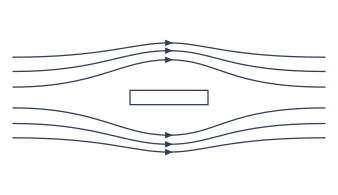
⚠ This question is not in the current syllabus — para-/dia-/ferromagnetic substances with examples (removed 2023-24)
[1]
Q4.
The figure shows variation of current (II) with time (tt) in four devices P, Q, R and S. The device in which an alternating current flows is : (A) P (B) Q (C) R (D) S Figure — CBSE 2023 55/4/1 Q4
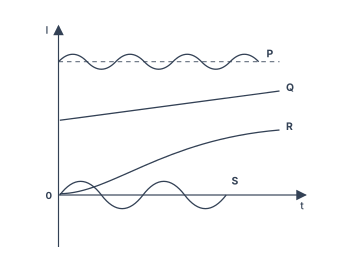
[1]
Q5.
The electromagnetic waves used in radar systems are : (A) Infrared waves (B) Ultraviolet rays (C) Microwaves (D) X-rays
[1]
Q6.
In a Young's double-slit experiment, the fringe width is found to be β\beta. If the entire apparatus is immersed in a liquid of refractive index μ\mu, the new fringe width will be : (A) βμ\beta\mu (B) βμ\beta\sqrt{\mu} (C) βμ\dfrac{\beta}{\mu} (D) 2β2\beta
[1]
Page 1 of 7
Q7.
Photons of energy 3.2eV are incident on a photosensitive surface. If the stopping potential for the emitted electrons is 1.5V, the work function for the surface is : (A) 1.5eV (B) 1.7eV (C) 3.2eV (D) 4.7eV
[1]
Q8.
Which of the following statements is not true for nuclear forces ? (A) They are stronger than Coulomb forces. (B) They have about the same magnitude for different pairs of nucleons. (C) They are always attractive. (D) They saturate as the separation between two nucleons increases.
[1]
Q9.
The direction of induced current in the loop abc is : (A) along abc if I decreases (B) along acb if I increases (C) along abc if I is constant (D) along abc if I increases
[1]
Q10.
An ac voltage v = v₀ sinω t is applied to a series combination of a resistor R and an element X. The instantaneous current in the circuit is I = I₀ sin(ω t + (π)/(4)). Then which of the following is correct ? (A) X is a capacitor and XC = √(2)R (B) X is an inductor and XL = R (C) X is an inductor and XL = √(2)R (D) X is a capacitor and XC = R
[1]
Q11.
A plane wavefront is incident on a concave mirror of radius of curvature R. The radius of the refracted wavefront will be : (A) 2R (B) R (C) (R)/(2) (D) (R)/(4)
[1]
Q12.
A proton and an alpha particle have the same kinetic energy. The ratio of de Broglie wavelengths associated with the proton to that with the alpha particle is : (A) 1 (B) 2 (C) 2√(2) (D) (1)/(2)
[1]
Q13.
The potential energy of an electron in the second excited state in hydrogen atom is : (A) -3.4eV (B) -3.02eV (C) -1.51eV (D) -6.8eV
[1]
Q14.
The difference in mass of a ₇X nucleus and total mass of its constituent nucleons is 21.00u. The binding energy per nucleon for this nucleus is equal to the energy equivalent of : (A) 3u (B) 3.5u (C) 7u (D) 21u
[1]
Q15.
The threshold voltage for a p-n junction diode used in the circuit is 0.7V. The type of biasing and current in the circuit are : (A) Forward biasing, 0A (B) Reverse biasing, 0A (C) Forward biasing, 5mA (D) Reverse biasing, 2mA
[1]
Page 2 of 7
Q16.
Two statements are given — one labelled Assertion (A) and the other labelled Reason (R). Select the correct answer from the codes (A), (B), (C) and (D) as given below. (A) Both Assertion (A) and Reason (R) are true and Reason (R) is the correct explanation of the Assertion (A). (B) Both Assertion (A) and Reason (R) are true, but Reason (R) is not the correct explanation of the Assertion (A). (C) Assertion (A) is true, but Reason (R) is false. (D) Assertion (A) is false and Reason (R) is also false. Assertion (A) : When three electric bulbs of power 200W, 100W and 50W are connected in series to a source, the power consumed by the 50W bulb is maximum. Reason (R) : In a series circuit, current is the same through each bulb, but the potential difference across each bulb is different.
⚠ This question is not in the current syllabus — series/parallel combinations of resistors (removed 2023-24)
[1]
Q17.
Two statements are given — one labelled Assertion (A) and the other labelled Reason (R). Select the correct answer from the codes (A), (B), (C) and (D) as given below. (A) Both Assertion (A) and Reason (R) are true and Reason (R) is the correct explanation of the Assertion (A). (B) Both Assertion (A) and Reason (R) are true, but Reason (R) is not the correct explanation of the Assertion (A). (C) Assertion (A) is true, but Reason (R) is false. (D) Assertion (A) is false and Reason (R) is also false. Assertion (A) : A current carrying square loop made of a wire of length L is placed in a magnetic field. It experiences a torque which is greater than the torque on a circular loop made of the same wire carrying the same current in the same magnetic field. Reason (R) : A square loop occupies more area than a circular loop, both made of wire of the same length.
[1]
Q18.
Two statements are given — one labelled Assertion (A) and the other labelled Reason (R). Select the correct answer from the codes (A), (B), (C) and (D) as given below. (A) Both Assertion (A) and Reason (R) are true and Reason (R) is the correct explanation of the Assertion (A). (B) Both Assertion (A) and Reason (R) are true, but Reason (R) is not the correct explanation of the Assertion (A). (C) Assertion (A) is true, but Reason (R) is false. (D) Assertion (A) is false and Reason (R) is also false. Assertion (A) : In an n-type semiconductor, the number density of electrons is greater than the number density of holes but the crystal maintains an overall charge neutrality. Reason (R) : The charge of electrons donated by donor atoms is just equal and opposite to that of the ionised donor.
[1]
Section B

Very short answer · 2 marks each · 7 of 7 shown

Q1.
Two identical dipoles are arranged in the x-y plane as shown in the figure. Find the magnitude and the direction of net electric field at the origin O.
[2]
Q2.
Write two differences between the emf and terminal potential difference of a cell. What is the most important precaution that one should take while drawing current from a cell ?
[2]
Q3.
A small magnetised needle P is placed at the origin of the x-y plane with its magnetic moment pointing along the y-axis. Another identical magnetised needle Q is placed in two positions, one by one. Case 1 : at (a, 0) with its magnetic moment pointing along the x-axis. Case 2 : at (0, a) with its magnetic moment pointing along the y-axis. (a) In which case is the potential energy of P and Q minimum ? (b) In which case is P and Q not in equilibrium ? Justify your answers.
[2]
Page 3 of 7
Q4.
(a) What is a displacement current ? How is it different from a conduction current ? OR (b) Write any two characteristics of an electromagnetic wave. Why are microwaves used in radar systems ?
[2]
Q5.
The figure shows a vm² versus (1)/(λ) graph for photoelectrons emitted from a surface, where vm is the maximum speed of the electrons and λ is the wavelength of the incident radiation. Using this graph and Einstein's photoelectric equation, obtain the expressions for Planck's constant and the work function of the surface.
[2]
Q6.
Draw the graph showing the variation of binding energy per nucleon with mass number A of nuclei (2 < A < 170). Use this graph to explain the release of energy in nuclear fission.
[2]
Q7.
(a) Obtain an expression for the electrostatic potential energy of an equilateral triangle of side a with three charges q, 2q and -3q placed at its vertices. OR (b) Two small conducting balls A and B of radius r₁ and r₂ have charges q₁ and q₂ respectively. They are connected by a wire. Obtain the expression for the charges on A and B, in equilibrium.
[2]
Section C

Short answer · 3 marks each · 5 of 5 shown

Q1.
Two circular loops A and B, each of radius 3m, are placed coaxially at a distance of 4m. They carry currents of 3A and 2A in opposite directions respectively. Find the net magnetic field at the centre of loop A.
[3]
Q2.
(a) The figure shows the variation of induced emf as a function of the rate of change of current for two identical solenoids X and Y. One is air cored and the other is iron cored. Which one of them is iron cored ? Why ? (b) Obtain an expression for the self-inductance of a long solenoid of length L and cross-sectional area A having N turns.
[3]
Page 4 of 7
Q3.
(a) A resistor of 30Ω and a capacitor of (250)/(π)muF are connected in series to a 200V, 50Hz ac source. Calculate (i) the current in the circuit, and (ii) voltage drops across the resistor and the capacitor. (iii) Is the algebraic sum of these voltages more than the source voltage ? If yes, solve the paradox. OR (b) A series LCR circuit with R = 20Ω, L = 2H and C = 50muF is connected to a 200V ac source of variable frequency. What is (i) the amplitude of the current, and (ii) the average power transferred to the circuit in one complete cycle, at resonance ? (iii) Calculate the potential drop across the capacitor.
[3]
Q4.
(a) (i) In diffraction due to a single slit, the phase difference between light waves reaching a point on the screen is 5π. Explain whether a bright or a dark fringe will be formed at the point. (ii) What should the width (a) of each slit be to obtain eight maxima of two double-slit patterns (slit separation d) within the central maximum of the single slit pattern ? (iii) Draw the plot of intensity distribution in a diffraction pattern due to a single slit. OR (b) (i) In a Young's double-slit experiment SS₂ - SS₁ = (λ)/(4), where S₁ and S₂ are the two slits as shown in the figure. Find the path difference (S₂P - S₁P) for constructive and destructive interference at P. (ii) What is the effect on the interference fringes in a double-slit experiment, if the monochromatic source S is replaced by a source of white light ?
[3]
Q5.
Briefly explain the Geiger-Marsden experiment. Show the variation of the number of particles scattered (N) with scattering angle (θ) in this experiment. What is the main conclusion that can be inferred from this plot ?
[3]
Section D

Long answer · 5 marks each · 3 of 3 shown

Q1.
(a) (i) Define mobility of electrons. Give its SI units. (ii) A steady current flows through a wire AB, as shown in the figure. What happens to the electric field and the drift velocity along the wire ? Justify your answer. (iii) Consider the circuit shown in the figure. Find the effective resistance of the circuit and the current drawn from the battery. OR (b) (i) Define electrical conductivity of a wire. Give its SI unit. (ii) High current is to be drawn safely from (1) a low-voltage battery, and (2) a high-voltage battery. What can you say about the internal resistance of the two batteries ? (iii) Calculate the total energy supplied by the batteries to the circuit shown in the figure, in one minute.
[5]
Page 5 of 7
Q2.
(a) (i) Draw a ray diagram to show how the final image is formed at infinity in an astronomical refracting telescope. Obtain an expression for its magnifying power. (ii) Two thin lenses L₁ and L₂, L₁ being a convex lens of focal length 24cm and L₂ a concave lens of focal length 18cm, are placed coaxially at a separation of 45cm. A 1cm tall object is placed in front of the lens L₁ at a distance of 36cm. Find the location and height of the image formed by the combination. OR (b) (i) Explain the working principle of an optical fibre with the help of a diagram. Mention one use of a light pipe. (ii) A ray of light is incident at an angle of 60^° on one face of a prism with the prism angle A = 60^°. The ray passes symmetrically through the prism. Find the angle of minimum deviation (δm) and refractive index of the material of the prism. If the prism is immersed in water, how will δm be affected ? Justify your answer.
[5]
Q3.
(a) (i) A germanium crystal is doped with antimony. With the help of an energy-band diagram, explain how the conductivity of the doped crystal is affected. (ii) Briefly explain the two processes involved in the formation of a p-n junction. (iii) What will the effect of (1) forward biasing, and (2) reverse biasing be on the width of the depletion layer in a p-n junction diode ? OR (b) (i) With the help of a circuit diagram, briefly explain the working of a full-wave rectifier using p-n junction diodes. (ii) Draw the V–I characteristics of a p-n junction diode. Explain how these characteristics make a diode suitable for rectification. (iii) Carbon and silicon have the same lattice structure. Then why is carbon an insulator but silicon a semiconductor ?
[5]
Section E

Case-based · 4 marks each · 2 of 2 shown

Q1.
Electrostatics deals with the study of forces, fields and potentials arising from static charges. Force and electric field due to a point charge is basically determined by Coulomb's law. For symmetric charge configurations Gauss's law, which is also based on Coulomb's law, helps us to find the electric field. A charge / a system of charges like a dipole experiences a force / torque in an electric field. Work is required to be done to provide a specific orientation to a dipole with respect to an electric field. Answer the following questions based on the above : (a) Consider a uniformly charged thin conducting shell of radius R. Plot a graph showing the variation of |vecE| with distance r from the centre, for points 0 ≤ r ≤ 3R. (b) The figure shows the variation of potential V with (1)/(r) for two point charges Q₁ and Q₂, where V is the potential at a distance r due to a point charge. Find (Q₁)/(Q₂). (c) An electric dipole of dipole moment of 6 × 10⁻⁷C-m is kept in a uniform electric field of 10⁴N/C such that the dipole moment and the electric field are parallel. Calculate the potential energy of the dipole. OR (c) An electric dipole of dipole moment vecp is initially kept in a uniform electric field vecE such that vecp is perpendicular to vecE. Find the amount of work done in rotating the dipole to a position at which vecp becomes antiparallel to vecE.
[4]
Page 6 of 7
Q2.
The lens maker's formula is useful to design lenses of desired focal lengths using surfaces of suitable radii of curvature. The focal length also depends on the refractive index of the material of the lens and the surrounding medium. The refractive index depends on the wavelength of the light used. The power of a lens is related to its focal length. Answer the following questions based on the above : (a) How will the power of a lens be affected with an increase of wavelength of light ? (b) The radius of curvature of two surfaces of a convex lens is R each. For what value of μ of its material will its focal length become equal to R ? (c) The focal length of a concave lens of μ = 1.5 is 20cm in air. It is completely immersed in water of μ = (4)/(3). Calculate its focal length in water. OR (c) An object is placed in front of a lens which forms its erect image of magnification 3. The power of the lens is 5D. Calculate the distance of the object and the image from the lens.
[4]
Page 7 of 7