Skip to content
← All years

Physics · 2024

CBSE Class 12 Physics 2024 — Previous-Year Question Paper

CBSE Class XII Board 2024 · Set 55/1/1

Real board examination
Sets

About this paper

The real Class-12 board examination held in 2024. Every question below is solved the concept-first way. Sample papers are labelled honestly — never shown as a past exam.

Total marks
70
Questions
33
Duration
180 min
Sections
5

The marks / questions / duration above are the official exam pattern. We currently have 33 of this paper’s questions (100% of the full paper), with 33 fully solved. Questions we couldn’t yet extract or verify are held — never shown as complete.

Sections & marks

SectionTypeQuestionsMarks eachTotal
ASection AMCQ / Assertion-Reason16116
BSection BVery short answer5210
CSection CShort answer7321
DSection DCase-based248
ESection ELong answer3515
Total3370

The question paper

The questions we hold for this paper, laid out by section. Solutions are on the Answers tab.

Board Examination

Physics

CBSE Class XII Board 2024 · Set 55/1/1

Series/Set: 55/1/1Roll No. ________
Time Allowed: 3 hoursMaximum Marks: 70

General Instructions

  1. This question paper contains 33 questions divided into 5 sections — A, B, C, D, E.
  2. Section A comprises 16 questions of 1 mark each (MCQ / Assertion-Reason).
  3. Section B comprises 5 questions of 2 marks each (Very short answer).
  4. Section C comprises 7 questions of 3 marks each (Short answer).
  5. Section D comprises 2 questions of 4 marks each (Case-based).
  6. Section E comprises 3 questions of 5 marks each (Long answer).

Above is the official exam pattern. The questions printed below are those we currently hold for this paper.

Section A

MCQ / Assertion-Reason · 1 mark each · 16 of 16 shown

Q1.
A thin plastic rod is bent into a circular ring of radius RR. It is uniformly charged with charge density λ\lambda. The magnitude of the electric field at its centre is : (A) λ2ε0R\dfrac{\lambda}{2\varepsilon_0 R} (B) Zero (C) λ4πε0R\dfrac{\lambda}{4\pi\varepsilon_0 R} (D) λ4ε0R\dfrac{\lambda}{4\varepsilon_0 R}
[1]
Q2.
Ten capacitors, each of capacitance 1 μF1\ \mu\text{F}, are connected in parallel to a source of 100 V100\ \text{V}. The total energy stored in the system is equal to : (A) 10−2 J10^{-2}\ \text{J} (B) 10−3 J10^{-3}\ \text{J} (C) 0.5×10⁻³ J0.5\times10^{-3}\ \text{J} (D) 5.0×10⁻² J5.0\times10^{-2}\ \text{J}
[1]
Q3.
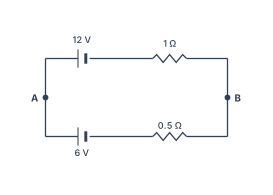
Consider the circuit shown in the figure. The potential difference between points A and B is : (A) 6 V6\ \text{V} (B) 8 V8\ \text{V} (C) 9 V9\ \text{V} (D) 12 V12\ \text{V} Figure: two-branch circuit between A and B
[1]
Q4.
A loop carrying a current II clockwise is placed in the xx–yy plane, in a uniform magnetic field directed along the zz-axis. The tendency of the loop will be to : (A) move along xx-axis (B) move along yy-axis (C) shrink (D) expand
[1]
Q5.
A 10 cm10\ \text{cm} long wire lies along the yy-axis. It carries a current of 1.0 A1.0\ \text{A} in the positive yy-direction. A magnetic field B⃗=(5 mT)j^−(8 mT)k^\vec{B} = (5\ \text{mT})\hat{j} - (8\ \text{mT})\hat{k} exists in the region. The force on the wire is : (A) (0.8 mN)i^(0.8\ \text{mN})\hat{i} (B) −(0.8 mN)i^-(0.8\ \text{mN})\hat{i} (C) (80 mN)i^(80\ \text{mN})\hat{i} (D) −(80 mN)i^-(80\ \text{mN})\hat{i}
[1]
Page 1 of 6
Q6.
A galvanometer of resistance G is converted into an ammeter of range 0 to I A. If the current through the galvanometer is 0.1\% of I A, the resistance of the ammeter is : (A) (G)/(999) (B) (G)/(1000) (C) (G)/(1001) (D) (G)/(100.1)
[1]
Q7.
The reactance of a capacitor of capacitance C connected to an ac source of frequency ω is X. If the capacitance of the capacitor is doubled and the frequency of the source is tripled, the reactance will become : (A) (X)/(6) (B) 6X (C) (2X)/(3) (D) (3X)/(2)
[1]
Q8.
In the four regions, I, II, III and IV, the electric fields are described as : Region I : Eₓ = E₀ sin(kz - ω t) Region II : Eₓ = E₀ Region III : Eₓ = E₀ sin kz Region IV : Eₓ = E₀ cos kz The displacement current will exist in the region : (A) I (B) IV (C) II (D) III
[1]
Q9.
The transition of electron that gives rise to the formation of the second spectral line of the Balmer series in the spectrum of hydrogen atom corresponds to : (A) nf = 2 and nᵢ = 3 (B) nf = 3 and nᵢ = 4 (C) nf = 2 and nᵢ = 4 (D) nf = 2 and nᵢ = ∞
[1]
Q10.
Ge is doped with As. Due to doping, (A) the structure of Ge lattice is distorted. (B) the number of conduction electrons increases. (C) the number of holes increases. (D) the number of conduction electrons decreases.
[1]
Q11.
Two beams, A and B, whose photon energies are 3.3eV and 11.3eV respectively, illuminate a metallic surface (work function 2.3eV) successively. The ratio of the maximum speed of electrons emitted due to beam A to that due to beam B is : (A) 3 (B) 9 (C) (1)/(3) (D) (1)/(9)
[1]
Q12.
The waves associated with a moving electron and a moving proton have the same wavelength λ. It implies that they have the same : (A) momentum (B) angular momentum (C) speed (D) energy
[1]
Q13.
For question 13, two statements are given – one labelled Assertion (A) and the other labelled Reason (R). Select the correct answer from the codes (A), (B), (C) and (D) below. (A) Both Assertion (A) and Reason (R) are true and Reason (R) is the correct explanation of the Assertion (A). (B) Both Assertion (A) and Reason (R) are true, but Reason (R) is not the correct explanation of the Assertion (A). (C) Assertion (A) is true, but Reason (R) is false. (D) Assertion (A) is false and Reason (R) is also false. Assertion (A) : In photoelectric effect, the kinetic energy of the emitted photoelectrons increases with increase in the intensity of the incident light. Reason (R) : Photoelectric current depends on the wavelength of the incident light.
[1]
Page 2 of 6
Q14.
For question 14, two statements are given – one labelled Assertion (A) and the other labelled Reason (R). Select the correct answer from the codes (A), (B), (C) and (D) below. (A) Both Assertion (A) and Reason (R) are true and Reason (R) is the correct explanation of the Assertion (A). (B) Both Assertion (A) and Reason (R) are true, but Reason (R) is not the correct explanation of the Assertion (A). (C) Assertion (A) is true, but Reason (R) is false. (D) Assertion (A) is false and Reason (R) is also false. Assertion (A) : The mutual inductance between two coils is maximum when the coils are wound on each other. Reason (R) : The flux linkage between two coils is maximum when they are wound on each other.
[1]
Q15.
For question 15, two statements are given – one labelled Assertion (A) and the other labelled Reason (R). Select the correct answer from the codes (A), (B), (C) and (D) below. (A) Both Assertion (A) and Reason (R) are true and Reason (R) is the correct explanation of the Assertion (A). (B) Both Assertion (A) and Reason (R) are true, but Reason (R) is not the correct explanation of the Assertion (A). (C) Assertion (A) is true, but Reason (R) is false. (D) Assertion (A) is false and Reason (R) is also false. Assertion (A) : Two long parallel wires, freely suspended and connected in series to a battery, move apart. Reason (R) : Two wires carrying current in opposite directions repel each other.
[1]
Q16.
For question 16, two statements are given – one labelled Assertion (A) and the other labelled Reason (R). Select the correct answer from the codes (A), (B), (C) and (D) below. (A) Both Assertion (A) and Reason (R) are true and Reason (R) is the correct explanation of the Assertion (A). (B) Both Assertion (A) and Reason (R) are true, but Reason (R) is not the correct explanation of the Assertion (A). (C) Assertion (A) is true, but Reason (R) is false. (D) Assertion (A) is false and Reason (R) is also false. Assertion (A) : Plane and convex mirrors cannot produce real images under any circumstance. Reason (R) : A virtual image cannot serve as an object to produce a real image.
[1]
Section B

Very short answer · 2 marks each · 5 of 5 shown

Q1.
Find the temperature at which the resistance of a wire made of silver will be twice its resistance at 20circC. Take 20circC as the reference temperature and the temperature coefficient of resistance of silver at 20circC = 4.0×10⁻³K⁻¹.
[2]
Q2.
(a) Monochromatic light of frequency 5.0×10¹⁴Hz passes from air into a medium of refractive index 1.5. Find the wavelength of the light (i) reflected, and (ii) refracted at the interface of the two media. OR (b) A plano-convex lens of focal length 16cm is made of a material of refractive index 1.4. Calculate the radius of the curved surface of the lens.
[2]
Q3.
An object is placed 30cm in front of a concave mirror of radius of curvature 40cm. Find the (i) position of the image formed and (ii) magnification of the image.
[2]
Q4.
Consider a neutron (mass m) of kinetic energy E and a photon of the same energy. Let λₙ and λp be the de Broglie wavelength of the neutron and the wavelength of the photon respectively. Obtain an expression for (λₙ)/(λp).
[2]
Page 3 of 6
Q5.
Plot a graph showing the variation of current with voltage for the material GaAs. On the graph, mark the region where : (a) resistance is negative, and (b) Ohm's law is obeyed.
[2]
Section C

Short answer · 3 marks each · 7 of 7 shown

Q1.
A cube of side 0.1m is placed, as shown in the figure, in a region where the electric field vecE = 500xhati exists. Here x is in metres and E in NC⁻¹. Calculate : (a) the flux passing through the cube, and (b) the charge within the cube.
[3]
Q2.
(a) Define 'current density'. Is it a scalar or a vector ? An electric field vecE is maintained in a metallic conductor. If n be the number of electrons (mass m, charge -e) per unit volume in the conductor and τ its relaxation time, show that the current density vecj = αvecE, where α = (ne²)/(m)τ. OR (b) What is a Wheatstone bridge ? Obtain the necessary conditions under which the Wheatstone bridge is balanced.
[3]
Q3.
A proton with kinetic energy 1.3384×10⁻¹⁴J, moving horizontally from north to south, enters a uniform magnetic field B of 2.0mT directed eastward. Calculate : (a) the speed of the proton, (b) the magnitude of acceleration of the proton, (c) the radius of the path traced by the proton. [Take (q/m) for proton = 1.0×10⁸C/kg]
[3]
Q4.
An inductor, a capacitor and a resistor are connected in series with an ac source v = vm sinω t. Derive an expression for the average power dissipated in the circuit. Also obtain the expression for the resonant frequency of the circuit.
[3]
Q5.
(a) "The wavelength of the electromagnetic wave is often correlated with the characteristic size of the system that radiates." Give two examples to justify this statement. (b) (i) Long distance radio broadcasts use short-wave bands. Why ? (ii) Optical and radio telescopes are built on the ground, but X-ray astronomy is possible only from satellites orbiting the Earth. Why ?
[3]
Page 4 of 6
Q6.
Write the drawbacks of Rutherford's atomic model. How did Bohr remove them ? Show that different orbits in Bohr's atom are not equally spaced.
[3]
Q7.
(a) State any two properties of a nucleus. (b) Why is the density of a nucleus much more than that of an atom ? (c) Show that the density of the nuclear matter is the same for all nuclei.
[3]
Section D

Case-based · 4 marks each · 2 of 2 shown

Q1.
Case Study : A lens is a transparent medium bounded by two surfaces, with one or both surfaces being spherical. The focal length of a lens is determined by the radii of curvature of its two surfaces and the refractive index of its medium with respect to that of the surrounding medium. The power of a lens is the reciprocal of its focal length. If a number of lenses are kept in contact, the power of the combination is the algebraic sum of the powers of the individual lenses. (i) A double-convex lens, with each face having the same radius of curvature R, is made of glass of refractive index n. Its power is : (A) (2(n-1))/(R) (B) ((2n-1))/(R) (C) ((n-1))/(2R) (D) ((2n-1))/(2R) (ii) A double-convex lens of power P, with each face having the same radius of curvature, is cut into two equal parts perpendicular to its principal axis. The power of one part of the lens will be : (A) 2P (B) P (C) 4P (D) (P)/(2) (iii) The above two parts are kept in contact with each other as shown in the figure. The power of the combination will be : (A) (P)/(2) (B) P (C) 2P (D) (P)/(4) (iv) (a) A double-convex lens of power P, with each face having the same radius of curvature, is cut along its principal axis. The two parts are arranged as shown in the figure. The power of the combination will be : (A) Zero (B) P (C) 2P (D) (P)/(2) OR (iv) (b) Two convex lenses of focal lengths 60cm and 20cm are held coaxially in contact with each other. The power of the combination is : (A) 6.6D (B) 15D (C) (1)/(15)D (D) (1)/(80)D
[4]
Q2.
Case Study – Junction Diode as a Rectifier : The process of conversion of an ac voltage into a dc voltage is called rectification and the device which performs this conversion is called a rectifier. The characteristics of a p-n junction diode reveal that when it is forward biased it offers a low resistance and when it is reverse biased it offers a high resistance. Hence a p-n junction diode conducts only when it is forward biased. Thus, when an ac voltage is applied across a p-n junction, it conducts only during those alternate half cycles for which it is forward biased. A rectifier which rectifies only one half cycle of an ac voltage is called a half-wave rectifier, and one that rectifies both half cycles is called a full-wave rectifier. (i) The root mean square value of an alternating voltage applied to a full-wave rectifier is dfracV₀√(2). Then the root mean square value of the rectified output voltage is : (A) dfracV₀√(2) (B) dfrac√(2)V₀2 (C) (V₀²)/(2) (D) dfracV₀2√(2) (ii) In a full-wave rectifier, the current in each of the diodes flows for : (A) Complete cycle of the input signal (B) Half cycle of the input signal (C) Less than half cycle of the input signal (D) Only for the positive half cycle of the input signal (iii) In a full-wave rectifier : (A) Both diodes are forward biased at the same time. (B) Both diodes are reverse biased at the same time. (C) One is forward biased and the other is reverse biased at the same time. (D) Both are forward biased in the first half of the cycle and reverse biased in the second half of the cycle. (iv) (a) An alternating voltage of frequency 50Hz is applied to a half-wave rectifier. Then the ripple frequency of the output will be : (A) 100Hz (B) 50Hz (C) 25Hz (D) 150Hz OR (iv) (b) A signal, as shown in the figure, is applied to a p-n junction diode. Identify the output across the resistance RL (choose from the four output waveforms A, B, C, D shown).
[4]
Page 5 of 6
Section E

Long answer · 5 marks each · 3 of 3 shown

Q1.
(a) (i) Derive an expression for the potential energy of an electric dipole vecp in an external uniform electric field vecE. When is the potential energy of the dipole (1) maximum, and (2) minimum ? (ii) An electric dipole consists of point charges -1.0pC and +1.0pC located at (0, 0) and (3mm, 4mm) respectively in the x–y plane. An electric field vecE = (1000dfracVm)hati is switched on in the region. Find the torque vecτ acting on the dipole. OR (b) (i) An electric dipole (dipole moment vecp = phati), consisting of charges -q and q, separated by distance 2a, is placed along the x-axis with its centre at the origin. Show that the potential V, due to this dipole, at a point x, (x gg a) is equal to (1)/(4πvarepsilon₀)·dfracvecp·hatix². (ii) Two isolated metallic spheres S₁ and S₂ of radii 1cm and 3cm respectively are charged such that both have the same charge density ((2)/(π)×10⁻⁹)C/m². They are placed far away from each other and connected by a thin wire. Calculate the new charge on sphere S₁.
[5]
Q2.
(a) (i) A resistor and a capacitor are connected in series to an ac source v = vm sinω t. Derive an expression for the impedance of the circuit. (ii) When does an inductor act as a conductor in a circuit ? Give a reason for it. (iii) An electric lamp is designed to operate at 110V dc and 11A current. If the lamp is operated on a 220V, 50Hz ac source with a coil in series, then find the inductance of the coil. OR (b) (i) Draw a labelled diagram of a step-up transformer and describe its working principle. Explain any three causes for energy losses in a real transformer. (ii) A step-up transformer converts a low voltage into high voltage. Does it violate the principle of conservation of energy ? Explain. (iii) A step-up transformer has 200 and 3000 turns in its primary and secondary coils respectively. The input voltage given to the primary coil is 90V. Calculate : (1) the output voltage across the secondary coil, (2) the current in the primary coil if the current in the secondary coil is 2.0A.
[5]
Q3.
(a) (i) A ray of light passes through a triangular prism. Show graphically how the angle of deviation varies with the angle of incidence. Hence define the angle of minimum deviation. (ii) A ray of light is incident normally on a refracting face of a prism of prism angle A and suffers a deviation of angle δ. Prove that the refractive index n of the material of the prism is given by n = (sin(A+δ))/(sin A). (iii) The refractive index of the material of a prism is √(2). If the refracting angle of the prism is 60^°, find the (1) angle of minimum deviation, and (2) angle of incidence. OR (b) (i) State Huygens' principle. A plane wave is incident at an angle i on a reflecting surface. Construct the corresponding reflected wavefront. Using this diagram, prove that the angle of reflection is equal to the angle of incidence. (ii) What are coherent sources of light ? Can two independent sodium lamps act like coherent sources ? Explain. (iii) A beam of light consisting of a known wavelength 520nm and an unknown wavelength λ, in a Young's double-slit experiment, produces two interference patterns such that the fourth bright fringe of the unknown wavelength coincides with the fifth bright fringe of the known wavelength. Find the value of λ.
[5]
Page 6 of 6