Skip to content
← All years

Physics · 2025

CBSE Class 12 Physics 2025 — Previous-Year Question Paper

CBSE Class XII Board 2025 · Set 55/4/1

Real board examination
Sets

About the 2025 exam: CBSE issued its Physics papers in several series in 2025 (55/4, 55/5, 55/6 …); the series 1 and 2 official PDFs were image-only and there was no series 3. Three distinct series are available here — 55/4/1, 55/5/1 and 55/6/1 — complete (33/33), digitised from the official CBSE papers.

About this paper

The real Class-12 board examination held in 2025. Every question below is solved the concept-first way. Sample papers are labelled honestly — never shown as a past exam.

Total marks
70
Questions
33
Duration
180 min
Sections
5

The marks / questions / duration above are the official exam pattern. We currently have 33 of this paper’s questions (100% of the full paper), with 33 fully solved. Questions we couldn’t yet extract or verify are held — never shown as complete.

Sections & marks

SectionTypeQuestionsMarks eachTotal
ASection AMCQ / Assertion-Reason16116
BSection BVery short answer5210
CSection CShort answer7321
DSection DCase-based248
ESection ELong answer3515
Total3370

The question paper

The questions we hold for this paper, laid out by section. Solutions are on the Answers tab.

Board Examination

Physics

CBSE Class XII Board 2025 · Set 55/4/1

Series/Set: 55/4/1Roll No. ________
Time Allowed: 3 hoursMaximum Marks: 70

General Instructions

  1. This question paper contains 33 questions divided into 5 sections — A, B, C, D, E.
  2. Section A comprises 16 questions of 1 mark each (MCQ / Assertion-Reason).
  3. Section B comprises 5 questions of 2 marks each (Very short answer).
  4. Section C comprises 7 questions of 3 marks each (Short answer).
  5. Section D comprises 2 questions of 4 marks each (Case-based).
  6. Section E comprises 3 questions of 5 marks each (Long answer).

Above is the official exam pattern. The questions printed below are those we currently hold for this paper.

Section A

MCQ / Assertion-Reason · 1 mark each · 16 of 16 shown

Q1.
A body acquires charge 8.0×10−128.0 \times 10^{-12} C. The mass of the body: (A) increases by 4.5×10−74.5 \times 10^{-7} kg (B) decreases by 1.0×10−61.0 \times 10^{-6} kg (C) decreases by 4.55×10−234.55 \times 10^{-23} kg (D) increases by 9.1×10−239.1 \times 10^{-23} kg
[1]
Q2.
A current flows through a cylindrical conductor of radius RR. The current density at a point in the conductor is j=αrj = \alpha r (along its axis), where α\alpha is a constant and rr is the distance from the axis of the conductor. The current flowing through the portion of the conductor from r=0r = 0 to r=R2r = \frac{R}{2} is proportional to: (A) RR (B) R2R^2 (C) R3R^3 (D) R4R^4
[1]
Q3.
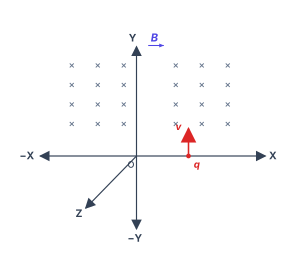
A particle having charge +q+q enters a uniform magnetic field B⃗\vec{B} as shown in the figure. The particle will describe: (A) a circular path in the XZ plane (B) a semicircular path in the XY plane (C) a helical path with its axis parallel to the Y-axis (D) a semicircular path in the YZ plane Figure — 55/4/1 Q3
[1]
Q4.
A bar magnet is initially at right angles to a uniform magnetic field. The magnet is rotated till the torque acting on it becomes one-half of its initial value. The angle through which the bar magnet is rotated is: (A) 30∘30^\circ (B) 45∘45^\circ (C) 60∘60^\circ (D) 75∘75^\circ
[1]
Q5.
Which one out of the following materials is not paramagnetic? (A) Aluminium (B) Sodium Chloride (C) Calcium (D) Copper Chloride
[1]
Q6.
An ammeter connected in series in an ac circuit reads 10 A. The maximum value of current at any instant in the circuit is: (A) 10210\sqrt{2} A (B) 102\frac{10}{\sqrt{2}} A (C) 10π\frac{10}{\pi} A (D) 102 π\frac{10}{\sqrt{2}\,\pi} A
[1]
Page 1 of 7
Q7.
The amplitude of the electric field in an electromagnetic wave in free space is 1000 Vm⁻¹. The amplitude of the magnetic field in this electromagnetic wave is: (A) 3.0 × 10⁻³ T (B) 3.33 × 10⁻⁸ T (C) 3.0 × 10¹¹ T (D) 3.33 × 10⁻⁶ T
[1]
Q8.
The magnification produced by a spherical mirror is -2.0. The mirror used and the nature of the image formed will be: (A) Convex and virtual (B) Concave and real (C) Concave and virtual (D) Convex and real
[1]
Q9.
Choose the correct statement: (A) Photons of light show diffraction whereas electrons do not show diffraction. (B) Electrons have momentum whereas photons do not have momentum. (C) Photons of light and electrons both exhibit dual nature. (D) All electromagnetic radiations do not have photons.
[1]
Q10.
A beam of red light and a beam of blue light have equal intensities. Which of the following statements is true? (A) The blue beam has more number of photons than the red beam. (B) The red beam has more number of photons than the blue beam. (C) Wavelength of red light is lesser than the wavelength of blue light. (D) The blue light beam has lesser energy per photon than that in the red light beam.
[1]
Q11.
Which of the following is an electrical conductor at room temperature? (A) Sn (B) Mica (C) Si (D) C
[1]
Q12.
A long straight wire is held vertically and carries a steady current in the upward direction. The shape of the magnetic field lines produced by the current-carrying wire are: (A) horizontal straight lines directed radially out from the wire. (B) straight lines parallel to the current-carrying wire. (C) concentric horizontal circles around the wire. (D) coaxial helixes around the wire.
[1]
Q13.
Assertion (A): An n-type semiconductor is not negatively charged. Reason (R): A neutral pentavalent impurity atom doped in an intrinsic (neutral) semiconductor donates its fifth unpaired electron to the crystal lattice and becomes a positive donor. (A) Both Assertion (A) and Reason (R) are true and Reason (R) is the correct explanation of the Assertion (A). (B) Both Assertion (A) and Reason (R) are true, but Reason (R) is not the correct explanation of the Assertion (A). (C) Assertion (A) is true, but Reason (R) is false. (D) Both Assertion (A) and Reason (R) are false.
[1]
Q14.
Assertion (A): A series LCR circuit behaves as a pure resistive circuit at resonance. Reason (R): At resonance, XL = XC, which gives ω = frac1√(LC). (A) Both Assertion (A) and Reason (R) are true and Reason (R) is the correct explanation of the Assertion (A). (B) Both Assertion (A) and Reason (R) are true, but Reason (R) is not the correct explanation of the Assertion (A). (C) Assertion (A) is true, but Reason (R) is false. (D) Both Assertion (A) and Reason (R) are false.
[1]
Page 2 of 7
Q15.
Assertion (A): In a double slit experiment, if one slit is closed, the diffraction pattern due to the other slit will appear on the screen. Reason (R): For interference, at least two waves are required. (A) Both Assertion (A) and Reason (R) are true and Reason (R) is the correct explanation of the Assertion (A). (B) Both Assertion (A) and Reason (R) are true, but Reason (R) is not the correct explanation of the Assertion (A). (C) Assertion (A) is true, but Reason (R) is false. (D) Both Assertion (A) and Reason (R) are false.
[1]
Q16.
Assertion (A): For monochromatic incident radiation, the photoelectrons emitted from a given metal have speeds ranging from zero to a certain maximum value. Reason (R): Each metal has a definite work function. (A) Both Assertion (A) and Reason (R) are true and Reason (R) is the correct explanation of the Assertion (A). (B) Both Assertion (A) and Reason (R) are true, but Reason (R) is not the correct explanation of the Assertion (A). (C) Assertion (A) is true, but Reason (R) is false. (D) Both Assertion (A) and Reason (R) are false.
[1]
Section B

Very short answer · 2 marks each · 5 of 5 shown

Q1.
(a) In the given figure, three identical bulbs P, Q and S are connected to a battery. (i) Compare the brightness of bulbs P and Q with that of bulb S when key K is closed. (ii) Compare the brightness of bulbs S and Q when the key K is opened. Justify your answer in both cases. OR (b) Two cells of emf 10 V each, two resistors of 20 Ω and 10 Ω, and a bulb B of 10 Ω resistance are connected together as shown in the figure. Find the current that flows through the bulb.
[2]
Q2.
Find the angle of diffraction (in degrees) for the first secondary maximum of the pattern due to diffraction at a single slit. The width of the slit and wavelength of light used are 0.55 mm and 550 nm, respectively.
[2]
Q3.
An equiconvex lens is made of glass of refractive index 1.55. If the focal length of the lens is 15.0 cm, calculate the radius of curvature of its surfaces.
[2]
Q4.
Calculate the mass of an α-particle in atomic mass unit (u). Given: Mass of a normal helium atom = 4.002603 u; Mass of carbon atom = 1.9926 × 10⁻²⁶ kg.
[2]
Page 3 of 7
Q5.
The intrinsic carrier concentration of a semiconductor is 5 × 10⁸ m⁻³. On doping with impurity atoms, the hole concentration becomes 8 × 10¹² m⁻³. (a) Identify (i) the type of dopant and (ii) the extrinsic semiconductor so formed. (b) Calculate the electron concentration in the extrinsic semiconductor.
[2]
Section C

Short answer · 3 marks each · 7 of 7 shown

Q1.
(a)(i) Derive an expression for the resistivity of a conductor in terms of the number density of free electrons and the relaxation time. (ii) The figure shows the plot of current through a cross-section of a wire over two different time intervals. Compare the charges (Q₁ and Q₂) that pass through the cross-section during these time intervals. OR (b)(i) A battery of emf E and internal resistance r is connected to a variable external resistance R. (I) Obtain the expression for the current I in the circuit and the value of the maximum current the battery can supply. (II) Obtain the terminal voltage V across the battery and its maximum possible value. (ii) The above battery sends a current I₁ when R = R₁ and a current I₂ when R = R₂. Obtain the internal resistance of the battery in terms of I₁, I₂, R₁ and R₂.
[3]
Q2.
(a) Write the vector form of the Biot-Savart law. (b) Two insulated long straight wires, each carrying 2.0 A current, are kept along the xx' and yy' axes as shown in the figure. Find the magnitude and direction of the resultant magnetic field at point P (4m, 5m).
[3]
Q3.
Predict the direction of the induced current in coil 1 in the following situations, justifying your answers: (a) Coil 2 is moved towards coil 1. (b) Coil 2 is moved away from coil 1. (c) The resistance connected in coil 2 is increased, keeping both coils stationary.
[3]
Q4.
(a) State any three characteristics of electromagnetic waves. (b) Briefly explain how and where the displacement current exists during the charging of a capacitor.
[3]
Page 4 of 7
Q5.
A double slit set-up was initially placed in a tank filled with water and the interference pattern was obtained using a laser light. When water is replaced by a transparent liquid of refractive index n > nwater, what will be the effect on the following? (a) Speed, frequency and wavelength of the laser beam light. (b) The fringe width, shape of the interference fringes and shift in the position of the central maximum.
[3]
Q6.
Explain the following observations using Einstein's photoelectric equation: (a) Photoelectric emission does not occur from a surface when the frequency of the light incident on it is less than a certain minimum value. (b) It is the frequency, and not the intensity, of the incident light which affects the maximum kinetic energy of the photoelectrons. (c) The cut-off voltage (V₀) versus frequency (nu) of the incident light curve is a straight line with a slope (h)/(e).
[3]
Q7.
(a) What are the majority and minority charge carriers of p-type and n-type semiconductors? (b) Explain briefly the formation of diffusion current and drift current in a p-n junction diode.
[3]
Section D

Case-based · 4 marks each · 2 of 2 shown

Q1.
A parallel plate capacitor consists of two conducting plates kept parallel to each other at a distance. When the capacitor is charged, the charge resides on the inner surfaces of the plates and an electric field is set up between them, storing electrostatic energy. Three identical conducting plates P₁, P₂ and P₃, each of area L², are held parallel and equidistant (separation d) from each other. The space between P₁ and P₂ and between P₂ and P₃ is completely filled with mica sheets of dielectric constant K. Plate P₂ is connected to point A and the other plates P₁ and P₃ are connected to point B. Point A is at a positive potential with respect to B, and the potential difference between A and B is V. (i) The capacitance of the system between A and B will be: (ii) The charge on plate P₁ is: (iii) The electric field in the region between P₁ and P₂ is: (iv)(a) The separation between the plates of the same area (L²) of a parallel plate air capacitor having capacitance equal to that of this system will be: OR (iv)(b) If the source of potential difference applied between A and B is removed, and then A and B are connected by a conducting wire, the net charge on the system will be:
[4]
Page 5 of 7
Q2.
A hydrogen atom consists of an electron revolving in a circular orbit of radius r with a certain velocity v around a proton located at the nucleus. The electrostatic force of attraction between the revolving electron and the proton provides the requisite centripetal force to keep it in certain stable orbits. The angular momentum of the electron in these orbits is some integral multiple of (h)/(2π). When an electron makes a transition from one orbit of higher energy to that of lower energy, a photon is emitted having energy equal to the difference between the energies of the initial and final states. Assuming the mass and charge of the electron as m and -e respectively, answer the following questions. (Take K = (1)/(4πvarepsilon₀).) (i) The expression for the speed of the electron v in terms of the radius of the orbit (r) and the physical constant K is: (ii) The total energy of the atom in terms of r and the physical constant K is: (iii) A photon of wavelength 500 nm is emitted when an electron makes a transition from one state to another state in an atom. The change in the total energy of the electron and the change in its kinetic energy (in eV) are: (A) 2.48,-2.48 (B) 1.24,1.24 (C) -2.48,2.48 (D) 1.24,-1.24 (iv)(a) The frequency of revolution of the electron in its nth orbit is proportional to: (A) n (B) (1)/(n) (C) (1)/(n²) (D) (1)/(n³) OR (iv)(b) An electron makes a transition from the -3.4 eV state to the ground state in a hydrogen atom. Its radius of orbit changes by: (radius of orbit of electron in the ground state = 0.53 Å) (A) 0.53 Å (B) 1.06 Å (C) 1.59 Å (D) 2.12 Å
[4]
Section E

Long answer · 5 marks each · 3 of 3 shown

Q1.
(a)(i) Two point charges +q and -q are held at (a, 0) and (-a, 0) in the x-y plane. Obtain an expression for the net electric field due to the charges at a point (0, y). Hence, find the electric field at a far-off point (y gg a). (ii) Three point charges of -2 nC, -1 nC and +5 nC are kept at the vertices A, B and C of an equilateral triangle of side 0.2 m. Find the total amount of work done in shifting the charges from A to A₁, B to B₁ and C to C₁. Here A₁, B₁ and C₁ are the midpoints of sides AB, BC and CA, respectively. OR (b)(i) State Gauss's law. Using it, derive an expression for the electric field due to a uniformly charged thin spherical shell of radius r at a point at a distance y from the centre of the shell such that (I) y > r, and (II) y < r. (ii) A point charge of +2 nC is kept at the origin of a three-dimensional coordinate system. Find the type and magnitude of the charge which should be kept at (0, 0, -6m) so that the potential due to the system becomes zero at (0, 0, 2m).
[5]
Q2.
(a)(i) State Lenz's law. How is this law a consequence of the principle of conservation of energy? (ii) A square shaped loop of side l/2 is initially lying outside a region of uniform magnetic field vecB as shown in the figure. The loop is moved towards the right with a constant velocity v till it goes out of the region of the magnetic field. (I) What will be the directions of the induced current when the loop enters the field and when it leaves the field? (II) Draw the plots showing the variation of magnetic flux φ linked with the loop with time t and the variation of induced emf E with time t. Mark the relevant values of E, φ and t on the graphs. OR (b)(i) Differentiate between the peak and rms values of alternating current. How are they related? (ii) A current element X is connected across an ac source of emf V = V₀ sin 2πnu t. It is found that the voltage leads the current in phase by (π)/(2) radian. If element X was replaced by element Y, the voltage lags behind the current in phase by (π)/(2) radian. (I) Identify elements X and Y by drawing phasor diagrams. (II) Obtain the condition of resonance when both elements X and Y are connected in series to the source, and obtain the expression for the resonant frequency. What is the impedance value in this case?
[5]
Page 6 of 7
Q3.
(a)(i) An object is placed 30 cm from a thin convex lens of focal length 10 cm. The lens forms a sharp image on a screen. If a thin concave lens is placed in contact with the convex lens, the sharp image on the screen is formed when the screen is moved by 45 cm from its initial position. Calculate the focal length of the concave lens. (ii) Calculate the angle of minimum deviation of an equilateral prism whose refractive index is √(3). Calculate the angle of incidence for this case of minimum deviation also. OR (b)(i) A physics teacher wants to demonstrate interference with the help of a double slit experiment using a laser beam of 633 nm wavelength. Since the hall is large enough, the interference pattern is formed on the wall 5.0 m from the slits. For a clear and comfortable view by all the students they want the fringe width 5 mm. (I) Find the slit separation for obtaining the desired interference pattern. (II) How far will the first minimum be from the central maximum? (ii) A parallel beam of light of wavelength 650 nm passes through a slit of width 0.6 mm. The diffraction pattern is obtained on a screen kept 60 cm away from the slit. Find the distance between the first order minima on both sides of the central maximum.
[5]
Page 7 of 7