Q.Explain Sliding Filament Theory of Muscle Contraction with neat sketch. OR Describe events in Cardiac Cycle. Explain double circulation.
You're viewing a preview — the full solution, concept, methods & PYQ mapping are locked.
Start your 14-day free trial to unlock the full solution →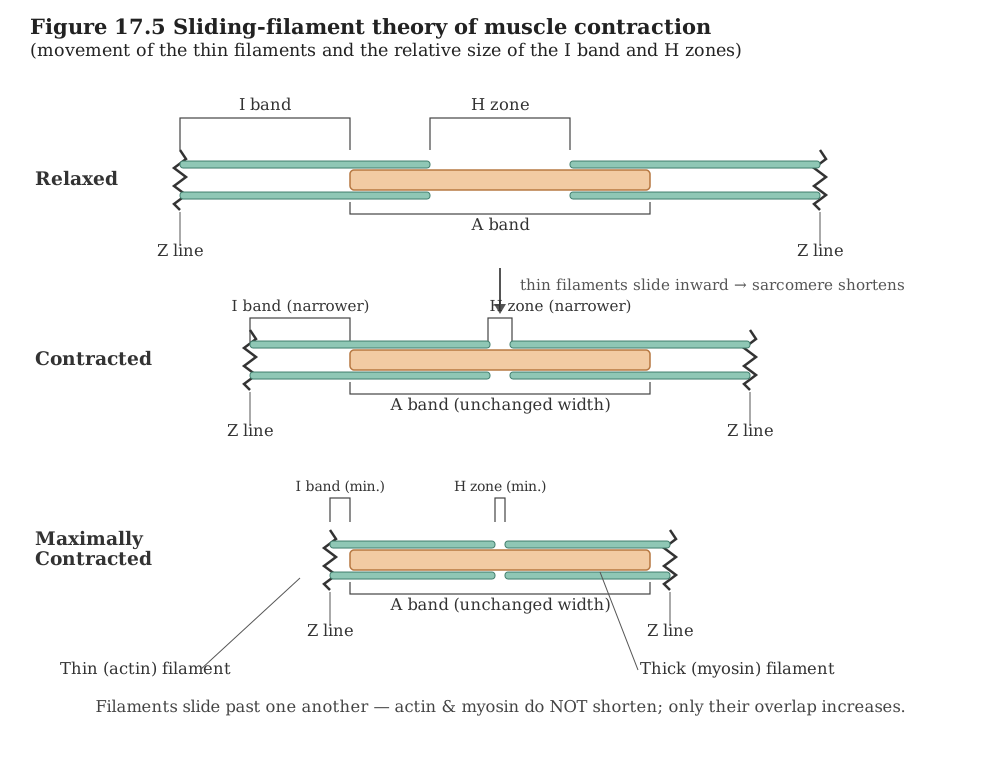
Muscle contraction happens because the actin and myosin filaments of the sarcomere slide over one another (they don't shorten themselves), pulled together by repeated myosin cross-bridge cycling powered by ATP, under the control of calcium ions.
(Answering the primary part of this question — the sliding filament theory of muscle contraction — as instructed by the solve contract.)
A skeletal muscle fibre is made of many myofibrils, each divided into repeating units called sarcomeres, bounded by Z-lines. Each sarcomere contains overlapping thin filaments (actin, anchored to the Z-lines) and thick filaments (myosin, positioned centrally, forming the A-band).
Steps of contraction:
- A nerve impulse arriving at the neuromuscular junction triggers release of acetylcholine, generating an action potential in the sarcolemma that spreads via T-tubules into the muscle fibre.
- This causes release of Ca²⁺ ions from the sarcoplasmic reticulum into the sarcoplasm.
- Ca²⁺ binds to troponin, causing a conformational shift in the troponin-tropomyosin complex that exposes the myosin-binding sites on the actin filament (normally blocked by tropomyosin at rest).
- The myosin head, energised by hydrolysing ATP into ADP + Pi, binds to the exposed site on actin, forming a cross-bridge.
- The myosin head then bends, pulling the actin filament inward toward the centre of the sarcomere (the power stroke) — this is the actual sliding step.
- A new ATP molecule binds to the myosin head, causing it to detach from actin; ATP hydrolysis then 're-cocks' the head, ready to bind further along the actin filament and repeat the cycle.
- As many such cross-bridge cycles occur simultaneously along the sarcomere, the actin filaments are progressively pulled further into the region between the myosin filaments. …
Unlock everything free for 14 days
- Full step-by-step solutions
- Concept-first explanations
- Methods, shortcuts & mistakes
- PYQ mapping + timed mock tests
Full access for 14 days. No credit card required.