Skip to content
← Chemistry

Chemistry · Class 11 Science

Haryana Bseh Class 11 Chemistry — Real Previous-Year Papers

with complete answers

Real previous-year board papers, year by year — the official exam pattern, the full question paper, and every question solved the concept-first way. Distinct from the chapter-wise textbook bank.

2017–2026
Years of papers
10
Total Papers
10
Real Board Papers
0
Sample papers
361
Real-paper Q & A
0
Sample-paper Q & A

Real board-paper questions available, by year

35 Q2026complete
35 Q2025complete
35 Q2024complete
35 Q2023complete
47 Q2022complete
48 Q2021complete
34 Q2020complete
34 Q2019complete
29 Q2018complete
29 Q2017complete

Board of School Education Haryana (Senior Secondary Part-I / Class 11) 2026 · Set ANNUAL

Real board examination

About this paper

The real Class-12 board examination held in 2026. Every question below is solved the concept-first way. Sample papers are labelled honestly — never shown as a past exam.

Total marks
70
Questions
35
Duration
180 min
Sections
5

The marks / questions / duration above are the official exam pattern. We currently have 35 of this paper’s questions (100% of the full paper), with 35 fully solved. Questions we couldn’t yet extract or verify are held — never shown as complete.

Sections & marks

SectionTypeQuestionsMarks eachTotal
ASection Acompulsory18118
BSection Bcompulsory7214
CSection Ccompulsory5315
DSection Dcompulsory248
ESection Ecompulsory3515
Total3570

The question paper

The questions we hold for this paper, laid out by section. Solutions are on the Answers tab.

Board Examination

Chemistry

Board of School Education Haryana (Senior Secondary Part-I / Class 11) 2026 · Set ANNUAL

Series/Set: ANNUALRoll No. ________
Time Allowed: 3 hoursMaximum Marks: 70

General Instructions

  1. This question paper contains 35 questions divided into 5 sections — A, B, C, D, E.
  2. Section A comprises 18 questions of 1 mark each (compulsory).
  3. Section B comprises 7 questions of 2 marks each (compulsory).
  4. Section C comprises 5 questions of 3 marks each (compulsory).
  5. Section D comprises 2 questions of 4 marks each (compulsory).
  6. Section E comprises 3 questions of 5 marks each (compulsory).

Above is the official exam pattern. The questions printed below are those we currently hold for this paper.

Section A

compulsory · 1 mark each · 18 of 18 shown

Q1.
The empirical formula of a compound is CH2. Molar mass of compound is 42 gram. Its molecular formula is:
  • (a) C3H6
  • (b) C3H8
  • (c) CH2
  • (d) C2H2
[1]
Q2.
For the reaction, x + 2y → z, 5 moles of x and 9 moles of y will produce:
  • (a) 5 moles z
  • (b) 9 moles z
  • (c) 14 moles z
  • (d) 4.5 moles z
[1]
Q3.
Which of the following option is correctly matched? Column I (Type of Series) vs Column II (Wave length range):
  • (a) Lymen – Ultraviolet
  • (b) Paschen – Visible
  • (c) Balmer – Near infrared
  • (d) Pfund – Far infrared
[1]
Q4.
Which of the following is the correct order of size of the given species? I, I⁻, I⁺
  • (a) I > I⁻ > I⁺
  • (b) I⁺ > I⁻ > I
  • (c) I > I⁺ > I⁻
  • (d) I⁻ > I > I⁺
[1]
Q5.
Which of the following is not true for hybridisation?
  • (a) The orbitals present in the valence shell of the atom are hybridised.
  • (b) The orbital undergoing hybridisation should have almost equal energy.
  • (c) Promotion of electron is essential condition prior to hybridisation.
  • (d) It is not necessary that only half filled orbitals participate in hybridisation. In some case, filled and even empty orbitals of valence shell take part in hybridisation.
[1]
Q6.
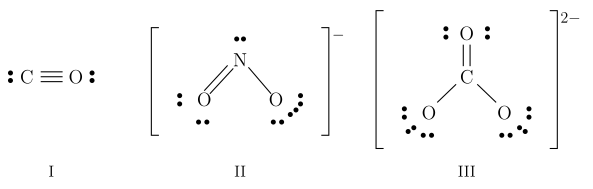
Lewis dot structure of CO, NO2⁻ and CO3²⁻ are I, II and III respectively (see figure). Which of the above structure(s) is/are wrong?
  • (a) Only I
  • (b) Only II
  • (c) Only III
  • (d) None of these Haryana BSEH Class 11 Chemistry, Chemical Bonding: Lewis dot structures labelled I, II and III — I is carbon monoxide (C≡O triple bond with one lone pair on each atom), II is the nitrite ion NO2⁻ (bent, one N=O double bond, one N–O single bond, lone pair on N) and III is the carbonate ion CO3²⁻ (one C=O double bond and two C–O single bonds), each shown with the overall ionic charge.
[1]
Page 1 of 6
Q7.
Which of the following is not extensive properties? (a) Mass (b) Volume (c) Enthalpy (d) Density
[1]
Q8.
Which of the following reactions has a value of ΔS° greater than zero? (a) N2(g) + 3H2(g) ⇌ 2NH3(g) (b) CuSO4(aq) ⇌ CuSO4(s) (c) NaCl(s) ⇌ Na⁺(aq) + Cl⁻(aq) (d) CaO(s) + CO2(g) ⇌ CaCO3(s)
[1]
Q9.
Which of the following is not a general characteristics of equilibria involving physical processes? (a) Equilibrium is possible only in a closed system at a given temperature. (b) All measurable properties of the system remain constant. (c) All the physical processes stop at equilibrium. (d) The opposing processes occur at the same rate and there is dynamic but stable condition.
[1]
Q10.
BF3 is a ................. acid.
[1]
Q11.
Bohr's model failed to explain the spectrum of atoms other than .................
[1]
Q12.
Oxidation number of chlorine (Cl) in ClO3⁻ is .................
[1]
Q13.
Write ethane, ethene and ethyne in order of decreasing electronegativity of carbon in them.
[1]
Q14.
Write IUPAC name of the following compound:
[1]
Q15.
Write chemical equation for the preparation of butane by Wurtz reaction.
[1]
Q16.
Assertion (A): In the Lassaigne's test for nitrogen in an organic compound, Prussian blue colour is obtained. Reason (R): Prussian blue colour is due to the formation of [Fe(SCN)]²⁺ during the test. (a) Both Assertion (A) and Reason (R) are true and Reason (R) is the correct explanation of Assertion (A). (b) Both Assertion (A) and Reason (R) are true, but Reason (R) is not the correct explanation of Assertion (A). (c) Assertion (A) is true, but Reason (R) is false. (d) Assertion (A) is false, but Reason (R) is true.
[1]
Page 2 of 6
Q17.
Assertion (A): It is not possible to separate Staggered conformation from Eclipsed conformation. Reason (R): The energy difference between the two extreme forms is very small. (a) Both Assertion (A) and Reason (R) are true and Reason (R) is the correct explanation of Assertion (A). (b) Both Assertion (A) and Reason (R) are true, but Reason (R) is not the correct explanation of Assertion (A). (c) Assertion (A) is true, but Reason (R) is false. (d) Assertion (A) is false, but Reason (R) is true.
[1]
Q18.
Assertion (A): Boiling point of alkanes decreases with increase in molecular mass. Reason (R): Intermolecular Vander Waals forces increase with increase in molecular size or surface area of the molecules. (a) Both Assertion (A) and Reason (R) are true and Reason (R) is the correct explanation of Assertion (A). (b) Both Assertion (A) and Reason (R) are true, but Reason (R) is not the correct explanation of Assertion (A). (c) Assertion (A) is true, but Reason (R) is false. (d) Assertion (A) is false, but Reason (R) is true.
[1]
Section B

compulsory · 2 marks each · 7 of 7 shown

Q1.
Express the result of following calculation to the appropriate number of significant figures: 4.27 × 0.07883 / 6.005 **OR** Calculate the number of atoms in each of the following: (a) 52 µHe (b) 52 g He
[2]
Q2.
(i) State the principle that suggests the presence of only two electrons in an orbital. [1] (ii) Give reasons why chromium has electronic configuration 3d⁵ 4s¹ and not 3d⁴ 4s². [1]
[2]
Q3.
Consider the following species: N³⁻, O²⁻, Na⁺, Mg²⁺ Al³⁺. (a) What is common in them? [1] (b) Arrange them in the increasing order of their ionic radii. [1]
[2]
Q4.
For the equilibrium 2NOCl(g) ⇌ 2NO(g) + Cl2(g), the value of Kc is 3.75 × 10⁻⁶ at 1069 K. Calculate the value of Kp. **OR** (a) State Le Chatelier Principle. (b) What will be the effect of temperature change on the equilibrium constant of the following reaction? N2(g) + 3H2(g) ⇌ 2NH3(g), ΔH = ‒92.38 KJ mol⁻¹
[2]
Q5.
Balance the following redox reaction by ion electron method (acidic medium): H2O2(aq) + Fe²⁺(aq) → Fe³⁺(aq) + H2O(l)
[2]
Page 3 of 6
Q6.
What is Heterolytic cleavage? Name the species formed during this process. **OR** What is metamerism? Write one example.
[2]
Q7.
An alkene 'A' on ozonolysis gives a mixture of propanal and pentan-3-one. Write structure and IUPAC name of 'A'.
[2]
Section C

compulsory · 3 marks each · 5 of 5 shown

Q1.
(i) State and explain Avogadro law. [2] (ii) Calculate the atomic mass (average) of chlorine using the following data: 35Cl — % Natural Abundance 75.77, Molar mass 34.9689; 37Cl — % Natural Abundance 24.23, Molar mass 36.9659. [1]
[3]
Q2.
Among the second period elements, the actual ionization enthalpies are in the order: Li < B < Be < C < O < N < F < Ne. Explain, why: (i) Be has higher ionization enthalpy than B? [1.5] (ii) O has lower ionization enthalpy than N? [1.5] **OR** What is the basic difference between electron gain enthalpy and electronegativity? Electronegativity of F is more than that of Cl, but electron gain enthalpy of F is less than that of Cl. Explain.
[3]
Q3.
(i) Use molecular orbital theory to explain why Be2 molecule does not exist? [1] (ii) Which out of NH3 and NF3 has higher dipole moment and why? [2] **OR** Define Octet rule and write its limitations.
[3]
Q4.
What is meant by the conjugate acid-base pair? Find the conjugate acid/base for the following species: HNO3, CN⁻, HClO4 and CO3²⁻ [1+2]
[3]
Page 4 of 6
Q5.
In a special type of redox reaction an element in one oxidation state is simultaneously oxidised and reduced. (i) Identify the type of this reaction. [1] (ii) Explain the essential conditions for such a reaction to occur, with a suitable example. [2]
[3]
Section D

compulsory · 4 marks each · 2 of 2 shown

Q1.
Case: The characteristics of an orbital are expressed in terms of three numbers called Principal quantum number (n), azimuthal quantum number (l), magnetic quantum number (Ml). These numbers are obtained from the solutions of the Schrodinger wave equation. Further, to represent the spin (rotation) of the electron about its own axis, a fourth quantum number, called spin quantum number has been introduced. Thus, a set of four quantum numbers which gives us complete information i.e. location, energy, the type of orbital occupied, shape and orientation of that orbital etc. about all the electrons present in an atom is called quantum numbers. Questions: (i) How many orbitals are associated with principal quantum number (n = 4)? [1] (ii) Using s, p, d notations, describe the orbitals with the following quantum numbers: (a) n = 2, l = 0 (b) n = 4, l = 3 [1] (iii) Explain Hund's rule of maximum multiplicity. [2] **OR** What is Aufbau rule? Why is 4s orbital filled before 3d?
[4]
Q2.
Case: In order to explain the characteristic geometrical shape of polyatomic molecules like CH4, NH3, H2O etc. Pauling introduced the concept of hybridisation. According to him the atomic orbitals combine to form new set of equivalent orbitals known as hybrid orbitals. Unlike pure orbitals, the hybrid orbitals are used in bond formation. The phenomenon is known as hybridisation which can be defined as the process of intermixing of atomic orbitals of slightly different energies so as to redistribute their energies, resulting in the formation of new set of orbitals of equivalent energies and shape. For example one 2s and three 2p orbitals of carbon hybridise, there is the formation of four new sp3 orbitals. Questions: (i) Which hybrid orbital are used by carbon atoms (1, 2 and 3) in the following molecule? CH3–CH2–COOH (atoms numbered 1, 2, 3 left to right over CH3, CH2, COOH respectively) [1] (ii) Is there any change in hybridisation of B and N as a result of the following reaction? BF3 + NH3 → F3B.NH3 [1] (iii) In PCl5 molecule, why are the axial bonds longer than equatorial bonds? [2] **OR** Although geometries of NH3 and H2O molecules are distorted tetrahedral, bond angle in water is less than that of ammonia. Discuss.
[4]
Section E

compulsory · 5 marks each · 3 of 3 shown

Q1.
(i) State and explain Hess's law. [2] (ii) For the reaction at 298 K, 2A + B → C, ΔH = 400 KJ mol⁻¹ and ΔS = 0.2 KJ K⁻¹ mol⁻¹. Considering ΔH and ΔS to be constant over the temperature range, at what temperature will the reaction become spontaneous? [2] (iii) For an isolated system, ΔU = 0, what will be ΔS? [1] **OR** (i) Explain the following terms: (a) Closed system (b) Intensive properties (c) Enthalpy of atomization [3] (ii) State and explain the first law of thermodynamics. [2]
[5]
Page 5 of 6
Q2.
What is electromeric effect? Explain its types with suitable examples. **OR** (i) Write the resonance structures of aniline and show the movement of electrons by curved arrow. [2] (ii) 0.3780 g of an organic chloro compound gave 0.5740 g of silver chloride in Carius estimation. Calculate the percentage of chlorine present in the compound. [2] (iii) Write the structural formula of the following: 2-bromo-4-ethyl-6-methylaniline [1]
[5]
Q3.
(i) How will you convert benzene into: (a) p-nitrotoluene (b) m-nitrotoluene [2] (ii) Complete the following reactions: (a) CH3–CH2–CH=CH2 + HBr —(Benzoyl Peroxide)→ ? (b) CH3–C≡CH + H2O —(Hg²⁺/H⁺, 33 K)→ ? [2] (iii) What is Huckel Rule? [1] **OR** (i) What happens when 1,2-dibromopropane is treated with alcoholic KOH followed by reaction with Sodamide (NaNH2)? [2] (ii) Explain the directive influence of nitro group in benzene. Why is nitro group known as deactivating group? [3]
[5]
Page 6 of 6