Skip to content
← Physics

Physics · Class 11 Science

Haryana Bseh Class 11 Physics — Real Previous-Year Papers

with complete answers

Real previous-year board papers, year by year — the official exam pattern, the full question paper, and every question solved the concept-first way. Distinct from the chapter-wise textbook bank.

2018–2026
Years of papers
9
Total Papers
9
Real Board Papers
0
Sample papers
340
Real-paper Q & A
0
Sample-paper Q & A

Real board-paper questions available, by year

41 Q2026complete
35 Q2025complete
39 Q2024complete
34 Q2023complete
47 Q2022complete
47 Q2021complete
34 Q2020complete
34 Q2019complete
29 Q2018complete

Board of School Education Haryana (Senior Secondary Part-I / Class 11) 2026 · Set ANNUAL

Real board examination

About this paper

The real Class-12 board examination held in 2026. Every question below is solved the concept-first way. Sample papers are labelled honestly — never shown as a past exam.

Total marks
70
Questions
35
Duration
180 min
Sections
5

The marks / questions / duration above are the official exam pattern. We currently have 41 of this paper’s questions (117% of the full paper), with 41 fully solved. Questions we couldn’t yet extract or verify are held — never shown as complete.

Sections & marks

SectionTypeQuestionsMarks eachTotal
ASection Acompulsory18118
BSection Bcompulsory7214
CSection Ccompulsory5315
DSection Dcompulsory3515
ESection Ecompulsory248
Total3570

The question paper

The questions we hold for this paper, laid out by section. Solutions are on the Answers tab.

Board Examination

Physics

Board of School Education Haryana (Senior Secondary Part-I / Class 11) 2026 · Set ANNUAL

Series/Set: ANNUALRoll No. ________
Time Allowed: 3 hoursMaximum Marks: 70

General Instructions

  1. This question paper contains 35 questions divided into 5 sections — A, B, C, D, E.
  2. Section A comprises 18 questions of 1 mark each (compulsory).
  3. Section B comprises 7 questions of 2 marks each (compulsory).
  4. Section C comprises 5 questions of 3 marks each (compulsory).
  5. Section D comprises 3 questions of 5 marks each (compulsory).
  6. Section E comprises 2 questions of 4 marks each (compulsory).

Above is the official exam pattern. The questions printed below are those we currently hold for this paper.

Section A

compulsory · 1 mark each · 26 of 18 shown

Q1.
In SI system:
  • (a) All derived units are obtained by multiplying (or) dividing the fundamental units.
  • (b) All derived units are obtained by adding the fundamental units.
  • (c) All derived units are obtained by subtracting the fundamental units.
  • (d) Depends on the physical quantity.
[1]
Q2.
The pair of physical quantities not having same dimension is:
  • (a) Torque and Energy
  • (b) Surface Tension and Impulse
  • (c) Angular momentum and Planck's constant
  • (d) None of the above
[1]
Q3.
When the momentum of body is increased by three times, its K.E. becomes:
  • (a) Twice
  • (b) Half
  • (c) Four times
  • (d) Nine times
[1]
Q4.
Swimming is possible on account of:
  • (a) First Law of Motion
  • (b) Second Law of Motion
  • (c) Third Law of Motion
  • (d) Newton's Law of Gravitation
[1]
Q5.
There are two objects of masses 1 kg and 2 kg located at (1, 2) and (-1, 3) respectively. The coordinates of the centre of mass are:
  • (a) (2, -1)
  • (b) (8/3, -1/3)
  • (c) (-1/3, 8/3)
  • (d) None of the above
[1]
Q6.
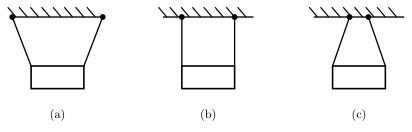
A rectangular frame is to be suspended symmetrically by two strings of equal length on two supports as shown in Fig. It can be done in following three ways, the tension in the strings will be:
  • (a) The same in all cases
  • (b) Least in
  • (a)
  • (c) Least in
  • (b)
  • (d) Least in
  • (c) ![a frame suspended by two strings in three different configurations (a),
  • (b) and
  • (c) — Class 12 Physics question](/figures/laws-of-motion/frame-suspended-two-strings-three-ways-a-b-c-fig-pyq-olw4zx.svg)
[1]
Page 1 of 6
Q7.
The position of the body is given by x = A sin ωt. The time at which the displacement would be maximum is: (a) π/ω (b) π/2ω (c) πω (d) None of the above
[1]
Q8.
The volume of a given mass of a gas at 27°C, 1 atmospheric pressure is 100 cc, its volume at same pressure and at 327°C would be: (a) 200 cc (b) 20 cc (c) 2 cc (d) None of the above
[1]
Q9.
In an isothermal process, the internal energy of an ideal gas: (a) Decreases (b) Increases (c) Remains constant (d) First increases, then decreases
[1]
Q10.
A boy went to market from his home, the distance of market to his home is 5 km. He found that market was closed, then he returned to his home. Total displacement covered by boy is ............. .
[1]
Q11.
Moment of inertia of a uniform circular ring about a diameter of a ring is ............. .
[1]
Q12.
............. law states that stress is directly proportional to strain.
[1]
Q13.
What does the area under velocity-time graph represents?
[1]
Q14.
What is Young's Modulus of a rigid body?
[1]
Q15.
Write S. I. unit of Angular Momentum.
[1]
Q16.
Two statements are given below, one labelled Assertion (A) and the other labelled Reason (R). Select the correct answer from the codes below. Assertion (A): The motion of an object moving with uniform acceleration can be expressed by three equations: v = u + at, s = ut + (1/2)at², v² = u² + 2as Reason (R): These equations do not apply to non-uniform or variable acceleration. (a) Both (A) and (R) are true and (R) is the correct explanation of (A). (b) Both (A) and (R) are true, but (R) is not the correct explanation of (A). (c) (A) is true, but (R) is false. (d) (A) and (R) both are false.
[1]
Page 2 of 6
Q17.
Two statements are given below, one labelled Assertion (A) and the other labelled Reason (R). Select the correct answer from the codes below. Assertion (A): The speed of a whirl wind in a tornado is alarmingly high. Reason (R): If no external torque acts on a body, its angular velocity remains constant. (a) Both (A) and (R) are true and (R) is the correct explanation of (A). (b) Both (A) and (R) are true, but (R) is not the correct explanation of (A). (c) (A) is true, but (R) is false. (d) (A) and (R) both are false.
[1]
Q18.
Two statements are given below, one labelled Assertion (A) and the other labelled Reason (R). Select the correct answer from the codes below. Assertion (A): Work and heat are two equivalent form of energy. Reason (R): Work is the transfer of mechanical energy irrespective of temperature difference, whereas heat is the transfer of thermal energy because of temp. difference only. (a) Both (A) and (R) are true and (R) is the correct explanation of (A). (b) Both (A) and (R) are true, but (R) is not the correct explanation of (A). (c) (A) is true, but (R) is false. (d) (A) and (R) both are false.
[1]
Q19.
Case study: We have learnt that the earth attracts objects towards it. This is due to the gravitational force. Whenever objects fall towards the earth under this force alone, we say that the objects are in free fall. Is there any change in the velocity of falling objects? While falling, there is no change in the direction of motion of the objects. But due to earth's attraction, there will be a change in the magnitude of velocity. Any change in the velocity involves acceleration; whenever an object falls towards the earth, an acceleration is involved. Escape velocity of a body does not depend on: (a) Mass of body (b) Mass of Earth (c) Radius of Earth (d) Universal Gravitational Constant
[1]
Q20.
If distance between two bodies is doubled, what is the effect on gravitational force between two bodies: (a) become half (b) become one fourth (c) become double (d) become four times
[1]
Q21.
Correct relation between g and density (ρ) of earth is: (a) g = (3/4)Rρ (b) g = (4/3)πRρ (c) g = (4/3)πGRρ (d) g = (3/4)πGRρ
[1]
Q22.
What is the mass of an object, whose weight is 98 N on the earth? **OR** Define Universal Gravitational Constant (G).
[1]
Q23.
Case study: Friction is a resistive force that arises when there is relative motion between two surfaces, provided the two surfaces are irregular relative to each other. Frictional force always opposes motion, i.e. it always acts in the direction opposite to the motion. Rubbing two objects against each other causes wear and tear due to friction, and heat energy is also generated. A cyclist travels on a circular track of radius 100 metres. If the coefficient of friction is .2, what is the maximum speed with which the cyclist can safely take the turn? (g = 9.8 m/s²) (a) 14 m/s (b) 140 m/s (c) 1.4 m/s (d) 9.8 m/s
[1]
Q24.
Which of the following is the greatest? (a) Static friction (b) Kinetic friction (c) Rolling friction (d) Fluid friction
[1]
Q25.
By using ball bearings, sliding friction can be converted into ............. friction.
[1]
Page 3 of 6
Q26.
Define coefficient of friction. **OR** Define angle of friction.
[1]
Section B

compulsory · 2 marks each · 7 of 7 shown

Q1.
The centripetal force F acting on a particle moving in circular orbit depends on its mass m, radius of the circle r and speed of particle v. Obtain the formula for the centripetal force, using dimension method.
[2]
Q2.
A batsman hits back a ball straight in the direction of the bowler without changing its initial speed of 12 m/s. If the mass of ball is .15 kg, determine the impulse imparted to the ball (Assume Linear Motion of the ball). **OR** State the Law of Conservation of Linear Momentum. Explain it by giving any one example.
[2]
Q3.
Distinguish between Conservative and Non-conservative force. **OR** A lighter particle moving with a speed of 10 ms⁻¹ collides with an object of double its mass moving in the same direction with half its speed. Assume that collision is elastic, what will be the speed of both particles after the collision?
[2]
Q4.
Establish the relation between Torque and Moment of Inertia (in rotational motion, between torque and angular acceleration).
[2]
Q5.
Find the height from the earth's surface where g will be 25% of its value on the Surface of Earth. (Radius of Earth R = 6400 km)
[2]
Q6.
Calculate the work done when 2 moles of an ideal gas expands reversibly and isothermally from a volume of 500 ml to a volume of 2 litre at 25°C and normal pressure. (Given Log 4 = .6021)
[2]
Page 4 of 6
Q7.
Draw: (i) Velocity-time graph and (ii) Acceleration-time graph in simple harmonic motion.
[2]
Section C

compulsory · 3 marks each · 5 of 5 shown

Q1.
Establish Mayer's formula Cp – Cv = R from the first law of thermodynamics. **OR** State the Law of Equipartition of Energy. Prove that for an ideal gas γ = 1 + 2/F, where F is the number of degrees of freedom of gas molecules.
[3]
Q2.
Define Surface Tension of a liquid. Find an expression for the excess pressure inside a soap bubble. **OR** Establish relation between coefficient of linear expansion (α), coefficient of superficial expansion (β) and coefficient of volume expansion (γ) of a solid material.
[3]
Q3.
Calculate the amount of heat required to convert 1 kg of ice at –10°C to steam at 100°C at normal pressure. Given: Specific heat of ice = 2100 J/kg-K, Latent heat of fusion of ice = 3.36 × 10⁵ J/kg, Specific heat of water = 4200 J/kg-K, Latent heat of steam = 2.25 × 10⁶ J/kg.
[3]
Q4.
Explain work-energy theorem and prove it.
[3]
Q5.
State parallelogram law of vector addition and derive expression for resultant.
[3]
Page 5 of 6
Section D

compulsory · 5 marks each · 3 of 3 shown

Q1.
A cylindrical piece of cork of base area (A) and height h floats in a liquid of density ρ₁. The cork is depressed slightly and then released. Show that the cork oscillates up and down simple harmonically with a period T = 2π√(hρ/ρ₁g), where ρ is the density of cork. **OR** What is meant by stationary wave? Prove that in an open organ pipe, both odd and even harmonics are produced.
[5]
Q2.
State and prove Bernoulli's theorem. **OR** Derive expression for height of the liquid rise (h) in a capillary tube.
[5]
Q3.
A projectile is fired at an angle θ with the horizontal with velocity u. Obtain expression for: (i) Time of flight (ii) Maximum height attained. **OR** Define uniformly accelerated motion. A particle is moving with uniform acceleration a in a straight path. Its initial velocity is u, displacement s and final velocity (v). Using graph method, show that: s = ut + (1/2)at². (t → time)
[5]
Page 6 of 6