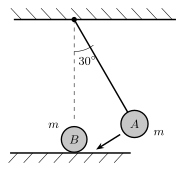
Q.The bob A of a pendulum released from 30° to the vertical hits another bob B of the same mass at rest on a table as shown in Fig. How high does the bob A rise after the collision? Neglect the size of the bobs and assume the collision to be elastic.
You're viewing a preview — the full solution, concept, methods & PYQ mapping are locked.
Start your 14-day free trial to unlock the full solution →Elastic collision + equal masses + target initially at rest ⇒ velocities are exchanged, so the striking bob (A) stops completely and rises to zero height.
For a head-on elastic collision between two bodies of equal mass , where the second body () is initially at rest, momentum and kinetic-energy conservation together give the standard result that the velocities are exchanged: body A (the one that was moving) ends up at rest, and body B moves off with A's original velocity.
Let A be released from to the vertical. By energy conservation on the way down (before the collision), A arrives at the bottom (table level) with some speed , having converted its initial gravitational PE fully into KE.
At the collision: since and it is elastic, the exchange-of-velocity result gives:
- A's velocity after collision
- B's velocity after collision (A's velocity just before collision) …
Unlock everything free for 14 days
- Full step-by-step solutions
- Concept-first explanations
- Methods, shortcuts & mistakes
- PYQ mapping + timed mock tests
Full access for 14 days. No credit card required.