Q.Derive an expression for the force between two parallel straight conductors carrying current in the same direction. Hence define one ampere. OR Explain the principle of a moving coil Galvanometer. How can it be converted into an ammeter ? Draw necessary diagram.
🔒You're viewing a preview — the full solution, concept, methods & PYQ mapping are locked.
🔒 Start your 14-day free trial to unlock the full solution →Concept understanding — Force Between Parallel Wires
Force Between Parallel Current-Carrying Wires
Imagine two long, straight wires placed side by side, each carrying an electric current. You already know that a current-carrying wire creates a magnetic field around it. And you know that a wire placed in a magnetic field experiences a magnetic force. So here, each wire sits inside the magnetic field created by the other wire. That is the whole story — each wire feels a force because of the other wire's magnetic field.
The direction of that force — attraction or repulsion — depends on whether the currents flow in the same direction or opposite directions.
The Intuition
Take two wires with currents in the same direction. Use the right-hand thumb rule: for wire 1, the magnetic field lines circle around it. At the location of wire 2, that field points in a particular direction. Now apply the right-hand rule for force on a current-carrying wire (Fleming's left-hand rule works too): the current in wire 2, crossed with the field from wire 1, gives a force toward wire 1. The same reasoning from wire 2's perspective gives a force on wire 1 toward wire 2. So they attract.
If the currents are opposite, the field directions reverse, and the forces point away from each other — they repel.
A quick memory aid: Same direction → Attract; Opposite direction → Repel. This is the opposite of what you might guess from electric charges, where like charges repel. Don't mix them up.
The Precise Statement
For two long, straight, parallel wires separated by a distance d, carrying steady currents I1 and I2, the magnitude of the force per unit length on either wire is:
LF=2πdμ0I1I2
where μ0=4π×10−7N/A2 is the permeability of free space.
The force is attractive if the currents are in the same direction, repulsive if they are opposite.
Where Does This Formula Come From?
Wire 1 produces a magnetic field at the location of wire 2. The magnitude of that field is:
B1=2πdμ0I1
This field is perpendicular to wire 2. The magnetic force on a length L of wire 2 carrying current I2 in a perpendicular field B1 is:
F=I2LB1
Substitute B1:
F=I2L⋅2πdμ0I1
Divide both sides by L to get force per unit length:
LF=2πdμ0I1I2
That is the entire derivation — two simple steps: field from one wire, then force on the other.
This formula assumes the wires are infinitely long (or at least very long compared to d) and thin. It gives the force per unit length, which is constant along the wires.
The Definition of the Ampere
This effect is so fundamental that it defines the SI unit of current. One ampere is defined as the constant current which, when flowing through two infinitely long, straight, parallel wires of negligible cross-section placed one metre apart in vacuum, produces a force of exactly 2×10⁻⁷ newtons per metre of length between them. …
The field created by one current-carrying wire exerts a force on the current in the other; working out this mutual force per unit length, and then setting both currents and their separation to standard reference values, is exactly how the ampere is defined. …
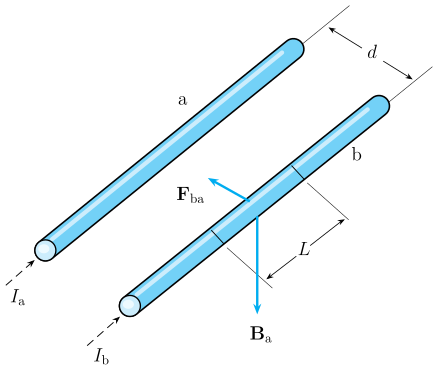
Each current-carrying wire creates a magnetic field that exerts a force on the other; for currents in the same direction the force is attractive, with magnitude μ₀I₁I₂/2πd per unit length — this defines the ampere.
Setup: Consider two long, straight, parallel conductors carrying currents I1 and I2 in the same direction, separated by a perpendicular distance d.
Derivation:
The magnetic field produced by wire 1 (carrying I1) at the location of wire 2, at distance d, is (from Ampere's circuital law):
B1=2πdμ0I1
This field is directed perpendicular to wire 2 (circling wire 1), and it exerts a force on wire 2 (carrying current I2). The force per unit length on wire 2 is
f=B1I2=2πdμ0I1I2
By the right-hand rule for the field direction combined with F=IL×B, when the currents flow in the same direction, the force is attractive; when they flow in opposite directions, the force is repulsive.
By Newton's third law, wire 1 experiences an equal and opposite force per unit length from wire 2's field, so the mutual force per unit length between the wires is
f=2πdμ0I1I2
Definition of one ampere: If I1=I2=1 A and d=1 m, then …
- CBSE 2026Set ANNUAL1 markMCQQ.Two long parallel wires each carrying a current of 1 A in the same direction, are placed 1 m apart. The force of attraction between them is(a) 2 x 10^7 N/m(b) 2 x 10^-4 N/m(c) 2 x 10^-7 N/m(d) 4 x 10^-7 N/m
›Reveal solutionSolution
Two parallel current-carrying wires attract if their currents are in the same direction; the force per unit length is mu_0I1I2/(2pid).
Each current-carrying wire produces a magnetic field around it, and this field exerts a force on the other current-carrying wire (F = I*L x B). The standard result for the force per unit length between two long straight parallel wires carrying currents I1 and I2, separated by a distance d, is
F/L = mu_0 * I1 * I2 / (2 * pi * d)
…
- CBSE 2026Set ANNUAL1 markMCQQ.Assertion (A): Two infinitely long straight conductors carrying current in the same direction attract each other. Reason (R): The net magnetic field at a point exactly halfway between two infinitely long straight conductors carrying current in the same direction is zero.(a) Both Assertion and Reason are true, and reason is the correct explanation(b) Both Assertion and Reason are true, but the Reason is not the correct explanation(c) Assertion is true, but Reason is false.(d) Assertion is false, but Reason is true.
›Reveal solutionSolution
Both statements are individually correct, but the field being zero at the midpoint is not why the two wires attract each other.
Checking the Assertion: Two infinitely long straight parallel conductors carrying current in the SAME direction do attract each other. Each wire sits in the magnetic field created by the other wire, and using F=IL×B (or the right-hand/Fleming's left-hand rule), the force on each wire due to the other's field points towards the other wire. So the Assertion is TRUE.
Checking the Reason: Take the two wires along the y-axis at x=−a and x=+a, both carrying current I in the +y direction. At the midpoint (origin), using B=2πrμ0Iϕ^ with ϕ^=I^×r^: the field due to the left wire points in +y^′s perpendicular direction (say +z^), while the field due to the right wire (displacement now in −x^ from that wire) points in the opposite transverse direction (−z^). Since both wires are equidistant and carry equal current, these two fields are equal in magnitude and opposite in direction — they cancel exactly. So the net field at the midpoint IS zero when the currents …
- CBSE 2025Set D1 markMCQQ.Dimensional formula of permeability is (A) [MLT^-2 A^-2] (B) [MLT^2 A^-2] (C) [MLT^2 A^2] (D) [MLT^-2 A]
›Reveal solutionSolution
Using the force per unit length between two wires, μ₀ works out to dimensions [M L T⁻² A⁻²].
The force per unit length between two parallel current-carrying wires is
ℓF=2πdμ0I1I2
Solving for μ₀:
μ0=I1I22πd(F/ℓ)
…
- CBSE 2025Set ANNUAL1 markMCQQ.Assertion: The turns of a spring come close to each other, when current is passed through it. Reason: It is because, the turns of a spring carry current in same direction and hence attract each other.(a) If both assertion and reason are true and reason is the correct explanation of assertion.(b) If both assertion and reason are true but reason is not a correct explanation of assertion.(c) Assertion is true but reason is false.(d) Both assertion and reason are false.
›Reveal solutionSolution
Adjacent turns of a current-carrying spring act like parallel wires carrying current in the same direction, which attract each other by the magnetic force between parallel currents — so the coils are pulled together.
Two straight parallel conductors carrying currents in the SAME direction attract each other (force per unit length F/l=μ0I1I2/2πd, attractive for like-directed currents, repulsive for opposite). A spring is essentially a coil of many closely-spaced turns; each turn carries current in the same sense as its neighbours. Treating adjacent turns as parallel current-carrying wires, they attract each other, so the spring's turns are pulled closer together ( …
- CBSE 2024Set 55/1/11 markMCQQ.For question 15, two statements are given – one labelled Assertion (A) and the other labelled Reason (R). Select the correct answer from the codes (A), (B), (C) and (D) below. (A) Both Assertion (A) and Reason (R) are true and Reason (R) is the correct explanation of the Assertion (A). (B) Both Assertion (A) and Reason (R) are true, but Reason (R) is not the correct explanation of the Assertion (A). (C) Assertion (A) is true, but Reason (R) is false. (D) Assertion (A) is false and Reason (R) is also false. Assertion (A) : Two long parallel wires, freely suspended and connected in series to a battery, move apart. Reason (R) : Two wires carrying current in opposite directions repel each other.
›Reveal solutionSolution
Connected in series, the two freely suspended parallel wires carry equal currents in opposite directions — the current goes out along one wire and returns along the other. Antiparallel currents repel, so the wires move apart. Both statements are true and the Reason is exactly why the wires separate. The correct option is (A).
The physical setup: what does "in series" mean here?
When two long parallel wires hang freely side by side and are joined in series to a battery, there is a single current path: the current leaves the battery, travels along the first wire, crosses over at the far end, and comes back along the second wire to the battery. Because the second wire carries the return current, the two adjacent wires carry equal currents in opposite directions — antiparallel currents.
Force between the wires
Each wire sits in the magnetic field created by the other. For two long parallel wires a distance d apart carrying currents I1 and I2, the force per unit length on either wire is
LF=2πdμ0I1I2
with the standard direction rule: parallel (same-direction) currents attract; antiparallel (opposite-direction) currents repel. You can check this with F=IL×B: for opposite currents, the field of wire 1 at wire 2 gives a force on wire 2 pointing away from wire 1, and by Newton's third law wire 1 is pushed away from wire 2 with equal magnitude.
Evaluating the statements
- Assertion (A): "Two long parallel wires, freely suspended and connected in series to a battery, move apart." As shown above, the series connection makes the currents antiparallel, the wires repel, and — being freely suspended — they move apart. True. …
- CBSE 2024Set A1 markMCQQ.The nature of electron beams moving with uniform velocity in the same direction will be (A) converging (B) diverging (C) parallel (D) none of these
›Reveal solutionSolution
Like charges repel electrostatically; this force exceeds the magnetic attraction at ordinary speeds, so the beams diverge.
Two parallel electron beams experience two effects:
- As parallel currents in the same direction, the magnetic force is attractive.
- As streams of like (negative) charges, the electrostatic force is repulsive. …
- CBSE 2024Set ANNUAL1 markMCQQ.Two long parallel wires each carrying a current of 1 A in the same direction, are placed 1 m apart. The force of attraction between them is(a) 2 x 10^-7 N/m(b) 2 x 10^-4 N/m(c) 1 x 10^-7 N/m(d) 4 x 10^-7 N/m
›Reveal solutionSolution
Two parallel current-carrying wires attract each other (same direction) with a force per unit length given by mu0 I1 I2 / (2pid).
The force per unit length between two long parallel wires carrying currents I1 and I2, separated by distance d, is
lF=2πdμ0I1I2
Substituting μ0=4π×10−7 T m/A, I1=I2=1 A, d=1 m:
lF=2π×14π×10−7×1×1=2×10⁻⁷ N/m
…
- CBSE 2023Set ANNUAL1 markQ.Fill in the blank: The force between two parallel current carrying conductors (flowing in the same direction) is __________.
›Reveal solutionSolution
Two parallel current-carrying conductors carrying current in the same direction attract each other.
Each current-carrying conductor sets up a magnetic field around itself (by the Biot-Savart/Ampere law), and the other conductor, carrying current in that field, experiences a force F=BIL (via F=IL×B). Working out the directions with the right-hand rule shows that when the currents flow in the same direction, the force on each conductor points toward the other - i.e. the conductors …
- CBSE 2020Set ANNUAL1 markMCQQ.Two long parallel wires each carrying a current of 1A in the same direction, are placed 1m apart. The force of attraction between them is(a) 2 x 10^-7 Nm^-1(b) 2 x 10^-4 Nm^-1(c) 1 x 10^-7 Nm^-1(d) 4 x 10^-7 Nm^-1
›Reveal solutionSolution
Two parallel current-carrying wires exert a magnetic force on each other; the force per unit length is F/l = (mu0 I1 I2)/(2 pi d), and it is attractive when the currents flow in the same direction.
The magnetic field produced by wire 1 at the location of wire 2 (distance d away) is:
B1 = (mu0 I1)/(2 pi d)
This field exerts a force per unit length on wire 2 (carrying current I2):
F/l = B1 * I2 = (mu0 I1 I2)/(2 pi d)
…
- CBSE 2018Set ANNUAL1 markQ.When the nature of force between two parallel current carrying conductor becomes attractive and repulsive?
›Reveal solutionSolution
Like (same-direction) currents attract; unlike (opposite-direction) currents repel.
Each current-carrying conductor sets up a magnetic field, and the second conductor carrying current experiences a force in that field (F = BIL).
- Same direction: Using the right-hand rule, the field of one wire at the location of the other, combined with F = I L × B, gives a force pulling the wires toward each other. So the force is attractive.
- Opposite directions: the same analysis reverses the force direction, pushing the wires apart. So the force is repulsive. …
🎓Unlock everything free for 14 days
- ✓Full step-by-step solutions
- ✓Concept-first explanations
- ✓Methods, shortcuts & mistakes
- ✓PYQ mapping + timed mock tests
Full access for 14 days. No credit card required.