Q.(a) Explain Kranz anatomy with the help of diagram.
You're viewing a preview — the full solution, concept, methods & PYQ mapping are locked.
Start your 14-day free trial to unlock the full solution →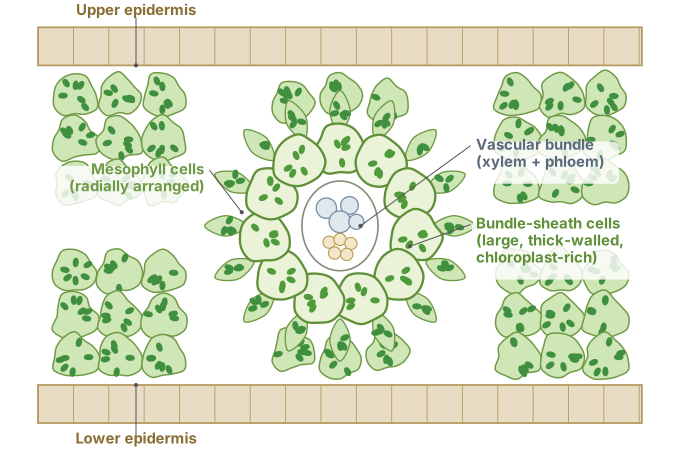
Kranz anatomy is the characteristic wreath-like arrangement of bundle sheath cells in C4 plants; the light reaction supplies ATP and NADPH to drive the dark reaction; OAA is the first stable C4 product; and the overall photosynthesis equation is 6CO2 + 12H2O -> C6H12O6 + 6O2 + 6H2O.
(a) Kranz anatomy: In C4 plants (e.g., maize, sugarcane), the leaf veins are surrounded by a ring of large, thick-walled bundle sheath cells packed with numerous chloroplasts (agranal or with reduced grana), arranged around the vascular bundle like a wreath (German 'Kranz' = wreath). Just outside this bundle sheath ring lies a layer of mesophyll cells, radially arranged around the bundle sheath. In this arrangement:
- Mesophyll cells first fix atmospheric CO2 using the enzyme PEP carboxylase (which has a high affinity for CO2, even at low concentrations), forming the 4-carbon compound oxaloacetic acid (OAA), which is then converted to malate or aspartate.
- This C4 acid is transported into the bundle sheath cells, where it is decarboxylated to release CO2, which then enters the Calvin cycle (C3 pathway) within the bundle sheath chloroplasts to form sugars. This two-cell, two-step mechanism (mesophyll for initial fixation, bundle sheath for the Calvin cycle) concentrates CO2 around RuBisCO, minimising photorespiration — the functional advantage of Kranz anatomy. (A simple sketch would show: an outer ring of mesophyll cells surrounding an inner ring of large bundle sheath cells, which in turn surround the vascular bundle/veins, with arrows showing OAA moving inward from mesophyll to bundle sheath and CO2 being released there for the Calvin cycle.) …
Unlock everything free for 14 days
- Full step-by-step solutions
- Concept-first explanations
- Methods, shortcuts & mistakes
- PYQ mapping + timed mock tests
Full access for 14 days. No credit card required.