Question of 108
Q.(i) Draw the structure of p-Toluidine.
(1)
(ii) Write short note on acetylation.
(2)
(iii) Arrange the following in increasing order of solubility in water : Aniline, ethanamine, 2-ethylethanamine.
(1)
(iv) Arrange the following amines in decreasing order of Basic strength in gas phase.
(1)
C2H5NH2, (C2H5)2NH, (C2H5)3N and NH3
C2H5NH2, (C2H5)2NH, (C2H5)3N and NH3
Himachal HpboseHPBOSE Plus Two Board 2026Subjective· 5mImportance★★★★★
0% · 0/108 Questions
You're viewing a preview — the full solution, concept, methods & PYQ mapping are locked.
Start your 14-day free trial to unlock the full solution →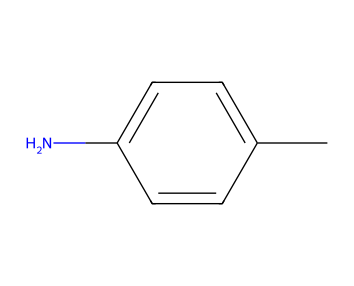
p-Toluidine is 4-methylaniline; acetylation converts –NH₂ to the milder –NHCOCH₃ group; aqueous solubility falls with increasing hydrophobic bulk (aniline lowest, then diethylamine, then ethanamine highest); in the gas phase (no solvation), basicity rises steadily with each added alkyl group, so triethylamine is the strongest base and ammonia the weakest.
- Structure of p-Toluidine p-Toluidine is 4-methylaniline: a benzene ring bearing an –NH₂ group at C1 and a –CH₃ group at C4 (para position, directly opposite –NH₂ across the ring): (–NH₂ and –CH₃ are on opposite corners of the hexagonal ring, i.e. 1,4-disubstituted benzene.)
- Acetylation Acetylation is the introduction of an acetyl group (–COCH₃) onto an amine's nitrogen, converting a primary (or secondary) amine into the corresponding amide (an acetanilide-type product), using acetic anhydride or acetyl chloride, typically in the presence of a mild base (e.g. pyridine): Acetylation converts the strongly activating, electron-donating –NH₂ group into the far less activating amide group –NHCOCH₃ (because the nitrogen lone pair is now delocalised into the carbonyl, reducing its donation into the ring). This is used, for example, to moderate aniline's very high reactivity before further electrophilic substitution (like bromination or nitration), preventing unwanted poly-substitution and oxidation side reactions, and improving para-selectivity by reducing the group's bulk/activating strength appropriately.
- Increasing order of solubility in water: Aniline, ethanamine, 2-ethylethanamine (diethylamine) Amine solubility in water depends on hydrogen-bonding ability with water versus the hydrophobic bulk of the carbon framework attached:
- Aniline (C₆H₅NH₂) has a bulky, hydrophobic aromatic ring, which strongly limits its water solubility (aniline is only slightly soluble in water) despite having an –NH₂ group capable of H-bonding.
- 2-Ethylethanamine / diethylamine, (C₂H₅)₂NH, is a small aliphatic secondary amine — more soluble than aniline (small aliphatic chain, still has an N–H for H-bonding) but somewhat less soluble than a primary amine of similar size, since it has bulkier alkyl groups shielding the nitrogen and only one N–H available for hydrogen bonding to water.
- Ethanamine (C₂H₅NH₂), a small primary amine, has two N–H bonds available for hydrogen bonding with water and minimal hydrophobic bulk, making it the most water-soluble of the three (in fact fully miscible with water).
…
Unlock everything free for 14 days
- Full step-by-step solutions
- Concept-first explanations
- Methods, shortcuts & mistakes
- PYQ mapping + timed mock tests
Full access for 14 days. No credit card required.