Q.(i) Write the name and atomic number of fourth element of 3d-series.
You're viewing a preview — the full solution, concept, methods & PYQ mapping are locked.
Start your 14-day free trial to unlock the full solution →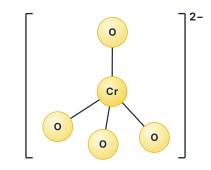
(i) The 3d series runs Sc(21), Ti(22), V(23), Cr(24), … so the 4th element is chromium, Z=24. (ii) Lanthanide contraction is the steady shrinkage of atomic/ionic radii across the lanthanides due to imperfect shielding by 4f electrons, causing 2nd and 3rd transition series elements in the same group to have almost identical radii. (iii) Fe²⁺ (d⁶, high spin) has 4 unpaired electrons, giving μ ≈ 4.90 BM. (iv) The chromate ion, CrO₄²⁻, is tetrahedral (sp³ hybridised Cr).
(i) 4th element of the 3d series
The 3d transition series (Period 4, d-block) begins at scandium:
- Sc (Z=21), 2. Ti (Z=22), 3. V (Z=23), 4. Cr (Z=24)
So the fourth element is Chromium (Cr), atomic number 24.
(ii) Lanthanide contraction
As we move across the lanthanide series (Ce to Lu, Z = 58 to 71), the atomic and ionic radii show a steady, gradual decrease — this is called lanthanide contraction.
Reason: In the lanthanides, the new electron added at each step enters an inner 4f orbital. 4f orbitals have very poor shielding ability (poor screening of the nuclear charge) because of their diffuse shape. So as the nuclear charge increases by one unit at each step, the 4f electron added does not effectively shield the outer (5d, 6s) electrons from the increased nuclear pull — the effective nuclear charge felt by the outer electrons increases steadily, pulling the electron cloud inward and shrinking the atomic/ionic size at every step.
Consequences:
- Because the total contraction over the whole series is substantial, it almost exactly compensates for the expected size increase on going from the second (4d) to the third (5d) transition series. As a result, elements of the second and third transition series lying in the same group (e.g. Zr & Hf, Nb & Ta, Mo & W) have almost identical atomic/ionic radii, making them very difficult to separate chemically.
- It also causes a gradual decrease in basicity of the lanthanide hydroxides from La(OH)₃ to Lu(OH)₃.
- It makes separation of individual lanthanides from each other difficult, since their sizes (and hence properties) are so close. …
Unlock everything free for 14 days
- Full step-by-step solutions
- Concept-first explanations
- Methods, shortcuts & mistakes
- PYQ mapping + timed mock tests
Full access for 14 days. No credit card required.