Q.[Case study, continued] The total work done in assembling the system of three charges q1, q2 and q3 at the given locations is given by
🔒You're viewing a preview — the full solution, concept, methods & PYQ mapping are locked.
🔒 Start your 14-day free trial to unlock the full solution →Concept understanding — Electrostatic Potential Energy of a System of Charges
The potential energy of a system of N point charges is the total work needed to assemble them by bringing each one, in turn, from infinity to its final position, working against the fields of every charge already placed. The general result is a sum over every distinct PAIR of charges: U=4πϵ01∑pairs j,krjkqjqk -- for just two charges this reduces to the simple two-charge formula U=4πϵ01r12q1q2. …
The total potential energy of assembling all three charges is just the sum of the work done at each step, which works out to every distinct pairwise interaction term added together, each with the sign already carried by the charges themselves. …
The total potential energy of the three-charge system is the sum of all THREE distinct pairwise interaction terms, each with a plain '+' sign.
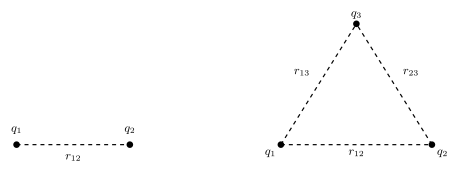
Assembling the three charges one at a time (as in parts i–iii): q1 costs no work (W1=0), q2 costs W2=4πε01r12q1q2, and q3 costs W3=4πε01(r13q1q3+r23q2q3).
The total work done to assemble the configuration — which equals the total electrostatic potential energy of the system, since this work is stored as PE — is:
U=W1+W2+W3=4πε01(r12q1q2+r13q1q3+r23q2q3)
…
- CBSE 2026Set 55/2/11 markMCQQ.Three point charges 2q, −2q and q are kept at the vertices of an equilateral triangle of side l. The potential energy of the system is (A) zero (B) −πε0l2q2 (C) 2πε0lq2 (D) −πε0lq2
›Reveal solutionSolution
The potential energy of a system of point charges is the sum of the potential energies of every distinct pair. For the given charges 2q, −2q, and q at the vertices of an equilateral triangle of side l, the total potential energy comes out to −πε0lq2, which corresponds to option (D).
The concept here is electric potential energy of a system of point charges. This is not about the potential at a point, but about the work done to assemble the charges from infinity to their positions. For any pair of charges qi and qj separated by distance rij, the potential energy of that pair is
Uij=4πε01rijqiqj.
The total potential energy of the system is simply the sum over all distinct pairs. Since the triangle is equilateral, every side is l, so the distances are all equal — that simplifies the arithmetic.
A common mistake is to forget the sign of the charges or to double-count pairs. Let’s be careful.
-
Identify the three distinct pairs.
The charges are at vertices A, B, C. Let’s label them:
- qA=2q
- qB=−2q
- qC=q
The three pairs are: (A,B), (B,C), and (C,A). Each pair is separated by distance l.
-
Write the potential energy for each pair.
Using U=4πε01lqiqj:
- Pair (A,B): UAB=4πε01l(2q)(−2q)=4πε01l−4q2
- Pair (B,C): UBC=4πε01l(−2q)(q)=4πε01l−2q2
- Pair (C,A): UCA=4πε01l(q)(2q)=4πε01l2q2
-
Sum them up.
Utotal=UAB+UBC+UCA=4πε0l1(−4q2−2q2+2q2) …
-
- CBSE 2026Set A1 markMCQQ.When an alpha-particle is brought towards another alpha-particle, the potential energy of the system (A) increases (B) decreases (C) remains unchanged (D) none of these
›Reveal solutionSolution
Two positive alpha particles repel; pushing them together raises the potential energy.
An alpha particle carries charge +2e. The electrostatic potential energy of two point charges is:
U=4πε01rq1q2
…
- CBSE 2026Set ANNUAL1 markMCQQ.[Case study] Consider the charges q1 and q2 initially at infinity and determine the work done by an external agency to bring the charges to the given locations. Suppose, first the charge q1 is brought from infinity to the point r1⃗. There is no external field against which work needs to be done, so work done in bringing q1 from infinity to r1⃗ is zero. From the definition of potential, work done in bringing charge q2 from infinity to the point r2⃗ is q2 times the potential at r2⃗ due to q1. (Figure: two point charges q1 and q2 joined by a line of length r12.)(i) To bring q2 from infinity to r2. The work done in this step is(a) W2 = 1/(4πε₀) × 2q1q2/r12³(b) W2 = 1/(4πε₀) × q1q2/r12³(c) W2 = 1/(4πε₀) × q1q2/r12²(d) W2 = 1/(4πε₀) × q1q2/r12
›Reveal solutionSolution
The work done to bring q2 from infinity is just q2 times the potential already set up by q1 at that point — no squared or cubed distance term.
Since q1 is already placed at r1, it sets up an electrostatic potential everywhere in space. At the point r2 (distance r12 away from q1), this potential is:
V1(r2)=4πε01r12q1
The work done in bringing charge q2 from infinity to r2 against this potential (by definition of electric potential, V=W/q) is:
W2=q2V1(r2)=4πε01r12q1q2
…
- CBSE 2026Set ANNUAL1 markMCQQ.[Case study, continued] Let us calculate the potential energy of a system of three charges q1, q2 and q3 located at r1⃗, r2⃗, r3⃗ respectively as shown in the figure (triangle with sides r12, r13, r23). To bring q1 first from infinity to r1⃗, no work is required (W1 = 0).(iii) The work done in bringing q3 from infinity to the point r3 is -(a) W3 = 1/(4πε₀) × (2q1q3/r13 + 2q2q3/r23)(b) W3 = 1/(4πε₀) × (q1q2/r12 + q1q3/r13)(c) W3 = 1/(4πε₀) × (q1q3/r13 + q2q3/r23)(d) W3 = 1/(4πε₀) × (q1q3/r12 - q2q3/r23)
›Reveal solutionSolution
The work to bring the third charge is q3 times the potential already created at that point by BOTH earlier charges combined.
By the time q3 is brought in, both q1 (at r1) and q2 (at r2) are already in place, having together set up a potential at the location r3 (where q3 will go):
V1,2(r3)=4πε01(r13q1+r23q2)
The work done in bringing q3 from infinity to this point, against this combined potential, is:
W3=q3V1,2(r3)=4πε01(r13q1q3+r23q2q3)
…
- CBSE 2026Set ANNUAL1 markMCQQ.[Case study, continued] The total work done in assembling the system of three charges q1, q2 and q3 at the given locations is given by(a) U = 1/(4πε₀) × (q1q2/r12 + q1q3/r13 + q2q3/r23)(b) U = 1/(4πε₀) × (q1q2/r12 - q1q3/r13 + q2q3/r23)(c) U = 1/(4πε₀) × (q1q2/r12 + q1q3/r13 - q2q3/r23)(d) U = 1/(4πε₀) × (q1q2/r13 + q1q3/r22 + q2q3/r12)
›Reveal solutionSolution
The total potential energy of the three-charge system is the sum of all THREE distinct pairwise interaction terms, each with a plain '+' sign.
Assembling the three charges one at a time (as in parts i–iii): q1 costs no work (W1=0), q2 costs W2=4πε01r12q1q2, and q3 costs W3=4πε01(r13q1q3+r23q2q3).
The total work done to assemble the configuration — which equals the total electrostatic potential energy of the system, since this work is stored as PE — is:
U=W1+W2+W3=4πε01(r12q1q2+r13q1q3+r23q2q3)
…
- CBSE 2025Set D1 markMCQQ.Two equal positive point charges of 1 μC charge are kept at a distance of 1 metre in air. The electric potential energy of the system will be (A) 1 joule (B) 1 eV (C) 9 × 10^-3 joule (D) zero
›Reveal solutionSolution
The mutual potential energy of two point charges is U = kq₁q₂/r; plugging in gives 9×10⁻³ J.
The electric potential energy of a system of two point charges is
U=4πε01rq1q2=rkq1q2
Here both charges are equal and positive: q1=q2=1μC=1×10⁻⁶C, the separation is r=1m, and k=9×10⁹Nm2/C2.
…
- CBSE 2025Set D1 markMCQQ.Which of the following statements is true for two point charges of opposite sign? (A) The potential energy is always negative (B) The potential energy is always positive (C) The potential energy can be either positive or negative (D) The potential energy is zero
›Reveal solutionSolution
Potential energy of two charges is U = kq₁q₂/r; for opposite signs the product q₁q₂ is negative, so U is always negative.
The mutual potential energy of two point charges is
U=rkq1q2
For two charges of opposite sign, one is positive and one is negative, so the product q1q2<0. Since k and r are positive, U is negative for every finite separation.
…
- CBSE 2024Set IMPROVEMENT1 markQ.What is the change in electric potential energy when one proton is brought near to another proton?
›Reveal solutionSolution
Bringing two like (positive) charges closer increases their electrostatic potential energy.
The electric potential energy of a pair of point charges is U=4πε01rq1q2. Both protons carry positive charge, so as one proton is brought closer to the other, the separation r decreases, and since U∝1/r for like charges, U increases. Physically, work has to be done against the mutually repuls …
- CBSE 2024Set A1 markMCQQ.The electrostatic energy of the system made by two electric dipoles kept at a distance 'r' is proportional to (A) r^2 (B) r^3 (C) r^4 (D) none of these
›Reveal solutionSolution
Dipole–dipole interaction energy ∝ 1/r³, not r², r³ or r⁴ → 'none of these'.
A single dipole's field falls off as 1/r³. The potential energy of a second dipole placed in that field is therefore proportional to r31:
U∝r3p1p2
…
- CBSE 2023Set F1 markMCQQ.If the distance between the two charges is increased, then the electrostatic potential energy of the charges (A) decreases (B) increases (C) may increase or decrease (D) remains the same
›Reveal solutionSolution
The sign of the effect depends on whether the charges are like or unlike, so U may increase or decrease.
The electrostatic potential energy of two charges is
U=4πε01rq1q2.
- Like charges (q1q2>0): U is positive and ∝1/r, so increasing r decreases U. …
- CBSE 2020Set OC1 markQ.Two equal negative point charges −2 μC each are held 1 m apart. Calculate their potential energy.
›Reveal solutionSolution
Both charges are negative, so their product is positive, giving a positive (repulsive) potential energy — plug straight into the two-point-charge PE formula.
Formula
U=rkq1q2
Substitute
…
- CBSE 2018Set ANNUAL1 markMCQQ.The electrostatic potential energy of two point charges, 1 uC each, place 1 m apart in vacuum is(a) 9 x 10^3 J(b) 9 x 10^9 J(c) 9 x 10^-3 J(d) 9 x 10^-3 eV
›Reveal solutionSolution
The potential energy of two point charges separated by a distance r is U = kq1q2/r; substituting the given values gives 9x10^-3 J.
The electrostatic potential energy of a system of two point charges q1 and q2 held a distance r apart in vacuum (the work needed to assemble them, starting from infinite separation) is
U = (1/4piepsilon0) * q1q2/r = kq1*q2/r, where k = 9 x 10^9 N m^2/C^2.
…
🎓Unlock everything free for 14 days
- ✓Full step-by-step solutions
- ✓Concept-first explanations
- ✓Methods, shortcuts & mistakes
- ✓PYQ mapping + timed mock tests
Full access for 14 days. No credit card required.