Q.(i) What are intrinsic semiconductors?
You're viewing a preview — the full solution, concept, methods & PYQ mapping are locked.
Start your 14-day free trial to unlock the full solution →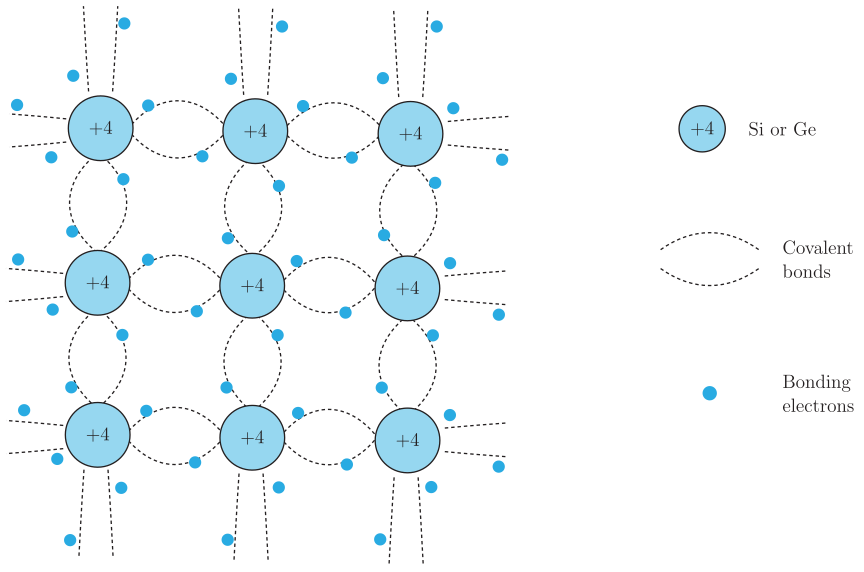
Intrinsic (pure) Si/Ge conduct only because their energy gap is small enough for thermal energy to occasionally break covalent bonds, creating electron-hole pairs; carbon's much larger gap keeps it an insulator.
- Intrinsic semiconductors: These are pure semiconductor crystals containing NO impurity atoms — e.g. pure (undoped) silicon or germanium. In such a crystal, at any temperature above 0 K, the number of free (conduction-band) electrons exactly equals the number of holes in the valence band, i.e. (the intrinsic carrier concentration). At absolute zero, an intrinsic semiconductor behaves exactly like an insulator (valence band completely full, conduction band completely empty).
- Why C is an insulator while Si and Ge are semiconductors, despite having the same (diamond cubic) lattice structure: All three elements have 4 valence electrons and form the same tetrahedral covalent-bond crystal structure. What differs is the width of the forbidden energy gap between the valence band and the conduction band:
- Carbon (diamond): eV — very large.
- Silicon: eV.
- Germanium: eV.
At room temperature, the thermal energy available is only about eV, but the Boltzmann/Fermi-Dirac distribution has a "tail" that allows some electrons to acquire energies well above the average. For Si and Ge, this small-but-nonzero energy gap is narrow enough that a significant number of valence electrons DO get thermally excited across the gap into the conduction band, giving these materials a usable (if modest) intrinsic conductivity — hence they behave as semiconductors. For carbon, the gap is so large that essentially no electrons can be thermally excited across it at ordinary temperatures, so it conducts negligibly and behaves as an insulator.
(iii) Generation of charge carriers (2-D covalent bond picture): Picture the Si (or Ge) crystal as a 2-D array of atoms, each sharing its 4 valence electrons in covalent bonds with its 4 nearest neighbours (each bond = 2 shared electrons, one from each atom). At very low (near 0 K) temperature, every valence electron is locked into a covalent bond — there are no free electrons, and the crystal behaves as an insulator.
…
Unlock everything free for 14 days
- Full step-by-step solutions
- Concept-first explanations
- Methods, shortcuts & mistakes
- PYQ mapping + timed mock tests
Full access for 14 days. No credit card required.