Q.Explain the mechanism of breathing with labelled diagrams.
You're viewing a preview — the full solution, concept, methods & PYQ mapping are locked.
Start your 14-day free trial to unlock the full solution →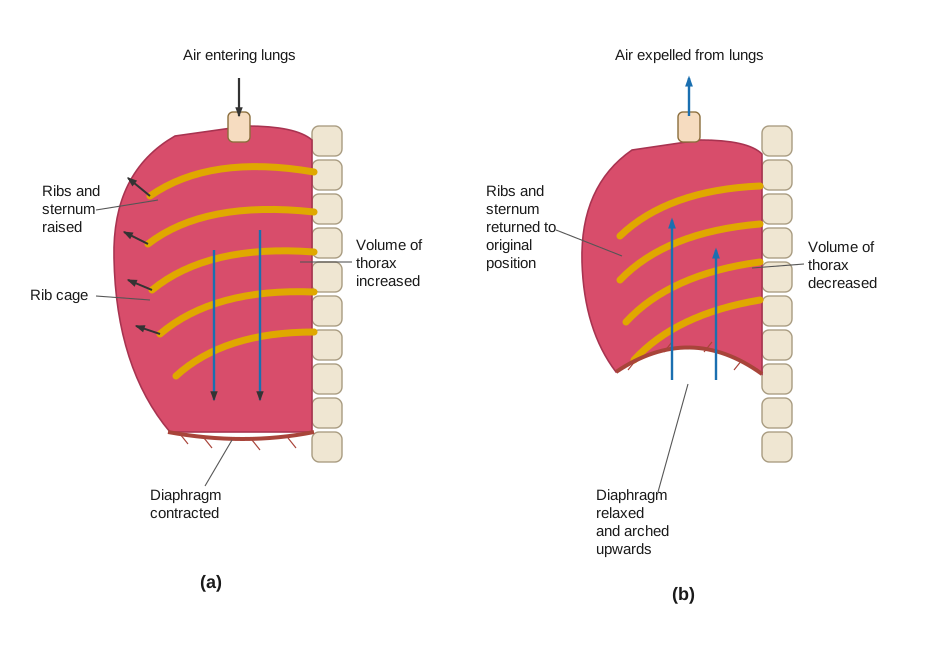
Breathing consists of inspiration (drawing air in) and expiration (pushing air out), both achieved by muscular changes in the size of the thoracic cavity that create a pressure gradient between the lungs and the atmosphere.
Respiratory pathway (for reference in the diagram): External nostrils → nasal passage → pharynx → larynx → trachea → bronchi (one to each lung) → bronchioles → alveoli (site of actual gas exchange, surrounded by a dense capillary network), all enclosed by the rib cage, with the dome-shaped diaphragm forming the floor of the thoracic cavity.
1. Inspiration (breathing in):
- The diaphragm (a dome-shaped muscle at the base of the thoracic cavity) contracts and flattens, moving downward.
- The external intercostal muscles (between the ribs) contract, lifting the ribs and sternum upward and outward.
- Together, these movements increase the volume of the thoracic cavity, which in turn expands the lungs.
- As lung volume increases, the pressure inside the lungs (pulmonary pressure) falls below atmospheric pressure.
- Since gases flow from a region of higher pressure to lower pressure, atmospheric air rushes in through the nostrils, down the respiratory tract, into the alveoli — this is inspiration.
2. Expiration (breathing out):
- The diaphragm and external intercostal muscles relax; the diaphragm domes upward again and the ribs and sternum move back down and inward.
- This decreases the volume of the thoracic cavity, compressing the lungs.
- Pulmonary pressure rises above atmospheric pressure.
- Air is then pushed out of the lungs to the atmosphere — this is expiration. …
Unlock everything free for 14 days
- Full step-by-step solutions
- Concept-first explanations
- Methods, shortcuts & mistakes
- PYQ mapping + timed mock tests
Full access for 14 days. No credit card required.