Q.Draw a well-labelled diagram of Human Kidney and with the help of a flow chart highlight path of urine drainage from collecting ducts to outside. OR Define a Neuron. Give an account on mechanism of synaptic transmission.
You're viewing a preview — the full solution, concept, methods & PYQ mapping are locked.
Start your 14-day free trial to unlock the full solution →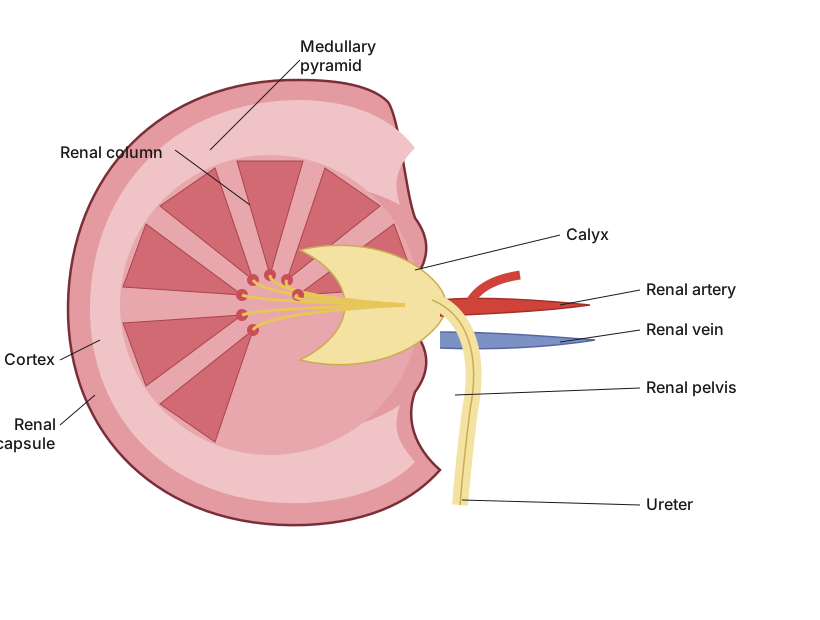
A labelled longitudinal section of the human kidney shows an outer cortex, an inner medulla made of pyramids, and a central hollow pelvis; urine formed in the nephrons drains outward via collecting ducts, papillary ducts, calyces, the pelvis, ureter, bladder, and finally the urethra.
Labelled diagram of the human kidney (longitudinal section) - the parts to label:
- Outer, dark Cortex, forming an arch over the base of the medullary pyramids and extending down between them as renal columns (columns of Bertini).
- Inner, light Medulla, divided into a number of conical masses called medullary pyramids, projecting into the calyces.
- The apex of each pyramid, called the renal papilla, opens into a funnel-shaped minor calyx.
- Several minor calyces join to form a larger major calyx.
- The major calyces converge into a single funnel-shaped renal pelvis.
- The renal pelvis narrows into the ureter, which leaves the kidney at a notch called the hilum (also where the renal artery enters and renal vein leaves).
- A renal capsule (thin connective-tissue covering) surrounds the whole kidney externally.
- Millions of microscopic nephrons (the functional filtering units, embedded within the cortex and medulla) each end in a collecting duct.
Flow chart - path of urine drainage from the collecting ducts to the outside:
Collecting duct (receives urine from many nephrons)
-> Papillary duct/duct of Bellini (several collecting ducts open into wider ducts that open at the renal papilla)
-> Minor calyx (receives urine from one renal papilla)
-> Major calyx (formed by union of several minor calyces)
-> Renal pelvis (formed by union of major calyces) …
Unlock everything free for 14 days
- Full step-by-step solutions
- Concept-first explanations
- Methods, shortcuts & mistakes
- PYQ mapping + timed mock tests
Full access for 14 days. No credit card required.