Q.Explain the term relative velocity with the help of position-time graph.
You're viewing a preview — the full solution, concept, methods & PYQ mapping are locked.
Start your 14-day free trial to unlock the full solution →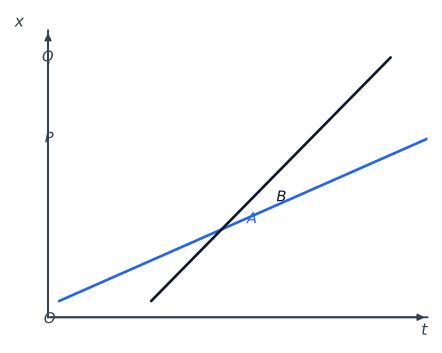
On a position-time graph, each object's velocity is the slope of its own line; the relative velocity of B with respect to A is the slope of the line obtained by plotting the separation (x_B - x_A) against time, and it equals v_B - v_A.
Consider two objects A and B moving along the same straight line (the x-axis). Their positions at time t are x_A(t) and x_B(t), and their individual (instantaneous) velocities are the slopes of their own x-t graphs:
v_A = dx_A/dt, v_B = dx_B/dt
The relative velocity of B with respect to A, written v_BA, is defined as the rate at which B's position changes as measured by an observer moving WITH A, i.e. the rate of change of the separation (x_B - x_A):
v_BA = d(x_B - x_A)/dt = dx_B/dt - dx_A/dt = v_B - v_A
Reading this off a position-time graph: draw the x-t graphs of A and B on the same axes. At any instant, the vertical gap between the two graphs is the separation (x_B - x_A). The relative velocity v_BA is simply the slope of the curve you get by plotting this gap against time -- equivalently, it is the difference of the two individual slopes at that instant.
Special cases, easily read from the graph:
- If both A and B move with uniform (constant) velocity, both x-t graphs are straight lines, and v_BA = v_B - v_A is itself constant -- the separation-vs-time graph is also a straight line. …
Unlock everything free for 14 days
- Full step-by-step solutions
- Concept-first explanations
- Methods, shortcuts & mistakes
- PYQ mapping + timed mock tests
Full access for 14 days. No credit card required.