Q.State Gauss's law in electrostatics. Derive an expression for the electric field due to an infinitely long straight charged wire at a point distant r from it. Plot a graph showing the variation of electric field with r. OR What is a capacitor ? Derive an expression for total capacitance when three capacitors of capacitances C1, C2 and C3 are connected in
You're viewing a preview — the full solution, concept, methods & PYQ mapping are locked.
Start your 14-day free trial to unlock the full solution →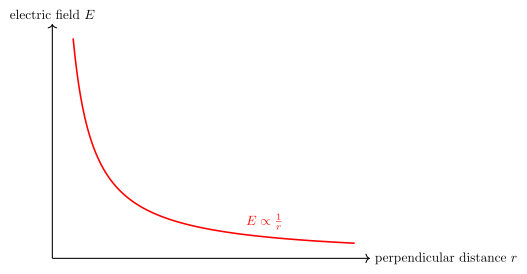
Gauss's law relates the total electric flux through any closed surface to the charge it encloses; applying it to a cylindrical surface around an infinite line charge gives E = λ/(2πε0 r), which falls off as 1/r and traces a hyperbola-like decreasing curve.
Gauss's law: The total electric flux through any closed surface (a Gaussian surface) equals 1/ε0 times the total charge enclosed by that surface:
ΦE = ∮E·dA = qenc / ε0
Electric field of an infinitely long, straight, uniformly charged wire (linear charge density λ):
By symmetry, the field due to an infinite line charge must point radially outward (or inward, for negative λ), perpendicular to the wire, and must have the same magnitude at every point on a cylinder of a given radius r coaxial with the wire.
Choose a cylindrical Gaussian surface of radius r and length l, coaxial with the wire.
- On the two flat end-caps, E is parallel to the cap surface (perpendicular to the area vector, which points along the axis), so the flux through them is zero.
- On the curved lateral surface, E is everywhere perpendicular to the surface (radial) and of constant magnitude, so:
ΦE = E × (2πrl)
Charge enclosed: qenc = λl
Applying Gauss's law:
E × 2πrl = λl/ε0
E = λ / (2πε0 r)
Graph of E vs r: E is inversely proportional to r (E ∝ 1/r), so the graph is a smoothly decreasing curve (a rectangular-hyperbola-type shape) — very large (in principle diverging) as r → 0, and falling off gradually towards zero as r increases, never actually reaching zero for finite r.
OR — Capacitor and combinations:
…
Unlock everything free for 14 days
- Full step-by-step solutions
- Concept-first explanations
- Methods, shortcuts & mistakes
- PYQ mapping + timed mock tests
Full access for 14 days. No credit card required.