Q.Explain the biogas plant with a neat labelled diagram.
🔒You're viewing a preview — the full solution, concept, methods & PYQ mapping are locked.
🔒 Start your 14-day free trial to unlock the full solution →Concept understanding — Microbial Fermentation Foods
Let’s begin with something you already know. Think of a pot of milk left out in warm weather. After a few hours, it turns sour and thickens into curd. That change is not spoilage in the usual sense — it is a controlled transformation caused by tiny living organisms called microbes. This is the heart of microbial fermentation.
Fermentation is a process in which microorganisms — bacteria, yeast, or moulds — break down organic substances (like sugars) in the absence of oxygen, producing energy for themselves and, as a by‑product, substances that change the food. When we deliberately use this process to make food, we call the result microbial fermented foods.
You have eaten many of them without thinking twice: curd (yogurt), idli and dosa batter, bread, cheese, pickles, vinegar, and even the dark chocolate you might enjoy. Each of these relies on specific microbes doing their work.
The NCERT textbook (Class XII, Biology, Chapter 10: Microbes in Human Welfare) introduces fermented foods under the topic “Microbes in Household Products.” It lists curd, cheese, idli, dosa, and bread as common examples. The key point is that these are not modern inventions — they have been part of Indian and global diets for centuries.
Why does this matter? Because fermentation does three things that are valuable for us:
- Preserves food — The acids or alcohol produced by microbes prevent spoilage by harmful bacteria. Pickles stay edible for months because of lactic acid from fermentation.
- Improves digestibility — Microbes break down complex molecules. Lactose in milk becomes easier to digest in curd; the proteins in soy become more digestible in tempeh.
- Enhances flavour and texture — The tang of yogurt, the airy holes in bread, the umami of soy sauce — all come from fermentation.
Let’s look at a few examples from your daily life, as the NCERT would describe them:
- Curd (yogurt): Milk is boiled and cooled, then a small amount of previous curd (containing Lactobacillus bacteria) is added. The bacteria convert lactose into lactic acid, which thickens the milk and gives it a sour taste.
- Idli and dosa batter: Rice and urad dal are soaked, ground, and left to ferment overnight. Naturally occurring Leuconostoc and other bacteria produce carbon dioxide gas, which makes the batter rise and gives idlis their spongy texture.
- Bread: Baker’s yeast (Saccharomyces cerevisiae) ferments the sugars in dough, releasing carbon dioxide that makes the dough rise. The alcohol produced evaporates during baking.
- Cheese: Milk is curdled using rennet (an enzyme) or acid, then specific bacteria and moulds are added to ripen it. Different microbes give different cheeses their distinct flavours — for example, Penicillium roqueforti gives blue cheese its veins and sharp taste. …
Biogas is a mixture of gases (mainly methane) produced by the anaerobic breakdown of organic waste such as cattle dung by methanogenic bacteria; a biogas plant is the structure built to carry out this process on a useful scale. …
A biogas plant produces biogas (mainly methane) by the anaerobic digestion of cattle dung by methanogens. Parts: inlet tank → digester tank → gas holder/dome → gas outlet pipe → outlet (spent-slurry) tank.
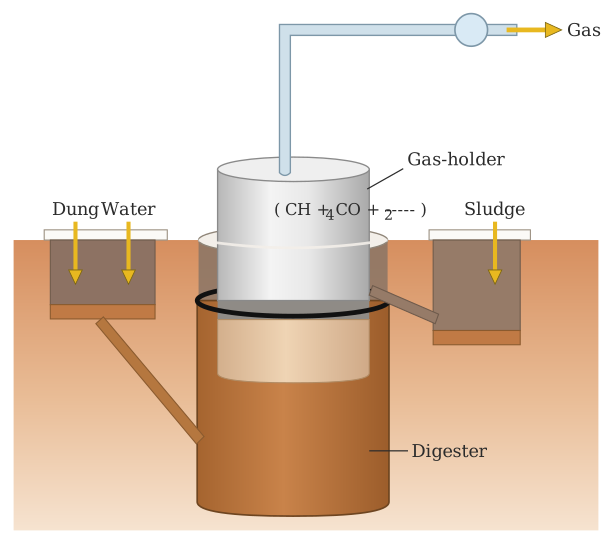
Concept. Biogas is a mixture of gases (predominantly methane, CH₄, with CO₂ and H₂S) produced by the microbial (bacterial) breakdown of organic wastes such as cattle dung ('gobar'). The bacteria responsible are the methanogens (e.g. Methanobacterium), which are anaerobic and are found in cattle dung and in anaerobic sludge. A biogas plant (gobar-gas plant) is built to harvest this gas.
Working and labelled parts (as drawn):
- Inlet / mixing tank: cattle dung is mixed with water to form a slurry, which is fed into the plant through the inlet pipe.
- Digester tank (digestion chamber): a deep, sealed underground concrete tank where the slurry undergoes anaerobic digestion by methanogens, releasing biogas over some weeks.
- Gas holder / floating cover (dome): a movable cover (or fixed dome) over the digester that collects the biogas; it rises as gas accumulates.
- Gas outlet pipe with valve: the biogas is drawn off from the top of the holder through this pipe and supplied for cooking and lighting. …
Showing the 12 most recent of 48 on this concept.
- CBSE 2026Set 57/2/11 markMCQQ.Assertion (A) : Microbes are used for commercial production of alcohol and beverages. Reason (R) : Yeast converts glucose into ethanol and carbon dioxide during fermentation. (A) Both Assertion (A) and Reason (R) are true and Reason (R) is the correct explanation for Assertion (A). (B) Both Assertion (A) and Reason (R) are true, but Reason (R) is not correct explanation for Assertion (A). (C) Assertion (A) is true, Reason (R) is false. (D) Assertion (A) is false, Reason (R) is true.
›Reveal solutionSolution
Microbes, particularly yeast, are essential for the commercial production of alcohol and beverages because yeast ferments sugars into ethanol and carbon dioxide.
The assertion that microbes are employed in the commercial production of alcohol and beverages is fundamentally correct. For centuries, various microorganisms have been harnessed by humanity for a wide array of industrial processes, and the brewing and distilling industries stand as prime examples. These industries rely heavily on the metabolic activities of specific microbes to transform raw materials into desirable products like beer, wine, whisky, and other alcoholic drinks.
Among these beneficial microbes, yeast holds a paramount position. Yeast, a single-celled fungus, is the primary agent responsible for alcoholic fermentation. This biological process is the cornerstone of alcohol production. Without the action of yeast, the sugars present in grains, fruits, or other plant materials would not be converted into ethanol, the alcohol found in these beverages.
ImportantThe specific species of yeast most commonly used in brewing and distilling is Saccharomyces cerevisiae, often referred to as "brewer's yeast" or "baker's yeast."
The reason provided, stating that yeast converts glucose into ethanol and carbon dioxide during fermentation, accurately describes the biochemical mechanism at play. Fermentation is an anaerobic process, meaning it occurs in the absence of oxygen. In this process, yeast enzymes break down glucose (a simple sugar) into two main products: ethanol (alcohol) and carbon dioxide gas.
- Glucose (a sugar, typically derived from malted barley for beer, grapes for wine, or other carbohydrate sources)
- Yeast enzymes (biological catalysts within the yeast cells) …
- CBSE 2026Set V11 markQ.A small amount of curd added to the fresh milk as ___________.
›Reveal solutionSolution
The small amount of curd added to fresh milk acts as an inoculum/starter of lactic acid bacteria.
A small amount of curd added to fresh milk acts as an inoculum (starter). It contains millions of lactic acid bacteria (LAB), such as Lactobacillus, which multiply at suitable temperatures and convert the milk into curd. During this process the LAB also produce acids that coagulate and partia …
- CBSE 2026Set A1 markMCQQ.Which vitamin content increases due to conversion of milk into curd?(a) Vitamin A(b) Vitamin B2(c) Vitamin C(d) Vitamin B12
›Reveal solutionSolution
Curdling by Lactobacillus increases vitamin B12; the correct option is (d).
When milk is converted into curd, lactic acid bacteria (LAB) such as Lactobacillus grow and multiply, coagulating the milk protein. Besides improving taste and nutritional quality, these bacteria also increase the vitamin B12 content of …
- CBSE 2026Set ANNUAL1 markQ.Fill in the blank: The dough, which is used to make bread, is fermented by yeast called as ______.
›Reveal solutionSolution
Bread dough is leavened by fermentation with the yeast Saccharomyces cerevisiae, whose CO2 production makes the dough rise.
Saccharomyces cerevisiae, commonly called baker's/brewer's yeast, ferments sugars in the dough, releasing carbon dioxide that causes the dough to rise (leavening) and gives bread its …
- CBSE 2026Set ANNUAL1 markQ.What is the botanical name of baker's yeast ?
›Reveal solutionSolution
Baker's yeast, used to leaven bread dough by fermentation, is the fungus Saccharomyces cerevisiae.
Saccharomyces cerevisiae is a unicellular fungus (yeast) that ferments sugars in dough, releasing carbon dioxide gas which causes the dough to rise (leavening) and gives bread its porous texture. The same sp …
- CBSE 2026Set ANNUAL1 markQ.Give one reason how the condition of a patient suffering from myocardial infarction can be improved by administering the bioactive agent Streptokinase.
›Reveal solutionSolution
Streptokinase dissolves the clot blocking the coronary artery, so blood flow to the heart muscle is restored — improving the heart-attack patient.
Myocardial infarction (a heart attack) occurs when a blood clot blocks a coronary artery, cutting off oxygen supply to part of the heart muscle. Streptokinase, produced by the bacterium Streptococcus and modified by genetic engineering, is a clot-buster (thrombolytic agent): it activates plasminogen to plasmin, which digests the fibrin of the clot. By dissolving the clot it removes the b …
- CBSE 2026Set ANNUAL1 markQ.Why are there large holes in 'Swiss Cheese'?
›Reveal solutionSolution
Large holes in Swiss cheese are caused by CO₂ gas released by the bacterium Propionibacterium sharmanii.
Concept: Microbes are used in the processing and production of many dairy foods, including different types of cheese, whose texture, flavour and appearance depend on the specific microbes used. …
- CBSE 2026Set ANNUAL1 markQ.Write True or False. Saccharomyces cerevisiae is used in the production of alcohol and bread.
›Reveal solutionSolution
True — Saccharomyces cerevisiae is used both to produce alcohol (brewer's yeast) and to make bread rise (baker's yeast).
In the CBSE/NCERT Microbes in Human Welfare chapter, Saccharomyces cerevisiae carries out fermentation of sugars:
- In brewing/wine-making it produces ethanol (alcohol) and CO₂. …
- CBSE 2025Set A1 markQ.Match the correct pair and write the match for 'Toddy'. Column I:(i) Apomixis(ii) Darwin(iii) Toddy(iv) Agarose(v) Detritivorous. Column II:(a) Galapagos Islands(b) Southern India(c) Sea weeds(d) Earthworm(e) Grass family.
›Reveal solutionSolution
Toddy matches with (b) Southern India, where it is a traditional fermented drink.
Toddy is a mildly alcoholic traditional beverage of Southern India, prepared by natural fermentation of the sap (sugary exudate) tapped from palm trees, using naturally occurring yeasts. It is a classic NCERT example of microbes (yeast) being used by humans in the production of trad …
- CBSE 2025Set ANNUAL1 markQ.By increasing of which vitamin the nutritional quality of curd is improves as compared to milk?
›Reveal solutionSolution
Lactic acid bacteria that convert milk into curd increase the vitamin B12 content of curd compared to milk.
During curd (dahi) formation, lactic acid bacteria (LAB, e.g., Lactobacillus) multiply in milk and, besides lowering pH and improving its keeping quality/flavour, they also enhance its nutritional valu …
- CBSE 2025Set ANNUAL1 markMCQQ.Industrial production of which of these products can be negatively affected by the presence of Saccharomyces cerevisiae ?(a) beer(b) wine(c) fruit juice(d) wheat bread
›Reveal solutionSolution
S. cerevisiae is desirable for beer, wine and bread, but an unwanted contaminant in fruit juice.
Saccharomyces cerevisiae (baker's/brewer's yeast) is deliberately used in beer and wine production (fermenting sugars to ethanol) and in the baking industry (its CO2 production leavens bread dough). In fruit juice manufacturing, however, the same yeast is an unwanted contaminant: if it is present, it ferments the sugars in the juice into alcohol and CO2, spoiling the product and altering its taste, clarity an …
- CBSE 2025Set ANNUAL1 markMCQQ.Vitamin whose content increases following the conversion of milk into curd by lactic acid bacteria is :(a) Vitamin C(b) Vitamin B12(c) Vitamin D(d) Vitamin E
›Reveal solutionSolution
Lactic Acid Bacteria (LAB, e.g. Lactobacillus) not only sour milk into curd but also enhance its nutritional quality by boosting Vitamin B12.
When a small amount of curd is added to fresh milk as inoculum, LAB present in it multiply rapidly and convert milk into curd, which also acts as inoculum containing millions of LAB. Besides changing the flavour and texture of milk into curd, LAB significantly increase the vitamin B12 content of the product during fermentation, in addition to improving …
🎓Unlock everything free for 14 days
- ✓Full step-by-step solutions
- ✓Concept-first explanations
- ✓Methods, shortcuts & mistakes
- ✓PYQ mapping + timed mock tests
Full access for 14 days. No credit card required.