Q.Draw the labeled diagram representing the schematic arrangement of Geiger-Marsden experiment for alpha-particle scattering.
🔒You're viewing a preview — the full solution, concept, methods & PYQ mapping are locked.
🔒 Start your 14-day free trial to unlock the full solution →Concept understanding — Geiger-Marsden Alpha-Scattering Experiment
The Geiger-Marsden experiment (carried out 1908-1913, on Rutherford's suggestion) was designed to directly probe how the positive charge inside an atom is actually distributed, by firing a narrow, collimated beam of alpha particles -- positively charged, comparatively heavy particles, essentially bare helium nuclei -- at an extremely thin gold foil and observing how they scattered.
A surrounding scintillation screen, together with a moveable microscope, let the experimenters measure how many alpha particles scattered into each range of angles from the beam's original direction. The overwhelming majority passed straight through the foil with little or no deflection, consistent with the foil (and hence the atoms making it up) being mostly empty space. But a small, very specific fraction scattered through LARGE angles -- about 1 in 8000 through more than 90 degrees, and some almost straight back through nearly 180 degrees. …
This experiment fires a fine beam of alpha-particles at a thin gold foil to probe how the positive charge is distributed inside the atom, so the diagram must show how the beam is produced, where it strikes the foil, and how the scattered particles are counted at different angles. …
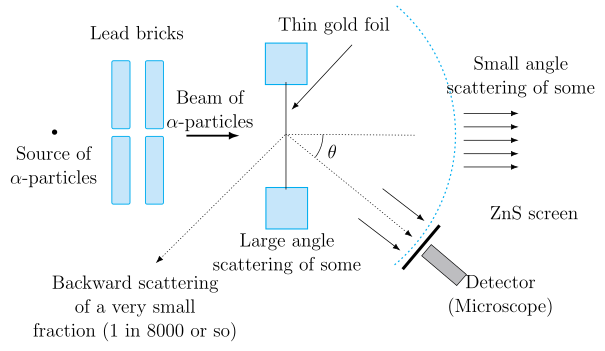
α-source in a lead shield → collimating slit → fine α-beam → thin gold foil → movable ZnS/detector records scattering at various angles.
The Geiger–Marsden (Rutherford) α-particle scattering apparatus consists of:
- A radioactive source of α-particles (e.g. 83214Bi) enclosed in a lead block with a narrow opening.
- A collimating slit (lead) that produces a fine, narrow beam of α-particles.
- A thin gold foil (about 10−7 m thick) on which the beam is incident.
- A rotatable detector — a zinc-sulphide (ZnS) fluorescent screen viewed through a microscope — that can be moved to different scattering angles to count the α-particles scattered in each direction.
  ______
 |  Pb  |  radioactive
 | ( α )|--- source        thin gold foil
 |______|      \               ||
                \==== beam ====>||====> (undeflected, θ≈0)
                    (slit)      || \
                                ||  \ (scattered through θ)
                                     \ …
Showing the 12 most recent of 15 on this concept.
- CBSE 2026Set DS1 markMCQQ.The path of scattered α-particle is:i) circularii) paraboliciii) ellipticaliv) hyperbolic
›Reveal solutionSolution
The scattered α-particle travels along a hyperbola with the nucleus at the focus.
Concept. In Rutherford's gold-foil experiment, a positively charged α-particle approaching the positively charged nucleus experiences a repulsive inverse-square Coulomb force. An unbound particle moving under an inverse-square repulsive force traces one branch of a hyperbola, with the nucleus located at the focus. The impact parameter decides …
- CBSE 2026Set ANNUAL1 markMCQQ.Radioactive source used in the Geiger-Marsden scattering experiment is(a) 235/92 U(b) 214/83 Bi(c) 141/56 Ba(d) 89/36 Kr
›Reveal solutionSolution
Geiger and Marsden bombarded a thin gold foil with alpha particles emitted by the naturally radioactive isotope Bismuth-214 (214/83 Bi, historically called 'radium C').
In Rutherford's classic alpha-scattering experiment, a beam of fast alpha particles from a naturally radioactive source was collimated and directed onto a thin gold foil, and the scattering angles of the alpha particles …
- CBSE 2026Set ANNUAL1 markMCQQ.The force which causes scattering of alpha particles in Rutherford's alpha particle scattering experiment is(a) Gravitational force(b) Coulomb force(c) Magnetic force(d) Nuclear force
›Reveal solutionSolution
Rutherford's alpha-scattering results are explained by electrostatic repulsion between the positively charged alpha particle and a tiny, dense, positively charged nucleus.
In Rutherford's gold-foil experiment, most alpha particles passed through nearly undeflected, but a small fraction were scattered through large angles, and a very few even bounced almost straight back. Rutherford explained this by proposing that almost all of the atom's positive charge and mass is concentrated in a tiny central nucleus. As an alpha particle (also positively charged) approaches this nucleus, the Coulomb (electrostatic) repulsive force between the two positive charges grows very large at close range, deflecting - and occasionally nearly reversing - the alpha particle's path. Gravitati …
- CBSE 2026Set ANNUAL1 markMCQQ.Assertion (A): The force of repulsion between atomic nucleus and alpha particle varies with distance according to inverse square law. Reason (R): Rutherford did alpha scattering experiment.(a) Both Assertion (A) and Reason (R) are true and Reason (R) is the correct explanation of Assertion (A).(b) Both Assertion (A) and Reason (R) are true, but Reason (R) is not the correct explanation of Assertion (A).(c) Assertion (A) is true, but Reason (R) is false.(d) Assertion (A) and Reason (R) both are false.
›Reveal solutionSolution
The inverse-square nature of the nuclear repulsion force comes from Coulomb's law, not from the mere fact that Rutherford performed the scattering experiment.
Assertion (A) is true: the Coulomb repulsion between the positively charged nucleus and an alpha particle is F=4πε01r22Ze2∝r21, an inverse-square law. Reason (R) is also true — Rutherford did perform the alpha-particle scattering experiment — but this is a historical/experimental fact, not the physica …
- CBSE 2025Set 55/5/11 markMCQQ.Assertion (A): The presence of only a few alpha particles at a scattering angle of 180∘ led Rutherford to the discovery of the nucleus. Reason (R): The size of the nucleus is approximately 10−5 times the size of an atom, and therefore only a few alpha particles are rebounded. (A) Both A and R are true and R is the correct explanation of A. (B) Both A and R are true, but R is not the correct explanation of A. (C) A is true, but R is false. (D) Both A and R are false.
›Reveal solutionSolution
In Rutherford's gold-foil experiment only a very small fraction of alpha particles bounced back at large angles (up to 180∘), which told him the atom's positive charge and mass are concentrated in a tiny nucleus — so A is true. The nucleus is indeed only about 10−5 times the size of the atom, and it is exactly this minute size that makes rebounding encounters so rare — so R is true and it correctly explains A. The answer is (A).
-
Understanding the assertion (A).
In Rutherford's experiment, most alpha particles passed through the thin gold foil undeflected, a few were deflected through small angles, and an extremely small number — about 1 in 8000 — were turned through very large angles, some rebounding almost along their original path (≈180∘). A fast, comparatively heavy, positively charged alpha particle can be turned straight back only by an intense repulsive force from something very massive and positively charged concentrated in a tiny region. From the rarity of these rebounds together with the fact that they happened at all, Rutherford concluded that the atom's positive charge and nearly all its mass sit in a minute central core — the nucleus. So A is true.
-
Understanding the reason (R).
The radius of a nucleus is of the order of 10−15m, while the radius of an atom is of the order of 10−10m. Their ratio is
10−10m10−15m=10−5
so the nucleus is about 10−5 times the size of the atom. So R is also true.
- Does R explain A? …
-
- CBSE 2025Set X11 markMCQQ.In Rutherford's α-ray scattering experiment, α-particles of specific energy are projected towards a thin gold foil. If the impact parameter for the α-particles is zero, the angle of scattering is(a) θ=0∘(b) θ=90∘(c) θ=180∘(d) θ=45∘
›Reveal solutionSolution
(c) θ=180∘ Impact parameter b=0 means the α-particle is aimed directly at the nucleus (head-on approach). It decelerates, stops at the distance of closest approach, and is …
- CBSE 2025Set IMPROVEMENT1 markMCQQ.[FIGURE: Three diagrams labelled (I), (II) and (III), each showing an alpha particle (α) approaching, and passing near, a nucleus N (marked as a dot). Path (I) shows the α-particle travelling in an almost straight line directly over N. Path (II) shows the α-particle's path curving/bending as it passes near N. Path (III) shows the α-particle travelling in a straight line, offset from N.] In the following pictures three paths of an α-particle passing near a nucleus (N) are shown. Which of these paths will be correct?(a) All three paths(b) Only path I(c) Only path II(d) Only path III
›Reveal solutionSolution
Since the nucleus and the α-particle are both positively charged, the Coulomb force between them is repulsive, so the α-particle's trajectory must be a hyperbola that curves away from the nucleus (never crossing through it or continuing undeviated).
In Rutherford's scattering experiment, an α-particle approaching a nucleus experiences a repulsive Coulomb force (both are positively charged) that increases as the particle gets closer to the nucleus. This causes the α-particle's path to bend continuously away from the nucleus, tracing a smooth hyperbolic trajectory with the nucleus at the outer focus — the particle is deflected but the deflection increases smoothly as it approaches, and the path never touches or crosses the nucleus, no …
- CBSE 2025Set ANNUAL1 markQ.Define impact parameter.
›Reveal solutionSolution
Impact parameter (b) measures how far off-centre an incoming particle's original straight-line path is aimed relative to the nucleus, which determines its scattering angle.
In scattering experiments (e.g. Rutherford's alpha-particle scattering), the impact parameter b is defined as the perpendicular distance of the initial velocity vector of the incident particle from the centre of the nucleus (target), measured while the particle is still far away and moving in a straight line, unaffected by the nucleus.
…
- CBSE 2024Set ANNUAL1 markMCQQ.Choose the correct option from the given options and fill in the blank - At the suggestion of Rutherford, Geiger and Marsden performed a scattering experiment. In this experiment they directed a beam of ________ at a thin gold foil.(a) γ-rays(b) α-particles(c) β-particles(d) Neutrons
›Reveal solutionSolution
The Geiger-Marsden experiment used alpha particles to probe the atom's structure and led to the nuclear model.
At the suggestion of Rutherford, Geiger and Marsden performed the alpha-particle scattering experiment: a beam of α-particles (from a radioactive source) was directed at a thin gold foil, and the scattering pattern observed (most …
- CBSE 2024Set FS1 markMCQQ.The path of scattered α-particle is:(i) circular(ii) parabolic(iii) elliptical(iv) hyperbolic
›Reveal solutionSolution
An α-particle deflected by the repulsive Coulomb field of the nucleus follows a hyperbolic path — option (iv).
Concept. In Rutherford's α-scattering experiment the positively charged α-particle is repelled by the positive nucleus through the inverse-square Coulomb force F∝1/r2.
…
- CBSE 2024Set ANNUAL1 markMCQQ.The value of scattering angle of alpha particle for maximum value of impact parameter is -(a) 90°(b) 60°(c) 45°(d) 0°
›Reveal solutionSolution
Impact parameter b and scattering angle θ are inversely related in Rutherford scattering — the largest b (particle passing far from the nucleus) gives almost no deflection.
In Rutherford's alpha-scattering theory, the relation between impact parameter b and scattering angle θ is:
b=4πε0EZe2cot(2θ)
This shows b and θ are inversely related: as b increases (the alpha particle's path passes farther from the nucleus, feeling weaker repulsion), θ decreases.
…
- CBSE 2024Set ANNUAL1 markMCQQ.The force which causes scattering of alpha particles in the Rutherford alpha particle scattering experiment is(a) Gravitational force(b) Coulomb force(c) Magnetic force(d) Nuclear force
›Reveal solutionSolution
Alpha particles are scattered by the concentrated positive charge of the nucleus purely through electrostatic (Coulomb) repulsion; nuclear and gravitational forces play no role at the distances involved.
In Rutherford's gold-foil experiment, fast alpha particles (+2e) approaching a heavy nucleus (charge +Ze) are repelled because like charges repel. At the impact parameters and energies used, the alpha particles never get close enough to feel the (extremely short-range) strong nuclear force, and the gravitational force between such tiny masses is utterly negligible. The entire large-angle scattering, including rare near-1 …
🎓Unlock everything free for 14 days
- ✓Full step-by-step solutions
- ✓Concept-first explanations
- ✓Methods, shortcuts & mistakes
- ✓PYQ mapping + timed mock tests
Full access for 14 days. No credit card required.