The Problem ATP Synthase Solves
Imagine a water wheel. Water flows downhill, and the wheel captures that flow to turn a millstone. The cell faces a similar problem: it has a steep proton gradient across the inner mitochondrial membrane — many protons (H⁺) crowded in the intermembrane space, few in the matrix. That gradient is potential energy, like water behind a dam. The cell needs to use that energy to make ATP, the universal energy currency.
The machine that does this is ATP synthase, also called Complex V or the F₀F₁ complex. It is a rotary molecular motor.
The Two Parts: F₀ and F₁
The complex has two distinct functional halves.
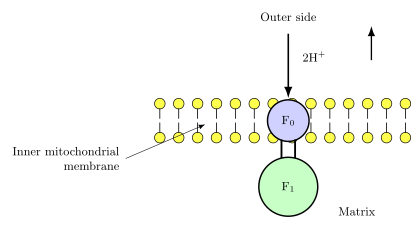
F₀ (the "o" stands for oligomycin-sensitive, a poison that blocks it) is embedded in the inner membrane. It contains a channel through which protons flow down their gradient, from the intermembrane space into the matrix. This is the "water wheel" part — the proton flow provides the mechanical energy.
F₁ sticks out into the matrix. It is the catalytic head where ADP and inorganic phosphate (Pᵢ) are bound and squeezed together to form ATP. This is the "millstone" part — it does the chemical work.
The key insight: F₀ and F₁ are physically connected by a rotating shaft (the central stalk). Proton flow through F₀ turns the shaft, and that rotation drives conformational changes in F₁ that make ATP.
How It Works: The Binding Change Mechanism
The F₁ head has three identical catalytic sites, arranged like the lobes of a clover. At any moment, each site is in one of three states:
- Open (O) — binds ADP and Pᵢ loosely
- Loose (L) — traps the bound substrates
- Tight (T) — squeezes ADP and Pᵢ together, forming ATP
As the central shaft rotates (driven by proton flow through F₀), it forces each site to cycle through these three states. One full rotation (360°) produces three ATP molecules — one from each site.
The rotation is not continuous. Each proton passing through F₀ causes a small angular step. In most organisms, 3–4 protons are needed per ATP made, because the shaft has multiple subunits (usually 8–12 c-subunits in the rotor ring).
The Proton Path Through F₀
Protons enter F₀ from the intermembrane space, bind to specific sites on the rotor ring (the c-ring), and are carried partway around the ring before being released into the matrix. This movement turns the ring, which is attached to the central shaft. The shaft then rotates inside the stationary F₁ head.
Do not confuse the direction of proton flow with the direction of rotation. Protons flow down their gradient (high concentration → low concentration), but the rotation they drive is mechanical — it is the shaft turning, not the protons themselves moving in a circle.
The Final Picture …