Question of 112
Q.(a) Predict the hybridisation of phosphorous atom in PCl5 molecule.
(1)
(b) Account for the high reactivity of PCl5 molecule.
(1)
(c) Draw the MO energy level diagram of O2 molecule. (2)
Kerala DhseKerala DHSE Plus One Board 2020Subjective· 4mImportance★★★★★
0% · 0/112 Questions
You're viewing a preview — the full solution, concept, methods & PYQ mapping are locked.
Start your 14-day free trial to unlock the full solution →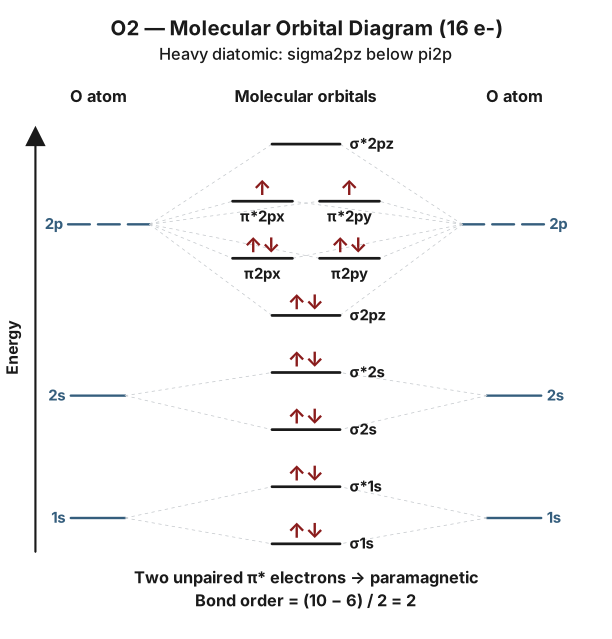
PCl5 is sp3d hybridised and reactive due to weak axial bonds; O2's MO diagram gives bond order 2 and explains its paramagnetism.
- Hybridisation of P in PCl5 Phosphorus is sp3d hybridised, giving PCl5 a trigonal bipyramidal geometry (3 equatorial P–Cl bonds at 120° to each other, 2 axial P–Cl bonds at 90° to the equatorial plane).
- High reactivity of PCl5 In the trigonal bipyramidal structure, the two axial P–Cl bonds are longer and weaker than the three equatorial P–Cl bonds, because each axial bond-pair experiences greater repulsion (from the three equatorial bond pairs at 90°) than an equatorial bond-pair does. These weaker axial bonds break more easily, so PCl5 hydrolyses readily and reacts vigorously (e.g. with water, alcohols), making it highly reactive.
- MO energy level diagram of O2 O2 has 16 electrons. For O2 (atomic number > 7, so no s–p mixing), the MO energy order is: σ1s < σ1s < σ2s < σ2s < σ2pz < (π2px = π2py) < (π2px = π2py) < σ2pz Filling 16 electrons: σ1s² σ1s² σ2s² σ2s² σ2pz² π2px²=π2py² π2px¹=π*2py¹ …
Unlock everything free for 14 days
- Full step-by-step solutions
- Concept-first explanations
- Methods, shortcuts & mistakes
- PYQ mapping + timed mock tests
Full access for 14 days. No credit card required.