Q.(i) Which of the following compound does not show cis-trans isomerism ?
(A) CHCl = CHCl (B) CH3CH = CHCH3
(C) CH3CCl = CClCH3 (D) (CH3)2C = CHC2H5
You're viewing a preview — the full solution, concept, methods & PYQ mapping are locked.
Start your 14-day free trial to unlock the full solution →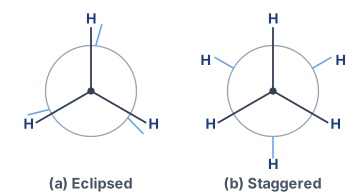
Cis-trans isomerism needs two DIFFERENT groups on each doubly-bonded carbon; (D) fails this because one carbon bears two identical methyl groups. Newman projections show the relative rotation (dihedral angle) between front and back C-H bonds around the C-C axis.
(i) For cis-trans (geometric) isomerism to be possible around a C=C double bond, each of the two doubly-bonded carbons must carry two different groups/atoms.
- (A) CHCl=CHCl: each carbon has H and Cl (different) → shows cis-trans isomerism.
- (B) CH3CH=CHCH3: each carbon has H and CH3 (different) → shows cis-trans isomerism.
- (C) CH3CCl=CClCH3: each carbon has CH3 and Cl (different) → shows cis-trans isomerism.
- (D) (CH3)2C=CHC2H5: one of the doubly-bonded carbons carries two identical CH3 groups — since the two substituents on that carbon are the same, this molecule cannot show cis-trans isomerism.
Answer: (D)
(ii) Newman projections of ethane (viewed along the C–C bond):
In a Newman projection, the front carbon is shown as a dot with three bonds radiating out at 120° to each other (to its 3 H atoms), and the back carbon is shown as a circle with three bonds also at 120° to each other (to its 3 H atoms), the two sets differing by their relative rotation (dihedral angle) about the central C–C axis.
…
Unlock everything free for 14 days
- Full step-by-step solutions
- Concept-first explanations
- Methods, shortcuts & mistakes
- PYQ mapping + timed mock tests
Full access for 14 days. No credit card required.