Q.(i) Draw the graph of the function f:R→R defined by f(x)=∣x∣.
R={(x,y):y=x+1}
🔒You're viewing a preview — the full solution, concept, methods & PYQ mapping are locked.
🔒 Start your 14-day free trial to unlock the full solution →Concept understanding — Relation Arrow Diagram
Relation Arrow Diagram
Imagine two groups of people at a party: one group of hosts, one group of guests. If you drew a string from every host to every guest they personally invited, you'd get a tangle of strings connecting the two groups. A relation arrow diagram does exactly this for sets — it draws an arrow from each element that is "related to" an element in the other set, so you can see a relation instead of just listing ordered pairs.
The Intuition First
A relation pairs up elements of one set with elements of another. Suppose:
- Set A={Ravi,Anu,Kiran} (students)
- Set B={Maths,Physics,Chemistry} (subjects)
and the relation is "studies": Ravi studies Maths and Physics; Anu studies only Chemistry; Kiran studies all three.
To draw the arrow diagram, list the elements of A in one oval on the left, the elements of B in another oval on the right, and draw one arrow for every pairing:
- Ravi → Maths
- Ravi → Physics
- Anu → Chemistry
- Kiran → Maths
- Kiran → Physics
- Kiran → Chemistry
Count the arrows leaving each name in A: Ravi has 2, Anu has 1, Kiran has 3 — six arrows in total, one for each ordered pair in the relation. That is the whole diagram: two ovals of labelled points, joined by one arrow per related pair.
The name comes from the arrows, not the ovals. What matters is: which element points to which, and in which direction.
The Precise Definition
Let A and B be two non-empty sets. A relation R from A to B is a subset of A×B (the Cartesian product). The arrow diagram of R represents this visually:
- Elements of A are listed in one oval (conventionally on the left).
- Elements of B are listed in another oval (on the right).
- An arrow is drawn from a∈A to b∈B if and only if (a,b)∈R.
Every arrow corresponds to exactly one ordered pair in R. If a diagram has k arrows, the relation has exactly k ordered pairs — nothing more, nothing less.
Key Points to Remember
- Direction matters. An arrow always starts at an element of A and ends at an element of B. An arrow "Ravi → Maths" is not the same statement as "Maths → Ravi" — the first element of the ordered pair is always where the arrow starts.
- An element of A can send multiple arrows. Kiran, above, sends three — one element can be related to many elements of B.
- An element of A can send zero arrows. Nothing requires every element of A to be related to something in B. If a student studies none of the listed subjects, no arrow leaves their name.
- An element of B can receive multiple arrows. Both Ravi and Kiran point to Maths — an element of B can be related to many elements of A.
A common mistake: assuming every element of A must have at least one outgoing arrow, or that every element of B must receive one. Neither is required. A relation can leave elements on either side completely unconnected.
A Relation on a Single Set
When a relation goes from a set to itself, both ovals contain the same elements, so they are usually drawn as one oval with arrows looping back into it. …
The modulus function's V-shaped graph is built from two linear rays meeting at the origin, and the relation is found by checking, for each element of A in turn, whether adding 1 to it keeps the result inside A. …
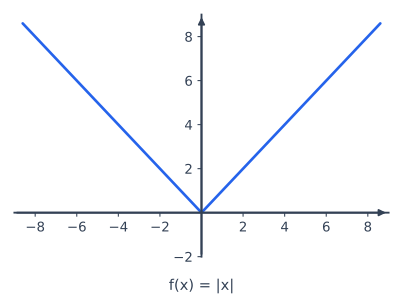
The graph of f(x)=∣x∣ is a V-shaped curve made of two rays meeting at the origin. For the relation R={(x,y):y=x+1} on A={1,2,3,4,5,6}, only pairs where both x and x+1 lie in A survive, giving 5 ordered pairs and domain {1,2,3,4,5}.
(i) Graph of f(x)=∣x∣
The modulus function is defined piecewise:
f(x)=∣x∣={x,−x,x≥0x<0
A table of values:
| x | −3 | −2 | −1 | 0 | 1 | 2 | 3 |
|---|---|---|---|---|---|---|---|
| f(x) | 3 | 2 | 1 | 0 | 1 | 2 | 3 |
Plotting these points: for x≥0 the graph is the straight line y=x (a ray from the origin going up-right at 45∘ to the x-axis); for x<0 it is the straight line y=−x (a ray from the origin going up-left, also at 45∘ to the x-axis). The two rays meet at the origin (0,0), forming a symmetric V-shape that is symmetric about the y-axis (since f(−x)=f(x)). The graph lies entirely in the region y≥0; its domain is R and its range is [0,∞).
(ii) The relation R={(x,y):y=x+1} on A={1,2,3,4,5,6}
Check each x∈A to see whether y=x+1 also lies in A:
- x=1⇒y=2∈A -> (1,2)
- x=2⇒y=3∈A -> (2,3)
- x=3⇒y=4∈A -> (3,4)
- x=4⇒y=5∈A -> (4,5)
- x=5⇒y=6∈A -> (5,6)
- x=6⇒y=7∈/A -> rejected
So R={(1,2),(2,3),(3,4),(4,5),(5,6)}.
…
- CBSE 2026Set ANNUAL1 markMCQQ.Case study: In our country there are nearly 950 million people who are voters and the voter turn up for voting is nearly 65%. Let A be the set of all citizens of India who are eligible to vote. A relation R is defined on A as follows: R = {(V1, V2) : V1, V2 ∈ A and V1 and V2 both casted their votes in election}. Let X and Y ∈ A, X casted his vote but Y did not cast his vote. Wife of X is W ∈ A and she casted her vote. F1, F2 and F3 are three friends who are voters and all casted their votes in election; F1, F2, F3 ∈ A. Now which of the following is true?(a) (X, Y) ∈ R(b) (Y, X) ∈ R(c) (Y, Y) ∈ R(d) (X, Y) ∉ R
›Reveal solutionSolution
R only relates people who BOTH voted; since Y did not cast a vote, no pair involving Y as either element can be in R.
The relation is R={(V1,V2):V1,V2∈A and both V1 and V2 casted their votes}.
We're told X casted his vote, but Y did not cast his vote.
For the ordered pair (X,Y) to belong to R, both X and Y must have voted. Since Y did not vote, this condition fails regardless of X's status.
So (X,Y)∈/R.
…
- CBSE 2026Set ANNUAL1 markMCQQ.(Continuing the same case study on relation R defined on the set of voters A — see 36(i) for full context.) Which of the following is true?(a) (X, W) ∈ R and (W, X) ∈ R(b) (X, W) ∈ R but (W, X) ∉ R(c) (X, W) ∉ R and (W, X) ∉ R(d) (W, X) ∈ R but (X, W) ∉ R
›Reveal solutionSolution
Since both X and W (X's wife) casted their votes, the pair condition of R is satisfied in both orders.
We're told X casted his vote, and W (his wife) also casted her vote.
Since the relation R requires only that both elements of the pair voted — with no directional/order-dependent condition — and both X and W voted:
(X,W)∈Rand(W,X)∈R
…
- CBSE 2026Set ANNUAL1 markMCQQ.(Continuing the same case study on relation R defined on the set of voters A — see 36(i) for full context.) Which of the following is true?(a) (F1, F2) ∈ R, (F2, F3) ∈ R, (F1, F3) ∈ R(b) (F1, F2) ∈ R, (F2, F3) ∈ R but (F1, F3) ∉ R(c) (F1, F2) ∈ R, (F2, F2) ∈ R but (F3, F3) ∉ R(d) (F1, F2) ∉ R, (F2, F3) ∉ R and (F1, F3) ∉ R
›Reveal solutionSolution
F1, F2, F3 all casted their votes, so every pair drawn from among them satisfies R's "both voted" condition.
We're told F1,F2,F3 are all voters who all casted their votes.
…
- CBSE 2026Set ANNUAL1 markMCQQ.(Continuing the same case study on relation R defined on the set of voters A — see 36(i) for full context.) Relation R is:(a) Symmetric only(b) Reflexive only(c) Transitive only(d) Equivalence relation
›Reveal solutionSolution
Testing each property: R fails reflexivity (since only ~65% of voters actually voted, not everyone in A), but R IS symmetric and IS transitive whenever it holds — a case the listed 4 options don't fully capture.
Let's test each property of R={(V1,V2):V1,V2∈A, V1 and V2 both voted} against the full set A (all eligible voters, not just those who voted):
Reflexive? This requires (a,a)∈R for every a∈A, i.e. every eligible voter must have voted. Since the turnout is only about 65% (and we're explicitly told Y did not vote), this fails for people like Y: (Y,Y)∈/R. R is NOT reflexive.
Symmetric? If (a,b)∈R, then both a and b voted — which automatically means both b and a voted too, so (b,a)∈R. R IS symmetric.
Transitive? If (a,b)∈R and (b,c)∈R, then a,b both voted and b,c both voted — so a and c both voted, giving (a,c)∈R. R IS transitive.
Conclusion: R is both symmetric and transitive, but not reflexive — so it is not an equivalence relation on the full set A (it would be an equivalence relation only on the subset of people who actually voted).
…
- CBSE 2023Set ANNUAL1 markMCQQ.R={(x,x+5):x∈{0,1,2,3,4,5}} defines a relation R; its domain will be:(a) {5,6,7,8,9,10}(b) {1,2,3,4,5}(c) {0,1,2,3,4,5}(d) none of these
›Reveal solutionSolution
R is built from x∈{0,1,2,3,4,5}, so its domain is exactly that set: {0,1,2,3,4,5}.
The relation is R={(x,x+5):x∈{0,1,2,3,4,5}}. Writing out the pairs: (0,5),(1,6),(2,7),(3,8),(4,9),(5,10).
…
- CBSE 2023Set ANNUAL1 markMCQQ.Let A={1,2,3} and B={a,b}. Which of the following subsets of A×B is a mapping from A to B.(a) {(1,a),(3,b),(2,a),(2,b)}(b) {(1,b),(2,a),(3,a)}(c) {(1,a),(2,b)}(d) None of these
›Reveal solutionSolution
Only (b) is a mapping from A to B.
A function from A={1,2,3} to B must pair every element of A with exactly one element of B (NCERT Class 11 Relations and Functions).
- (a) has (2,a) and (2,b) — 2 has two images ✗. …
- CBSE 2022Set ANNUAL1 markQ.Let A = {1, 2, 3, 4, 5, ......, 14}. A relation R is defined from A to A where R = {(x, y) : y = 3x, x, y ∈ A}. Then the range of relation R is {............}.
›Reveal solutionSolution
Only x=1,2,3,4 give a y=3x that stays within A={1,…,14}.
A={1,2,3,…,14} and R={(x,y):y=3x, x,y∈A}.
We need y=3x≤14, so x≤14/3≈4.67, meaning x∈{1,2,3,4} (and x≥1 since x∈A).
…
- CBSE 2022Set ANNUAL1 markQ.Find the domain and range of the relation R defined by R={(x,x+5):x∈{0,1,2,3,4,5}}.
›Reveal solutionSolution
Domain ={0,1,2,3,4,5}; Range ={5,6,7,8,9,10}.
R={(x,x+5):x∈{0,1,2,3,4,5}} gives the pairs (0,5),(1,6),(2,7),(3,8),(4,9),(5,10).
…
- CBSE 2022Set ANNUAL1 markMCQQ.The number of relations which are possible from a set A of m elements to another set B of n elements is(a) mn(b) nm(c) m.n(d) 2mn
›Reveal solutionSolution
Number of relations from A to B is 2mn.
…
- CBSE 2021Set ANNUAL1 markQ.Let A = {0, 1, 2, 3, 4, 5, 6, 7}. A relation R is defined from A to A where R = {(x, y) : y = x + 5, x, y ∈ A}. Then the relation R has the range {...........}.
›Reveal solutionSolution
Only x=0,1,2 give y=x+5 inside A, so the range is {5, 6, 7}.
A={0,1,2,3,4,5,6,7} and R={(x,y):y=x+5, x,y∈A}.
For each x∈A, we need y=x+5 to also be a member of A, i.e. x+5≤7, so x≤2.
- x=0⇒y=5
- x=1⇒y=6
- x=2⇒y=7 …
- CBSE 2020Set ANNUAL1 markQ.Let A={1,2,3,…,14}. Define a relation R from A to A by R={(x,y):3x−y=0, where x,y∈A}. Write down its domain.
›Reveal solutionSolution
The domain of R is {1,2,3,4}.
R={(x,y):3x−y=0, x,y∈A} means y=3x. For (x,y) to be a valid pair, both x and y=3x must lie in A={1,2,…,14}.
…
🎓Unlock everything free for 14 days
- ✓Full step-by-step solutions
- ✓Concept-first explanations
- ✓Methods, shortcuts & mistakes
- ✓PYQ mapping + timed mock tests
Full access for 14 days. No credit card required.