Q.State theorem of perpendicular axes on moment of inertia. Derive an expression to find the moment of inertia of a circular disc about one of its diameters with the help of a neat diagram.
You're viewing a preview — the full solution, concept, methods & PYQ mapping are locked.
Start your 14-day free trial to unlock the full solution →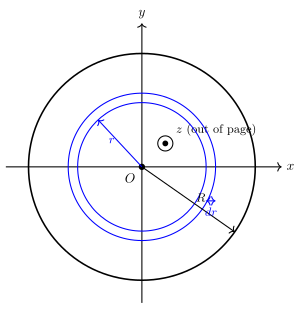
The theorem of perpendicular axes states that for a flat (planar) lamina, the moment of inertia about an axis perpendicular to its plane equals the sum of the moments of inertia about two mutually perpendicular axes lying in the plane, all three axes meeting at one point: . Applying this to a circular disc — whose moment of inertia about the central axis perpendicular to its plane is — and using the symmetry of the disc about any diameter () gives the moment of inertia about a diameter as .
Statement of the theorem of perpendicular axes
The moment of inertia of a planar lamina about an axis perpendicular to its plane (say the -axis) is equal to the sum of its moments of inertia about any two mutually perpendicular axes ( and ) lying in the plane of the lamina and intersecting each other at the point where the perpendicular axis passes through the lamina.
This theorem holds only for a flat, two-dimensional (planar) body.
Diagram (to draw): A thin circular disc of radius , lying flat in the plane of the page, with its centre at . Draw the -axis through , perpendicular to the disc (coming straight out of the page), and two mutually perpendicular diameters through , taken as the -axis and -axis, both lying in the plane of the disc.
Step 1 — Moment of inertia of the disc about the central axis perpendicular to its plane ()
Consider a uniform disc of mass and radius , with surface mass density .
Divide the disc into thin concentric rings centred at . Consider one such ring of radius and thickness .
Area of the ring , so its mass is .
Every particle of this ring is at the same perpendicular distance from the -axis, so its contribution to the moment of inertia about the -axis is:
Integrating over the whole disc, from to :
…
Unlock everything free for 14 days
- Full step-by-step solutions
- Concept-first explanations
- Methods, shortcuts & mistakes
- PYQ mapping + timed mock tests
Full access for 14 days. No credit card required.