Symmetry In Animals
Imagine you are looking at a starfish. You could draw a line through its centre in several directions, and each side would look roughly like a mirror image of the other. Now imagine a dog. There is only one line — straight down the middle of its face and spine — that gives you two matching halves. A sponge, on the other hand, has no line at all that works.
That is the core idea: symmetry is about how the parts of an animal's body are arranged around a central point or axis. It tells you whether the animal has a definite shape, and if so, how many ways you can cut it into equal-looking halves.
The Intuition: Why Does Symmetry Matter?
Symmetry is not just a visual curiosity. It is deeply tied to how an animal lives.
An animal that moves actively in one direction — say, a fish swimming forward — needs a head end (to sense what is coming) and a tail end (to push). Its left and right sides become mirror images because they experience the same forces and need the same muscles. That is bilateral symmetry, and it is the hallmark of animals that chase prey, flee predators, or navigate a complex environment.
An animal that stays fixed in one place, like a sea anemone, does not need a front or back. It needs to reach out in all directions equally to catch food or sense danger. That is radial symmetry — a body built like a wheel, with spokes radiating from a centre.
An animal that has no symmetry at all, like a sponge, simply grows however the environment allows. It has no organised body plan, no consistent left or right, no front or back. That is asymmetry.
The Precise Statement
In biology, symmetry is defined by the number of planes that can divide the body into two mirror-image halves.
Symmetry=Number of planes that produce mirror-image halves
Here is the breakdown:
1. Asymmetry — No plane of symmetry exists. The body has no definite shape. Example: sponges (Porifera). Even within a single species, two individuals look completely different.
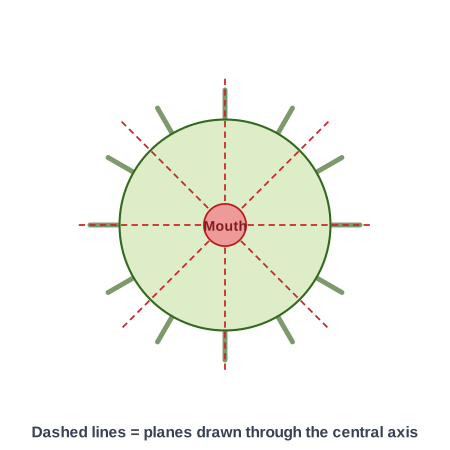
2. Radial Symmetry — Any plane passing through the central axis (the oral-aboral axis, from mouth to opposite end) divides the animal into mirror halves. The body is arranged like a cylinder or a wheel. Examples: cnidarians (jellyfish, hydra), echinoderms (starfish — though their larvae are bilateral, adults are radial).
In radial symmetry, there is no left or right, no front or back. There is only a top (oral side, with the mouth) and a bottom (aboral side).
3. Bilateral Symmetry — Exactly one plane, the sagittal plane (down the midline), divides the body into left and right mirror images. This plane runs from the head (anterior) to the tail (posterior) and from the back (dorsal) to the belly (ventral). Examples: most animals — worms, insects, fish, reptiles, birds, mammals (including humans).
Bilateral symmetry does not mean the inside organs are perfectly mirrored. Your heart is on the left, your liver on the right. The symmetry is about the external body plan and the overall arrangement of the major body axes.
How This Is Used in Classification
Symmetry is one of the very first filters in animal classification. It tells you about the animal's lifestyle and evolutionary history.
- Asymmetry is primitive. Sponges are the simplest animals, and they lack symmetry entirely.
- Radial symmetry is associated with a sessile (fixed) or planktonic (drifting) lifestyle. It evolved from bilateral ancestors in some groups (like echinoderms), but in cnidarians it is the ancestral condition. …