Q.(i) If A(x) = ∫ (from 0 to x) x² dx is the area function, then A'(2) is
🔒You're viewing a preview — the full solution, concept, methods & PYQ mapping are locked.
🔒 Start your 14-day free trial to unlock the full solution →Concept understanding — Area Under Parabola
Area Under a Parabola
Picture the simplest parabola, y=x2: a smooth U opening upward with its lowest point at the origin. Suppose we want the area trapped between this curve, the x-axis, and the vertical lines x=0 and x=1 — the area under the parabola on [0,1].
A rough estimate helps. A rectangle of base 1 and height 1 gives area 1 — too big, since the curve sits well below its top. A triangle gives 21×1×1=0.5 — too small, since the curve bulges above the straight edge. So the true area lies somewhere between 0.5 and 1.
Calculus pins it down exactly. The area under a curve y=f(x) from x=a to x=b (with f(x)≥0) is the definite integral
Area=∫abf(x)dx.
For y=x2 from 0 to 1 we use the power rule
∫xndx=n+1xn+1+C(n=−1)
so, with n=2,
∫01x2dx=[3x3]01=31−0=31.
The exact area is 31 square units (about 0.333) — comfortably between our two guesses.
The area is exactly one-third of the bounding rectangle. In general, under y=x2 from 0 to a the area is 3a3, i.e. one-third of the a×a2 rectangle.
The general statement
For y=kx2 (k constant), the area from x=a to x=b is
∫abkx2dx=k⋅3b3−a3.
If the parabola is shifted, such as y=x2+c, integrate term by term. If it opens sideways, such as x=y2, integrate with respect to y instead. …
Part (i) uses the Fundamental Theorem of Calculus, which says the derivative of an area function A(x)=∫₀ˣf(t)dt is simply f(x); part (ii) splits the region at the parabola's x-intercepts into the part below the axis and the part above it, taking absolute …
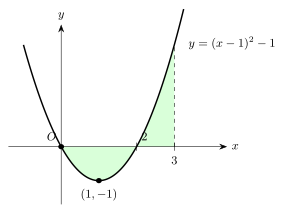
(i) By the Fundamental Theorem of Calculus, the derivative of an area function A(x) = ∫₀ˣ f(t)dt is just f(x). (ii) Split the region into the part below the x-axis (x = 0 to 2, where the parabola dips negative) and the part above it (x = 2 to 3), taking absolute values, then add.
(i) A′(2). The area function is A(x)=∫0xt2dt (t is the dummy variable of integration; x is the upper limit). By the Fundamental Theorem of Calculus, A′(x)=x2 for the upper-limit variable. So A′(2)=22=4. Answer: (a) 4.
(This can also be checked directly: A(x)=3x3, so A′(x)=x2, giving A′(2)=4.)
(ii) Area of the shaded region for y=(x−1)2−1. This parabola has vertex (1,−1) and crosses the x-axis where (x−1)2−1=0⇒(x−1)2=1⇒x=0 or x=2. So the curve dips below the x-axis on [0,2] and rises above it on [2,3] (matching the figure, which shades the region between the curve and the x-axis from x=0 to x=3).
An antiderivative: ∫[(x−1)2−1]dx=3(x−1)3−x+C.
Part below the axis, x=0 to x=2:
∫02[(x−1)2−1]dx=[3(x−1)3−x]02=(31−2)−(3−1−0)=(31−2)+31=32−2=−34. …
- CBSE 2026Set 65/1/11 markMCQQ.The area bounded by the curve y=x∣x∣, x-axis and the ordinates x=−1 and x=1 is given by (A) 0 (B) 31 (C) 32 (D) 3
›Reveal solutionSolution
The curve y=x∣x∣ is an odd function, so the signed area cancels to zero, but the bounded area (absolute area) is the sum of two equal positive lobes, giving 32.
The key here is to understand what y=x∣x∣ actually looks like. The absolute value on x splits the definition into two cases:
- When x≥0, ∣x∣=x, so y=x⋅x=x2.
- When x<0, ∣x∣=−x, so y=x⋅(−x)=−x2.
So the curve is a parabola opening upward on the right side, and a parabola opening downward on the left side. It is an odd function: f(−x)=−f(x). This symmetry is the heart of the problem.
The question asks for the area bounded by the curve, the x-axis, and the vertical lines x=−1 and x=1. "Area bounded" means geometric area — always positive — not signed area (the integral). This is a classic trap.
Let’s work through it.
- Set up the absolute area integral. The geometric area between a curve y=f(x) and the x-axis from x=a to x=b is ∫ab∣f(x)∣dx. Here:
Area=∫−11∣x∣x∣∣dx.
- Simplify ∣x∣x∣∣. Since ∣x∣x∣∣=∣x∣⋅∣x∣=∣x∣2=x2 (because squaring removes the sign), we have:
∣x∣x∣∣=x2for all real x.
That’s a neat simplification: the absolute value of the function is just x2, a simple upward parabola.
- Compute the integral.
Area=∫−11x2dx.
The antiderivative of x2 is 3x3. So: …
- CBSE 2026Set 65/2/11 markMCQQ.Which of the following expressions will give the area of region bounded by the curve y=x2 and line y=16? (A) ∫04x2dx (B) 2∫04x2dx (C) ∫016ydy (D) 2∫016ydy
›Reveal solutionSolution
The region between y=x2 and y=16 is symmetric about the y-axis; integrating horizontally from y=0 to y=16 with x=y and doubling for both sides gives 2∫016ydy.
The parabola y=x2 opens upward with vertex at the origin, and the horizontal line y=16 cuts it at two points. Finding those intersection points: x2=16 gives x=±4. So the bounded region sits between x=−4 and x=4, below the line and above the parabola.
The key decision is whether to integrate with respect to x (vertical slices) or y (horizontal slices). Both are valid, but the setup differs.
Vertical slices (integrating with respect to x):
At any x between −4 and 4, a vertical strip runs from the parabola y=x2 up to the line y=16. The height of that strip is 16−x2. The area is
A=∫−44(16−x2)dx.
Because the integrand 16−x2 is even (symmetric about x=0), this equals
A=2∫04(16−x2)dx=2∫0416dx−2∫04x2dx.
Notice that ∫04x2dx alone is not the area; it gives the area under the parabola from 0 to 4, not the region between the parabola and the line. So option (A) is incorrect, and option (B) is also incorrect (it's twice the area under the parabola, not the region we want).
Horizontal slices (integrating with respect to y):
At any height y between 0 and 16, a horizontal strip extends from the left branch of the parabola to the right branch. Solving y=x2 for x gives x=±y. The width of the strip is
y−(−y)=2y.
The area is then
A=∫0162ydy=2∫016ydy.
This matches option (D). …
- CBSE 2026Set ANNUAL1 markMCQQ.Area of the region bounded by the curve y2=4x, y-axis and the line y=3 is(a) 2(b) 4/9(c) 9/4(d) 9/2
›Reveal solutionSolution
Integrate x as a function of y (since the boundary is the y-axis and the line y=3) using x=y2/4 from the parabola.
From y2=4x, x=4y2.
…
- CBSE 2026Set ANNUAL1 markMCQQ.Area of the region bounded by the curve y2=4x, y-axis and the line y=3 is:(a) 2(b) 49(c) 39(d) 29
›Reveal solutionSolution
Integrate x=4y2 with respect to y from 0 to 3, since the region is bounded by the y-axis.
For y2=4x, we have x=4y2.
The area bounded by the curve, the y-axis, and y=3 (from y=0 to y=3) is
…
- CBSE 2025Set 65/1/11 markMCQQ.The area of the shaded region bounded by the curves y2=x,x=4 and the x-axis is given by (A) ∫04xdx (B) ∫02y2dy (C) 2∫04xdx (D) ∫04xdx
›Reveal solutionSolution
The shaded region is the area under the parabola y2=x from x=0 to x=4, above the x-axis. This area equals ∫04xdx, which matches option (D).
The problem asks for the area of the region bounded by y2=x, the vertical line x=4, and the x-axis. Let’s first picture what’s happening.
The curve y2=x is a right-opening parabola with its vertex at the origin. For a given x, y=±x. The x-axis is y=0, and the line x=4 cuts off the region on the right. The “shaded region” is typically the part above the x-axis — that is, the area under the upper half of the parabola from x=0 to x=4.
So we want the area between y=x (the upper branch), the x-axis, and the vertical line x=4.
1. Set up the integral with respect to x
The upper boundary is y=x, the lower boundary is y=0, and x runs from 0 to 4. The area is:
Area=∫x=04(x−0)dx=∫04xdx
That’s exactly option (D).
2. Check the other options
- (A) ∫04xdx would give the area under the line y=x, not under x. That’s a different shape entirely.
- (B) ∫02y2dy comes from rewriting x=y2 and integrating with respect to y from y=0 to y=2 (since at x=4, y=2). That actually gives the same numerical area — but the question asks for the area of the region bounded by the given curves and the x-axis, and the standard representation in x is ∫xdx. Option (B) is a valid alternative form, but it’s not the one listed that matches the direct x-integral.
- (C) 2∫04xdx would give the area of the full parabola (both upper and lower halves), which is twice the shaded region. …
- CBSE 2025Set 65/2/11 markMCQQ.The area of the shaded region (figure) represented by the curves y=x2, 0≤x≤2, and the y-axis is given by: (A) ∫02x2dx (B) ∫02ydy (C) ∫04x2dx (D) ∫04ydy
›Reveal solutionSolution
When integrating along the y-axis for a region bounded by y=x2 from x=0 to x=2, we express x in terms of y and integrate with respect to y over the corresponding range 0≤y≤4. The answer is (D) ∫04ydy.
The question asks for the area of a region bounded by the parabola y=x2 (from x=0 to x=2) and the y-axis. The key is recognizing that we can compute area by integrating either horizontally or vertically, and the setup depends entirely on which variable we choose as our integration variable.
When we integrate with respect to x, we sum vertical strips of width dx and height y=x2. When we integrate with respect to y, we sum horizontal strips of width dy and length equal to the horizontal distance from the y-axis to the curve.
Let me identify what happens at the boundaries. At x=0, we have y=02=0. At x=2, we have y=22=4. So as x ranges from 0 to 2, the variable y ranges from 0 to 4.
Now let's examine each option:
-
Option (A): ∫02x2dx
This integrates with respect to x from 0 to 2, summing vertical strips of height x2. This gives the area under the curve y=x2 from x=0 to x=2, which is indeed the region described. This is a valid representation.
-
Option (B): ∫02ydy
This integrates with respect to y, but only from 0 to 2. Since the curve reaches y=4 when x=2, stopping at y=2 would only capture part of the region. This is incorrect.
-
Option (C): ∫04x2dx
This integrates with respect to x from 0 to 4, which extends beyond the given domain 0≤x≤2. This would compute the area under the parabola all the way to x=4, which is not our region. This is incorrect.
-
Option (D): ∫04ydy …
-
- CBSE 2024Set ANNUAL1 markMCQQ.Area of the region bounded by the curve y2=4x, y-axis and the line y=3 is:(a) 2(b) 49(c) 89(d) 29
›Reveal solutionSolution
Integrate x as a function of y (since x=y2/4) from y=0 to y=3.
The parabola is y2=4x, so x=4y2.
Area bounded by the curve, the y-axis, and the line y=3:
…
- CBSE 2023Set ANNUAL1 markMCQQ.The area of the region bounded by the curve y=x2 and the line y=4 is:(a) 233(b) 38(c) 332(d) 34
›Reveal solutionSolution
Find where y=x2 meets y=4, then integrate the vertical strip (4−x2) between those limits.
The curve y=x2 meets y=4 where x2=4, i.e. x=±2.
By symmetry about the y-axis, the required area is
…
- CBSE 2023Set ANNUAL1 markQ.Find the area of the region bounded by y2=9x;x=2,x=4 and the x-axis in the first quadrant.
›Reveal solutionSolution
Express y in terms of x from y2=9x (first quadrant, so y≥0) and integrate between x=2 and x=4.
y2=9x⇒y=3x (taking the positive root, first quadrant)
…
- CBSE 2022Set ANNUAL1 markQ.The area of the region bounded by the curve y=x2, X-axis, x=−1 and x=1 is ____ square unit(s). Choices given: [34, 32, 21, 1]
›Reveal solutionSolution
Integrate y=x2 from −1 to 1; since the parabola is symmetric and non-negative, this directly gives the enclosed area.
…
- CBSE 2019Set HE1 markQ.Fill in the blank: Area bounded by curve y=x2, X-axis and x=1, x=2 is ______.
›Reveal solutionSolution
Integrate y=x2 from x=1 to x=2 to get area 37.
The area bounded by the curve y=x2, the X-axis, and the lines x=1,x=2 is A=∫12x2dx.
…
🎓Unlock everything free for 14 days
- ✓Full step-by-step solutions
- ✓Concept-first explanations
- ✓Methods, shortcuts & mistakes
- ✓PYQ mapping + timed mock tests
Full access for 14 days. No credit card required.