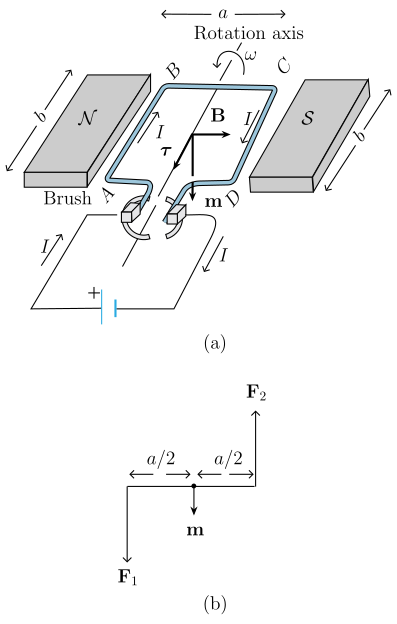
Imagine a compass needle in the Earth's magnetic field. The needle always turns until it points north. Why? Because the needle itself is a tiny magnet, and the field exerts a twist — a torque — that tries to align it.
A current-carrying loop behaves exactly like that tiny magnet. It has a magnetic momentm, which is like its own internal compass arrow. When you place this loop in an external magnetic field B, the field pulls on one side of the loop and pushes on the other, creating a turning effect.
The loop doesn't feel a net force (if the field is uniform), but it does feel a torque. That torque always tries to rotate the loop so that its magnetic moment points along the field — just like a compass needle.
The Key Players
The magnetic moment of a planar current loop is:
m=IAn^
where I is the current, A is the area of the loop, and n^ is a unit vector perpendicular to the plane of the loop (direction given by the right-hand rule: curl your fingers along the current, your thumb points along m).
The external field B is uniform — same magnitude and direction everywhere in the region of the loop.
The Torque: Two Equivalent Forms
The torque on the loop is:
τ=mBsinθ
where θ is the angle between m and B. The torque is maximum when m is perpendicular to B (θ=90∘), and zero when they are parallel or antiparallel (θ=0∘ or 180∘).
The vector form captures both magnitude and direction:
τ=m×B
τ=m×B
The cross product tells you: the torque is perpendicular to both m and B, and its direction is given by the right-hand rule. This torque always rotates m toward B.
Why It Happens (The Physics)
Consider a rectangular loop of sides a and b, carrying current I, placed in a uniform field B. Let the plane of the loop make an angle θ with the field.
The two sides of length a are perpendicular to B. On each of these sides, the magnetic force is F=IaB, but the forces on opposite sides are in opposite directions. These two forces form a couple — equal and opposite, not along the same line — which produces a torque.
The lever arm for each force is (b/2)sinθ, so the net torque is:
τ=2×(IaB)×2bsinθ=I(ab)Bsinθ=IABsinθ
Since m=IA, we get τ=mBsinθ.
Tip
For a rectangular loop, the torque comes only from the sides perpendicular to the field. The sides parallel to the field experience forces that are either zero or along the axis — they contribute nothing to the torque.
The Stable Equilibrium
When m is aligned with B (θ=0), the torque is zero. This is a stable equilibrium — if you nudge the loop slightly, the torque brings it back. …
A current loop in a uniform field experiences a torque from the forces acting on its current-carrying sides, giving τ = NIAB sinθ; the same loop's magnetic moment, m = NIA, instead follows directly from its number of turns, current and area, as used to answer (b). …
Figure — Part (a) is a hard 'Derive the expression for the torque on a rectangular current loop in a uniform magnetic f
A current loop in a magnetic field experiences a torque τ=NIABsinθ that tends to align its magnetic moment with the field; for the given 100-turn coil the magnetic moment works out to about 10.05A⋅m2.
(a) Torque on a rectangular current loop: Consider a rectangular loop PQRS of sides l (arms PQ and RS) and b (arms QR and SP), carrying current I, placed in a uniform magnetic field B such that the normal to the loop makes an angle θ with B.
The forces on the two arms QR and SP (each of length b, lying along the axis of rotation) are equal, opposite, and collinear — they cancel and produce no net torque.
The forces on the arms PQ and RS (each of length l), being perpendicular to B, are equal in magnitude, F=BIl, but opposite in direction — they form a couple. The perpendicular distance between these two forces (moment arm) is bsinθ (since the loop's plane is tilted by angle θ from B's perpendicular plane). Hence the torque of this couple:
τ=F×(bsinθ)=BIl×bsinθ=BI(lb)sinθ=BIAsinθ
where A=lb is the area of the loop. For a coil of N turns:
Same / Similar Concept — real previous-year questions on the same or a closely similar concept, not this exact question.
CBSE 2026Set ANNUAL1 markMCQ
Q.If vector m be the magnetic moment of a magnetic dipole placed in a magnetic field of induction vector B, the torque experienced by the dipole will be
(a) m . B
(b) |m| / |B|
(c) m x B
(d) |m| |B|
›Reveal solutionSolution
The torque on a magnetic dipole is τ=m×B, analogous to torque on an electric dipole p×E.
When a magnetic dipole of moment m is placed in a uniform magnetic field B, it experiences a torque that tends to align it with the field. This torque is given by the vector product:
Q.The torque on a rectangular current loop in a uniform magnetic field increases by ———————— the area of the loop.
Fill in the blank choosing the appropriate answer from the bracket: (decreasing, interference, helium, greater, diffraction, increasing)
›Reveal solutionSolution
increasing (the torque is directly proportional to the area of the loop). …
Q.The value of torque (τ) experienced by current loop of magnetic moment (m) placed in magnetic field (B) is
(A) τ = m × B
(B) τ = B × m
(C) τ = m/B
(D) τ = B/m
›Reveal solutionSolution
A current loop behaves like a magnetic dipole; the torque on it is the cross product of its magnetic moment and the field, τ = m × B.
A planar current loop carrying current I and enclosing area A has a magnetic (dipole) moment m=IA, directed along the normal to the loop (right-hand rule).
When this dipole is placed in a uniform magnetic field B, the two sides of the loop carry equal and opposite forces that form a couple. The resulting torque is
Q.Two statements are given — one labelled Assertion (A) and the other labelled Reason (R). Select the correct answer from the codes (A), (B), (C) and (D) as given below. (A) Both Assertion (A) and Reason (R) are true and Reason (R) is the correct explanation of the Assertion (A). (B) Both Assertion (A) and Reason (R) are true, but Reason (R) is not the correct explanation of the Assertion (A). (C) Assertion (A) is true, but Reason (R) is false. (D) Assertion (A) is false and Reason (R) is also false. Assertion (A) : A current carrying square loop made of a wire of length L is placed in a magnetic field. It experiences a torque which is greater than the torque on a circular loop made of the same wire carrying the same current in the same magnetic field. Reason (R) : A square loop occupies more area than a circular loop, both made of wire of the same length.
›Reveal solutionSolution
For a fixed wire length L, a circle encloses the maximum area, so the square loop has less area than the circular loop. Since torque τ=NIABsinθ depends directly on area, the square loop experiences less torque — making Assertion false and Reason false as well. The correct choice is (D).
The Core Idea: Magnetic Torque and Area
When a current-carrying loop sits in a uniform magnetic field, the net force on it is zero, but the field exerts a torque that tries to rotate the loop. The magnitude of this torque is given by:
τ=NIABsinθ
Here N is the number of turns (1 for a single loop), I is the current, A is the area enclosed by the loop, B is the magnetic field strength, and θ is the angle between the loop’s normal and the field. For a fixed I, B, and θ, the torque is directly proportional to the area A.
So the question boils down to: for a given wire length L, which shape — square or circle — gives a larger area?
Step-by-Step Reasoning
The wire length is fixed. Both loops are made from the same wire of total length L. This length becomes the perimeter of each loop. For the square, each side is L/4, so its area is:
Asquare=(4L)2=16L2
For the circle, the circumference is L=2πr, so the radius is r=L/(2π). The area is:
Acircle=πr2=π(2πL)2=4πL2
Compare the two areas. Which is larger? Compare L2/16 and L2/(4π). Since L2 is positive, we compare the denominators: 16 vs 4π≈12.57. A smaller denominator means a larger fraction, so:
4πL2>16L2
Therefore, Acircle>Asquare.
Tip
This is a classic isoperimetric result: for a given perimeter, the circle encloses the maximum possible area. Any other shape — square, rectangle, triangle — will have a smaller area. Memorising this saves you from recalculating every time. …
Q.A conducting circular loop of radius r carries a constant current I. It is placed in a uniform magnetic field B such that B is perpendicular to the plane of the loop. The magnetic force acting on the loop is
(a) BIr
(b) 2πrIB
(c) zero
(d) πrIB
›Reveal solutionSolution
The net magnetic force on any closed current loop placed in a uniform magnetic field is always zero.
For a current loop in a UNIFORM magnetic field B, the net force is F = I∮dl×B = I(∮dl)×B. Since the vector sum of all the line elements around a closed loop is zero (∮dl = 0), the net force is always zero — regardless of the loop's shape or its orientation relative to B. (A net torque can still act if …