Q.Determine the following in an alternating L-C-R circuit :
You're viewing a preview — the full solution, concept, methods & PYQ mapping are locked.
Start your 14-day free trial to unlock the full solution →Phasor addition of V_R (in phase), V_L (leads by 90°) and V_C (lags by 90°) gives V = √(V_R² + (V_L − V_C)²), Z = √(R² + (X_L − X_C)²), tanφ = (X_L − X_C)/R.
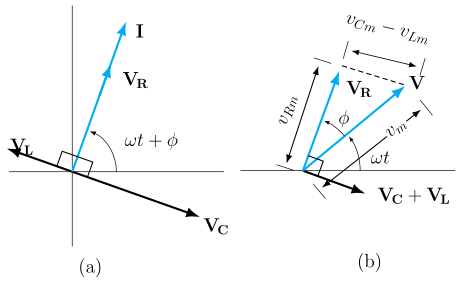
Consider a resistor R, inductor L and capacitor C connected in series across an AC source of angular frequency ω. The same current I flows through all three.
Step 1 — Voltage across each element:
- Across R: V_R = IR, in phase with the current.
- Across L: V_L = IX_L, where X_L = ωL; leads the current by 90°.
- Across C: V_C = IX_C, where X_C = 1/ωC; lags the current by 90°.
Step 2 — Phasor diagram:
Taking current as reference, V_R is along the current, V_L is 90° ahead, and V_C is 90° behind. V_L and V_C are opposite, so their resultant is (V_L − V_C).
(i) Resultant (applied) voltage:
V = √(V_R² + (V_L − V_C)²).
Step 3 — Impedance:
Dividing throughout by the current I (since V_R = IR, V_L = IX_L, V_C = IX_C): …
Unlock everything free for 14 days
- Full step-by-step solutions
- Concept-first explanations
- Methods, shortcuts & mistakes
- PYQ mapping + timed mock tests
Full access for 14 days. No credit card required.