Q.Deduce expression for electromotive force induced across the ends of a conducting rod moving in an uniform magnetic field. OR Describe a transformer under the following headings:
You're viewing a preview — the full solution, concept, methods & PYQ mapping are locked.
Start your 14-day free trial to unlock the full solution →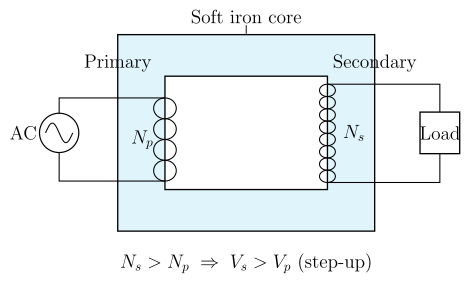
A conducting rod of length l moving with speed v perpendicular to a field B develops a motional EMF ε = Bvl; alternatively, a transformer changes AC voltage via mutual induction with ratio Vs/Vp = Ns/Np, losing energy to copper and core losses.
Motional EMF induced in a rod moving in a magnetic field
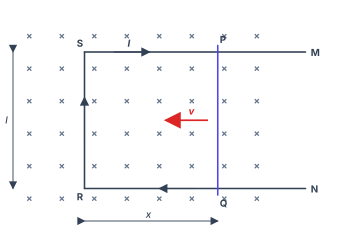
Consider a straight conducting rod PQ of length , moving with a constant velocity perpendicular to a uniform magnetic field (which is perpendicular to both the rod and its velocity — i.e. , , and mutually perpendicular). Each free electron in the rod, moving with the rod at velocity inside field , experiences a magnetic (Lorentz) force , which pushes the electrons toward one end of the rod. This causes one end of the rod to become negatively charged and the other positively charged, setting up an electric field inside the rod (and a potential difference across its ends) that grows until the electric force on the electrons balances the magnetic force :
The EMF is the work done per unit charge moving the length of the rod against this field, i.e. :
(Equivalently, this follows from : as the rod sweeps out area at rate , flux changes at rate .)
OR: The transformer
(i) Labelled diagram (described): A transformer has a laminated soft-iron core; a primary coil of turns is wound on one side of the core and connected to the AC input source; a secondary coil of turns is wound on the other side (or over the primary), connected to the load; the core magnetically links the two coils.
…
Unlock everything free for 14 days
- Full step-by-step solutions
- Concept-first explanations
- Methods, shortcuts & mistakes
- PYQ mapping + timed mock tests
Full access for 14 days. No credit card required.