Q.Establish the relation 1/f = 1/v - 1/u for a convex lens, where symbols have their usual meanings. OR Draw a labelled diagram of simple microscope and establish an expression for the magnifying power of simple microscope, when the image formed at
You're viewing a preview — the full solution, concept, methods & PYQ mapping are locked.
Start your 14-day free trial to unlock the full solution →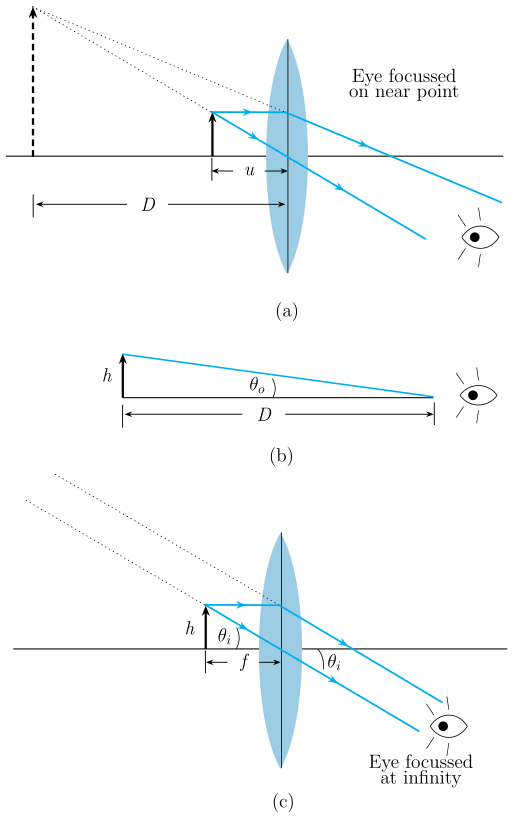
The thin lens formula follows from applying single-surface refraction twice, once at each face; alternatively, a simple microscope's magnifying power is D/f (image at infinity) or 1+D/f (image at near point).
Deriving 1/f = 1/v − 1/u for a convex lens
Consider a thin convex lens with two spherical refracting surfaces of radii and , made of a material of refractive index placed in a medium of refractive index . Light from an object at distance refracts first at surface 1 to form an intermediate (virtual) image at distance , given by the single-surface refraction formula:
This intermediate image acts as the object for the second surface, refracting back into medium to form the final image at :
Adding these two equations (the terms cancel):
Dividing by and writing (relative refractive index of the lens material):
When the object is at infinity (), , the focal length, giving the lensmaker's equation . Substituting the right-hand side by in the general relation above gives the familiar thin lens formula:
OR: Magnifying power of a simple microscope …
Unlock everything free for 14 days
- Full step-by-step solutions
- Concept-first explanations
- Methods, shortcuts & mistakes
- PYQ mapping + timed mock tests
Full access for 14 days. No credit card required.