Skip to content
← Zoology

Zoology · Class 11 Science

Mahe Dhse Class 11 Zoology — Real Previous-Year Papers

with complete answers

Real previous-year board papers, year by year — the official exam pattern, the full question paper, and every question solved the concept-first way. Distinct from the chapter-wise textbook bank.

2018–2026
Years of papers
9
Total Papers
9
Real Board Papers
0
Sample papers
183
Real-paper Q & A
0
Sample-paper Q & A

Real board-paper questions available, by year

20 Q2026complete
20 Q2025complete
20 Q2024complete
20 Q2023complete
17 Q2022complete
30 Q2021complete
20 Q2020complete
18 Q2019complete
18 Q2018complete

Kerala DHSE Plus One Board 2026 · Set ANN

Real board examination

About this paper

The real Class-12 board examination held in 2026. Every question below is solved the concept-first way. Sample papers are labelled honestly — never shown as a past exam.

Total marks
—
Questions
—
Duration
—
Sections
—

The marks / questions / duration above are the official exam pattern. We currently have 20 of this paper’s questions, with 20 fully solved. Questions we couldn’t yet extract or verify are held — never shown as complete.

The question paper

The questions we hold for this paper, laid out by section. Solutions are on the Answers tab.

Board Examination

Zoology

Kerala DHSE Plus One Board 2026 · Set ANN

Series/Set: ANNRoll No. ________
Time Allowed: —Maximum Marks: —
Section Other

Other / unmarked

Q1.
Arrange the following taxonomic categories in ascending order : Genus, Family, Order, Class, Species, Phylum, Kingdom
[1]
Q2.
When the inhibitor closely resembles the substrate in its molecular structure and inhibits the activity of the enzyme, it is known as _______ .
[1]
Q3.
Volume of air remaining in the lungs even after a forcible expiration is called _____ .
[1]
Q4.
Name the joint between the adjacent vertebrae in the vertebral column which permits limited movements.
[1]
Q5.
A complex disorder which is associated with loss of glucose through urine, it is successfully treated with insulin therapy. Name the disease.
[1]
Q6.
Observe the given figure and label A, B, C and D. A longitudinal-section diagram of an internal structure with four leader lines marked A (top left), B (top middle), C (pointing to a series — Class 12 Biology question
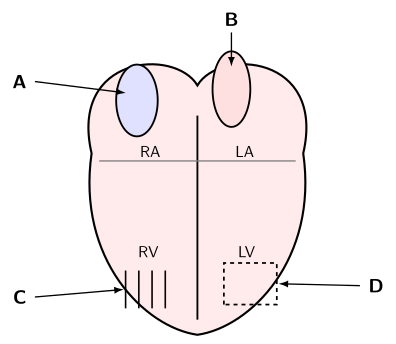
[2]
Page 1 of 3
Q7.
Identify the given biomolecules A and B.
[2]
Q8.
Differentiate aestivation and hibernation.
[2]
Q9.
Nature of enzyme action is given below. E + S ⇌ ES → EP → E + P (a) Expand ES and EP. (b) Write any two factors that affect enzyme action.
[2]
Q10.
Observe the given figure. (a) Write the name of organisms A and B. (b) Identify the phyla of these organisms.
[2]
Q11.
Write suitable terms for the following : (a) Bones are hollow with air cavities. (b) The property of a living organism to emit light. (c) Sexes are not separate. (d) Warm-blooded organisms.
[2]
Q12.
Diagrammatic representation of standard ECG is given below. (a) What does P-wave, QRS complex and T-wave indicates ? (b) Name the machine used to obtain this graph.
[2]
Q13.
Based on location, muscles are classified into three. (a) Name the three types of muscles found in human body. (b) The endoplasmic reticulum of a muscle cell is known as ____ .
[2]
Q14.
Schematic plan of human double circulation is given below. (a) Identify the blood vessels A and B from the diagram. (b) Name the blood vessel which carry oxygenated blood from the lungs to heart.
[2]
Page 2 of 3
Q15.
Match the following :
[2]
Q16.
Observe the diagram. Identify the endocrine glands A and B.
[2]
Q17.
Name the part of brain which control following activities : (a) Body temperature, urge for eating and drinking. (b) Sensory association, memory and communication. (c) Respiration, cardiovascular reflexes, and gastric secretions.
[3]
Q18.
(a) Accumulation of urea in blood may lead to kidney failure in some patients. Name the process to remove urea from blood. (b) Write any two processes involved in urine formation. (c) Mammals have the ability to produce a concentrated urine. Name the mechanism that maintain the concentration gradient in the medullary interstitium.
[3]
Q19.
(a) Some changes taking place during inspiration and expiration is given below. Find out A and B. (b) Blood transport CO2 from tissues to lungs by various means. Mention any two methods of carbon dioxide transport.
[3]
Q20.
Observe the diagram and answer the following : (a) The above two organisms A and B belong to same phylum. Name the phylum. (b) Write any one example of economically important insect of this phylum. (c) Write any four special characters of this phylum.
[3]
Page 3 of 3