Q.State the law of Demand. Illustrate it with the help of diagram. (2+6=8)
You're viewing a preview — the full solution, concept, methods & PYQ mapping are locked.
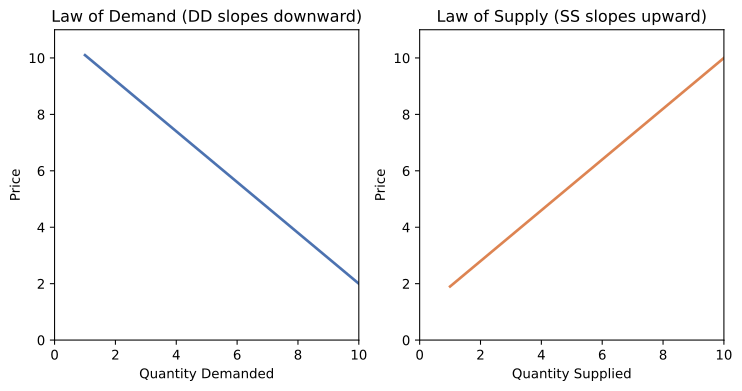
Start your 14-day free trial to unlock the full solution →Law of Demand: other things (income, tastes, prices of related goods) remaining constant, there is an inverse relationship between the price of a good and its quantity demanded — illustrated by a downward-sloping demand curve DD. [OR: Law of Supply states a DIRECT relationship between price and quantity supplied, illustrated by an upward-sloping supply curve SS.]
Part A (2 marks) — Statement of the Law of Demand:
The Law of Demand states that, ceteris paribus (other determinants of demand — income, tastes & preferences, prices of related goods, expectations — remaining unchanged), the quantity demanded of a commodity is INVERSELY related to its own price: as price rises, quantity demanded falls; as price falls, quantity demanded rises.
Part B (6 marks) — Illustration with a hypothetical demand schedule and diagram:
| Price (Rs. per unit) | Quantity Demanded (units) |
|---|---|
| 10 | 20 |
| 8 | 30 |
| 6 | 40 |
| 4 | 50 |
How to draw: Take Quantity Demanded on the horizontal (X) axis and Price on the vertical (Y) axis. Plot each (Quantity, Price) pair — (20,10), (30,8), (40,6), (50,4) — and join them with a smooth curve. The resulting demand curve DD slopes DOWNWARD from the upper-left to the lower-right, confirming that as price falls from Rs. 10 to Rs. 4, quantity demanded rises from 20 to 50 units — the inverse price-quantity relationship that is the Law of Demand. The negative slope arises from the Income Effect (a price fall raises real purchasing power, allowing more to be bought) and the Substitution Effect (the good becomes relatively cheaper than substitutes, so consumers substitute towards it).
OR — Law of Supply:
Part A (2 marks): The Law of Supply states that, other things remaining constant, the quantity supplied of a commodity is DIRECTLY related to its own price: as price rises, quantity supplied rises; as price falls, quantity supplied falls — because a higher price raises the producer's profit margin, incentivising greater output.
…
Unlock everything free for 14 days
- Full step-by-step solutions
- Concept-first explanations
- Methods, shortcuts & mistakes
- PYQ mapping + timed mock tests
Full access for 14 days. No credit card required.