Q.Draw the double helical structure of DNA and label –
You're viewing a preview — the full solution, concept, methods & PYQ mapping are locked.
Start your 14-day free trial to unlock the full solution →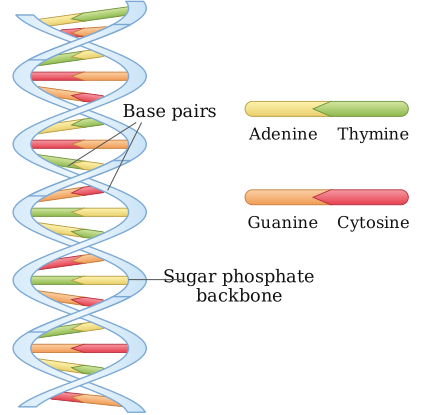
(Cannot literally draw here — both parts described fully in prose.) Part (i): the DNA double helix has antiparallel strands, an outer sugar-phosphate backbone, and alternating major/minor grooves. Part (ii): a nucleosome is DNA wrapped around a histone octamer, sealed at the linker by H1 histone.
As the underlying diagrams cannot be rendered here, both options are described fully in prose, covering every feature the question asks to be labelled.
Part (i) — Double helical structure of DNA, label (i) Minor groove (ii) Sugar phosphate backbone:
DNA (Watson–Crick model) consists of two polynucleotide chains coiled around a common axis in a right-handed helix, running antiparallel (5'→3' and 3'→5').
- Sugar-phosphate backbone: on the outside of the helix; alternating deoxyribose sugar and phosphate groups linked by phosphodiester bonds form the two "rails" of the ladder-like structure.
- Nitrogenous base pairs: project inward, pairing specifically — A=T (2 hydrogen bonds), G≡C (3 hydrogen bonds) — forming the "rungs."
- Dimensions: diameter ≈ 20 Å (2 nm); one full turn = 3.4 nm, containing 10 base pairs (0.34 nm per base pair).
- Major and minor groove: because the two backbones are asymmetrically placed around the axis, the helix surface shows alternating grooves of unequal width — a wider major groove and a narrower minor groove, running along the length of the helix.
Part (ii) — OR: Nucleosome diagram, label (i) DNA (ii) H1 histone:
…
Unlock everything free for 14 days
- Full step-by-step solutions
- Concept-first explanations
- Methods, shortcuts & mistakes
- PYQ mapping + timed mock tests
Full access for 14 days. No credit card required.