Q.Show that the electric current in a wire is directly proportional to the drift velocity of electrons in that wire.
🔒You're viewing a preview — the full solution, concept, methods & PYQ mapping are locked.
🔒 Start your 14-day free trial to unlock the full solution →Concept understanding — Drift Velocity
Drift Velocity: The Slow March of Electrons
Electrons in a metal are always moving — but randomly. At room temperature they zip around at roughly 106 m/s, colliding with the lattice ions every few trillionths of a second. Without an electric field this motion cancels out: for every electron heading left another heads right, so the net velocity is zero.
Apply a battery and the field gives every electron a tiny, steady push in one direction. Between collisions the electron accelerates only briefly before smashing into an ion and losing its directed motion. What survives is a very small average velocity along the field — the drift velocity.
The random thermal speed is about 105 m/s, but the drift velocity is only about 10−4 m/s — about a billion times slower. An electron drifts slower than a snail, yet a lamp lights instantly, because the electric field (not the electrons) propagates at nearly the speed of light and starts every electron drifting almost at once.
The precise definition
Drift velocity (vd) is the average velocity acquired by the charge carriers in a conductor under an applied electric field:
vd=meEτ
where:
- e = electron charge (1.6×10⁻¹⁹ C)
- E = electric field inside the conductor (V/m)
- τ = average relaxation time — the mean time between collisions (s)
- m = electron mass (9.1×10⁻³¹ kg)
vd=meEτ
Linking to current
Drift velocity connects the microscopic motion of electrons to the current an ammeter reads:
I=neAvd
where n is the free-electron number density and A the cross-sectional area. A larger vd means more current, but vd stays tiny because τ is tiny (about 10−14 s in copper).
For a copper wire carrying 1 A with area 1 mm² and n≈8.5×1028 m−3:
vd=neAI≈(8.5×1028)(1.6×10⁻¹⁹)(10−6)1≈7×10⁻⁵ m/s …
Why this formula?
Drift Velocity: Why the Formula Holds
Let's build this from first principles — understanding why electrons drift the way they do, not just memorizing the formula.
1. The Core Idea: What is Drift Velocity?
In a conductor, free electrons are constantly moving randomly (thermal motion, speeds ~105 m/s). Without an electric field, their net displacement is zero — they're like a swarm of bees buzzing in all directions.
When we apply an electric field E, it gently nudges each electron in the opposite direction (since electrons are negatively charged). This small, steady net velocity superimposed on the random motion is drift velocity (vd).
Key insight: Drift velocity is not the speed of individual electrons — it's the average velocity of the entire electron cloud.
2. The Derivation: Step by Step
Step 1: Force on a single electron
An electron of charge −e in an electric field E experiences:
F=−eE
The magnitude of acceleration (opposite to E) is:
a=mF=meE
where m is the electron's mass.
Step 2: What happens between collisions?
Electrons don't accelerate forever — they keep colliding with atoms/ions in the metal lattice. Let the average time between collisions be τ (relaxation time). Just after a collision an electron's velocity is essentially random (zero average in the field direction); it then accelerates for time τ before the next collision.
Step 3: Drift velocity
Averaging the field-driven velocity over the relaxation time τ gives the net drift:
vd=meEτ
Here τ is the average time since the last collision, so this expression already averages over electrons at every stage between collisions — it is the standard result used in the NCERT treatment.
3. Connecting to Current: The Big Picture
Drift velocity directly gives us current density J:
J=nevd
where n = number of free electrons per unit volume. …
Current is the total charge crossing a wire's cross-section per unit time, and this charge can be counted directly in terms of how many electrons drift through, and how fast, in a given interval. …
Counting how much charge crosses a cross-section per second, in terms of drift velocity, directly gives I∝vd.
Consider a conducting wire of cross-sectional area A, with n free electrons per unit volume, each of charge magnitude e, drifting with average drift velocity vd opposite to the applied electric field (conventional current flows along the field direction).
In a small time interval Δt, each electron moves a distance vdΔt along the wire. So all the free electrons contained in a cylindrical volume of length vdΔt and cross-section A will cross a given cross-section of the wire in that time. The volume of this region is
V=A(vdΔt)
The number of free electrons in this volume is nV=nAvdΔt, so the total charge that crosses the cross-section in time Δt is
Δq=(nAvdΔt)e=neAvdΔt
The current is charge flow per unit time:
I=ΔtΔq=neAvd
…
Showing the 12 most recent of 31 on this concept.
- CBSE 2026Set ANNUAL1 markMCQQ.Drift velocity Vd varies with the intensity of electric field E as per the relation(a) Vd is proportional to E^2(b) Vd is proportional to 1/E(c) Vd is proportional to sqrt(E)(d) Vd is proportional to E
›Reveal solutionSolution
Drift velocity is the (small) average velocity electrons gain between collisions due to the electric field, and it comes out directly proportional to E.
When an electric field E is applied to a conductor, each free electron experiences a force F = eE, giving it an acceleration a = eE/m between collisions with the lattice ions. If tau is the average time between collisions (relaxation time), the average extra velocity gained (the drift velocity) is
vd = a * tau = (eE/m) * tau = (e*tau/m) * E
…
- CBSE 2026Set ANNUAL1 markQ.If the current flowing in a copper wire be allowed to flow in another copper wire of same length but of doubled the radius then what will be the effect on the drift velocity of the electron?
›Reveal solutionSolution
For the same current, vd∝1/A, and doubling the radius quadruples the cross-sectional area.
Current is related to drift velocity by I=nAevd, so for the same current I (and the same material, hence the same n), vd=nAeI∝A1. If the radius is doubled, the cross-sectional area A=πr2 becomes 4 times larger. So the drift velocity becomes
…
- CBSE 2026Set ANNUAL1 markQ.State Ohm's law in terms of current density, specific conductance and electric field intensity.
›Reveal solutionSolution
Microscopic Ohm's law: current density J = σE (σ = conductivity, E = field).
The usual Ohm's law is V = IR. In microscopic (vector) form, it relates the current density J (current per unit cross-sectional area) to the electric field E inside the conductor through the material's specific conductance (conductivity) σ:
J = σ E.
…
- CBSE 2026Set SEM31 markMCQQ.Which of the following statement(s) is/are true ? A potential difference of V is applied at the two ends of a conductor of length l and area of cross-section A. Statement I : When potential difference is doubled, current density also gets doubled. Statement II : When potential difference is doubled, drift velocity gets halved. Statement III : When area of cross-section is doubled, current density decreases.(a) I and II are true(b) Only I is true(c) Only III is true(d) II and III are true
›Reveal solutionSolution
Doubling V doubles E, so J = σE and v_d = μE both double — Statement I true, Statement II (drift velocity halved) false. J = V/(ρl) is independent of area, so Statement III (J decreases when A doubles) is also false. Only I is true → option (b).
Statement I: J = σE and E = V/l, so doubling V doubles E and hence doubles the current density J. TRUE.
Statement II: drift velocity v_d = (eE/m)τ ∝ E ∝ V. Doubling V doubles v_d, it does not halve it. FALSE.
…
- CBSE 2025Set D1 markMCQQ.The relation between drift velocity v of free electrons in conductor in electric conduction and potential difference V between ends of conductor is (A) proportional to V (B) inversely proportional to V (C) proportional to V^2 (D) inversely proportional to V^2
›Reveal solutionSolution
Drift velocity is directly proportional to the potential difference V.
In a conductor of length L across which a potential difference V is applied, the electric field is E = V/L. Free electrons acquire a drift velocity
vd=meEτ=mLeVτ …
- CBSE 2025Set D1 markMCQQ.If the length of a conductor is doubled while keeping the potential difference across it constant, then the drift velocity of electron will (A) remain the same (B) be double (C) be halved (D) increase fourfold
›Reveal solutionSolution
Doubling the length at constant V halves the drift velocity.
The drift velocity is
vd=meEτ=mLeVτ …
- CBSE 2025Set ANNUAL1 markMCQQ.A thick wire is stretched so that its length becomes two times. What is the ratio of change in resistance of the wire to the initial resistance of the wire?(i) 2 : 1(ii) 4 : 1(iii) 3 : 1(iv) 1 : 4
›Reveal solutionSolution
New resistance is 4 times the old, so the change is 3 times the original: ratio 3 : 1.
Resistance R=ρL/A. Stretching keeps the volume AL constant, so if length doubles (L→2L) the area halves (A→A/2). Then R′=ρ(2L)/(A/2)=4ρL/A=4R. The change in …
- CBSE 2025Set ANNUAL1 markMCQQ.Calculate the amount of charge flowing in 2 minutes in a wire of resistance 10 ohm when a potential difference of 20 volts is applied between its ends.(i) 120 C(ii) 240 C(iii) 20 C(iv) 4 C
›Reveal solutionSolution
Q = It = (V/R) x t = 2 A x 120 s = 240 C.
…
- CBSE 2024Set 55/2/11 markMCQQ.Electrons drift with speed vd in a conductor with potential difference V across its ends. If V is reduced to 2V, their drift speed will become : (A) 2vd (B) vd (C) 2vd (D) 4vd
›Reveal solutionSolution
Drift speed is directly proportional to the applied potential difference for a given conductor, so halving V halves vd. The new drift speed is 2vd, which is option (A).
The key here is understanding what drift speed actually depends on. Many students memorise the formula vd=neAI and then try to relate I to V via Ohm's law — that works, but it's easy to lose track of which quantities stay constant. Let's build it from the physics up.
Drift speed is the average velocity electrons acquire due to an electric field inside the conductor. That field is E=V/L, where L is the length of the conductor. The force on each electron is eE, and in the steady state, this force is balanced by collisions with the lattice, giving a constant drift speed proportional to the field. So the fundamental proportionality is:
vd∝Eand sinceE=LV,we getvd∝V
for a fixed conductor (fixed L, fixed material properties like relaxation time τ, mass m, charge e).
Now let's walk through it step by step.
-
Start with the microscopic relation. The drift speed is given by vd=meEτ, where τ is the average time between collisions (relaxation time). This comes from F=eE=ma, and then vd=aτ. For a given conductor at a fixed temperature, τ, m, and e are constants.
-
Express the electric field in terms of the applied voltage. For a conductor of length L, the uniform electric field inside is E=V/L. So:
vd=me(V/L)τ=(mLeτ)V
The quantity in parentheses is constant for a given conductor. So vd is directly proportional to V.
-
Apply the change. If V becomes V/2, then:
vd′=(mLeτ)⋅2V=21(mLeτ)V=2vd …
-
- CBSE 2024Set FS1 markMCQQ.If drift velocity of electron be vd and intensity of electric field E, then which relation among the following obeys Ohm's law?(i) vd∝E2(ii) vd=Constant(iii) vd∝E(iv) vd∝E
›Reveal solutionSolution
Drift velocity vd=meEτ is directly proportional to the field E, which is exactly what Ohm's law requires — option (iii).
Concept. Under an electric field E, free electrons acquire a steady drift velocity
vd=meEτ,
where τ is the mean relaxation time.
…
- CBSE 2024Set ANNUAL1 markQ.Define the relaxation time of the free electrons drifting in a conductor.
›Reveal solutionSolution
The average free time an electron travels between collisions with the lattice.
…
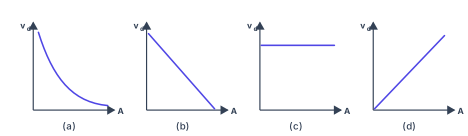
- CBSE 2023Set 55/1/11 markMCQQ.A steady current flows through a metallic wire whose area of cross-section (A) increases continuously from one end of the wire to the other. The magnitude of drift velocity (vd) of the free electrons as a function of A can be represented by :(a)(b)(c)(d)
›Reveal solutionSolution
For a steady current, the product Avd is constant because I=neAvd is fixed. Therefore vd∝1/A, which is a rectangular hyperbola — option (a).
Figure — CBSE 2023 55/1/1 Q4 The key to this question is understanding why drift velocity changes when the wire's cross-section changes — and that comes from the definition of steady current itself.
When we say "a steady current flows", we mean that the same amount of charge passes through every cross-section of the wire per second. The wire is in series with itself: whatever charge flows past the thin end must also flow past the thick end in the same time. If it didn't, charge would pile up somewhere — and that would violate the steady-state condition.
Now, current I is given by:
I=neAvd
where n is the free electron density (number per unit volume), e is the electron charge, A is the cross-sectional area at that point, and vd is the drift velocity.
For a metallic wire, n and e are constants (same material throughout). And for a steady current, I is constant along the wire. So:
neAvd=constant
which means:
Avd=constant
Therefore:
vd∝A1
This is the relationship we need.
-
Identify the mathematical form. vd∝1/A is an inverse proportion. Its graph is a rectangular hyperbola — a curve that falls steeply when A is small and flattens out as A grows large. It never touches either axis (asymptotic behaviour).
-
Check the options against this.
- Option (a) shows exactly this: a curve that drops as A increases, shaped like a hyperbola.
- Option (b) is a straight line — that would mean vd∝−A+constant, which is wrong.
- Option (c) is a horizontal line — that would mean vd is independent of A, which contradicts Avd=constant.
- Option (d) is a straight line through the origin — that would mean vd∝A, which is the opposite of what we have. …
-
🎓Unlock everything free for 14 days
- ✓Full step-by-step solutions
- ✓Concept-first explanations
- ✓Methods, shortcuts & mistakes
- ✓PYQ mapping + timed mock tests
Full access for 14 days. No credit card required.