Q.Distinguish between functional structure and divisional structure.
🔒You're viewing a preview — the full solution, concept, methods & PYQ mapping are locked.
🔒 Start your 14-day free trial to unlock the full solution →Concept understanding — Functional Structure
What is Functional Structure? A First Look
Think of a school. You have teachers who handle only teaching, a principal who handles administration, a sports coach who handles only sports, and a janitor who handles cleaning. Each person focuses on one kind of work. That is the core idea of functional structure — grouping people and activities based on the kind of function they perform.
In a business, instead of "teaching" or "sports," the functions are things like production, marketing, finance, human resources, and research. Every employee who does marketing work sits together in one department. Every employee who handles money sits in the finance department. The entire organisation is divided into these clear, separate boxes.
Functional structure is the simplest and most common way to organise a business. It is what most people imagine when they think of a "company" — separate departments for separate jobs.
The Precise Meaning
According to the NCERT Class 12 Business Studies textbook, functional structure is a type of organisational structure where the enterprise is divided into departments based on the functions that must be performed to achieve its objectives. Each department is headed by a specialist in that area — a marketing manager, a finance manager, a production manager, and so on.
The key idea is specialisation by function. Everyone in a department does similar work, uses similar skills, and reports to someone who understands that work deeply.
Why It Matters (The Advantages)
Functional structure is not just a neat way to draw an org chart. It has real, practical benefits:
- Specialisation leads to efficiency. When a person does only one type of work day after day, they become very good at it. A marketing person who never has to worry about production can focus entirely on selling better.
- Clear career paths. An employee knows that if they work hard in the marketing department, they can become a marketing manager, then a senior marketing manager, and so on. This motivates people.
- Easy coordination within the department. Since everyone speaks the same "language" (marketing terms, finance terms), decisions within a department are faster.
- Simpler training. You only need to train new hires in one function, not in everything the company does.
The Downsides (The Disadvantages)
Functional structure is not perfect. It has serious weaknesses that become visible as a company grows:
- Departmental silos. The marketing department stops caring about what finance needs. The production department ignores what marketing is promising to customers. Each department becomes an island.
- Slow decision-making across functions. If a problem involves both marketing and finance, the two department heads must talk, then both report to the top manager, who then decides. This takes time.
- Limited view for managers. A marketing manager knows marketing inside out but may have no idea how production or finance works. This makes it hard to groom future CEOs who need a broad view.
- Conflict between departments. Each department wants more budget, more resources, and more importance. This can lead to turf wars. …
Functional structure organises by specialised function; divisional structure organises by product/business division.
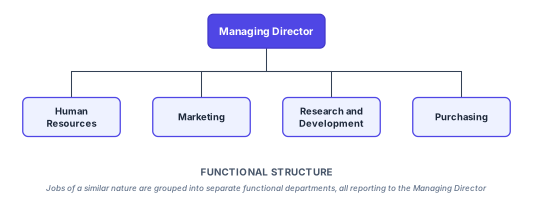
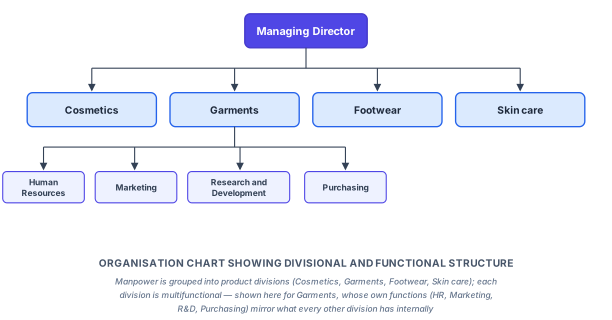
| Basis | Functional Structure | Divisional Structure |
|---|---|---|
| Formation basis | Grouping of jobs/activities on the basis of function (production, finance, marketing, etc.) | Grouping of activities on the basis of product/business lines |
| Accountability | Harder to fix accountability for overall results of one product, since functions are shared across all products | Easier to fix accountability — each division head is answerable for their own division's profits/results |
| Specialisation | Promotes functional specialisation and efficiency within each function | Divisions become self-contained, promoting managerial development through broader experience |
- CBSE 2026Set MARCH1 markMCQQ.In which type of organisation, work is given more importance than department?(a) (A) Linear(b) (B) Functional(c) (C) Informal(d) (D) Matrix
›Reveal solutionSolution
Functional organisation gives importance to the work/function performed.
This GSEB Class-12 Commerce organising question distinguishes structure types. In a functional structure, similar activities (production, finance, marketing, HR) are grouped so that specialisation of work drives the design.
- Linear (line) → straight vertical chain of authority. …
- CBSE 2025Set ANNUAL1 markMCQQ.Under ________, jobs related to common function are grouped under one department. (A) Assignment of Duties (B) Divisional departmentation (C) Functional departmentation (D) Identification and Division of work
›Reveal solutionSolution
Under Functional departmentation, the organisation is divided into departments on the basis of the functions performed (production, marketing, finance, personnel, etc.), with each department grouping all activities related to that one function.
When an organisation decides how to group its various activities and jobs, it can choose between (broadly) a functional structure and a divisional structure.
In a Functional structure, all jobs that relate to a common function are clubbed together into one department. For example, all activities relating to selling/advertising/market research go into the Marketing department; all activities relating to raising/using funds go into the Finance department; all activities relating to manufacturing go into the Production department. Each department is headed by a functional expert.
…
- CBSE 2024Set 66/1/11 markMCQQ.Online retailer 'Bizen' has grown to be the biggest provider worldwide in the field of e-commerce. Its revenues are growing steadily year after year. It owes its success to the rapid rate of digitisation and its organisational structure. 'Bizen's Managing Director, Mohit makes strategic decisions and has control over the entire organisation. In 'Bizen', jobs of similar nature are grouped together into Human Resource Department, Marketing Department, Purchase Department and Research and Development Department. These departments are further divided into sections and all departmental heads report to Mohit who is the co-ordinating head. This ensures efficiency in the utilization of manpower and minimizes duplication of efforts. The type of organizational structure of 'Bizen' is: (A) Informal organisational structure (B) Divisional organisational structure (C) Functional organisational structure (D) Both (B) and (C)
›Reveal solutionSolution
The question describes a company where jobs of similar nature are grouped into departments like HR, Marketing, Purchase, and R&D — this is the hallmark of a functional organisational structure. The correct answer is (C) Functional organisational structure.
The key to this question lies in understanding how different organisational structures group activities. In management theory, the two primary formal structures are functional and divisional.
A functional structure groups employees based on the functions they perform — marketing, finance, HR, production, etc. Each department specialises in one type of work. This is exactly what 'Bizen' does: "jobs of similar nature are grouped together into Human Resource Department, Marketing Department, Purchase Department and Research and Development Department."
A divisional structure, by contrast, groups activities around products, geography, or customer segments. For example, a company might have a "Consumer Electronics Division" and an "Industrial Equipment Division," each with its own marketing, HR, and production teams. That is not the case here — Bizen has a single HR department, a single marketing department, etc., serving the entire organisation.
An informal structure refers to the unofficial relationships and networks that emerge naturally among employees — not the formal departmental setup described.
Let's walk through the reasoning step by step.
-
Identify the basis of grouping. The passage explicitly says: "jobs of similar nature are grouped together into Human Resource Department, Marketing Department, Purchase Department and Research and Development Department." The phrase "similar nature" points to functions — all HR tasks go to one department, all marketing tasks to another, and so on. This is the defining feature of a functional structure.
-
Check the reporting lines. All departmental heads report to Mohit, the Managing Director. In a functional structure, each functional head reports directly to the top manager. In a divisional structure, divisional heads (each overseeing a product line) would report to the top, and each division would have its own functional sub-units — which is not described here.
-
Eliminate the other options.
- (A) Informal structure — This is about grapevine communication, social cliques, and unwritten norms. The question describes formal departments and reporting lines, so this is incorrect. …
-
- CBSE 2024Set MARCH1 markMCQQ.In which type of organisation, work is given more importance than department?(a) Linear(b) Functional(c) Informal(d) Matrix
›Reveal solutionSolution
In functional organisation, work is more important than the department.
Functional organisation, developed from F.W. Taylor's ideas, divides the organisation on the basis of major functions (such as purchase, production, sales, finance). Each functional specialist has authority over his function throughout the enterprise, so the type of work and specialisation receive more emphasis than any single department. Line …
- CBSE 2024Set MARCH1 markMCQQ.Company has its registered office in Delhi, manufacturing unit at Gurgaon and marketing and sales department at Faridabad. The company manufactures the consumer products. Which type of organisational structure should it adopt to achieve its target?(a) Functional structure(b) Formal organisation(c) Divisional structure(d) Informal organisation
›Reveal solutionSolution
(a) Functional structure — jobs of a single-product firm are grouped by function (production, marketing, finance), which is what this company needs.
…
- CBSE 2023Set ANNUAL1 markQ.What is functional organisation?(OR)What do you mean by line organisation?
›Reveal solutionSolution
Functional organisation groups jobs by function under specialist heads. Alternatively, line organisation is the simplest structure with a direct vertical flow of authority.
In a functional organisation, activities are grouped into departments on the basis of functions — for example, production, finance, marketing and personnel — each placed under a functional specialist. This promotes specialisation and efficiency.
For the OR part: a line organisation is the oldest and simplest form in which authority flows downward in a straight (scalar) line from the top executive to the lowest worker, with each person responsible to one superior.
…
- CBSE 2023Set ANNUAL1 markQ.Write the meaning of functional structure of organisation.
›Reveal solutionSolution
Functional structure is the grouping of similar jobs into departments on the basis of functions.
Under a functional organisation structure, activities are grouped together on the basis of functions or work to be performed. All tasks related to a particular function are put in one department — for example, a production department, a marketing department, a finance department and a personnel department — each headed by a functional specialist. This promotes specialisation and makes supervision easier. It is suitable where an organisatio …
- CBSE 2020Set MARCH1 markMCQQ.What is possible from the following due to departmentalization of work?(a) Specialization(b) Planning(c) Coordination(d) Directing
›Reveal solutionSolution
Departmentalisation of work leads mainly to specialisation. Correct option: (a) Specialization.
When work is divided and grouped into departments (production, marketing, finance, etc.), each employee handles a narrow set of related tasks. Repeating the same work builds skill, speed and expertise — this is specialisation, a key benefit of dividing and departmentalising work.
…
🎓Unlock everything free for 14 days
- ✓Full step-by-step solutions
- ✓Concept-first explanations
- ✓Methods, shortcuts & mistakes
- ✓PYQ mapping + timed mock tests
Full access for 14 days. No credit card required.