Q.(a)
You're viewing a preview — the full solution, concept, methods & PYQ mapping are locked.
Start your 14-day free trial to unlock the full solution →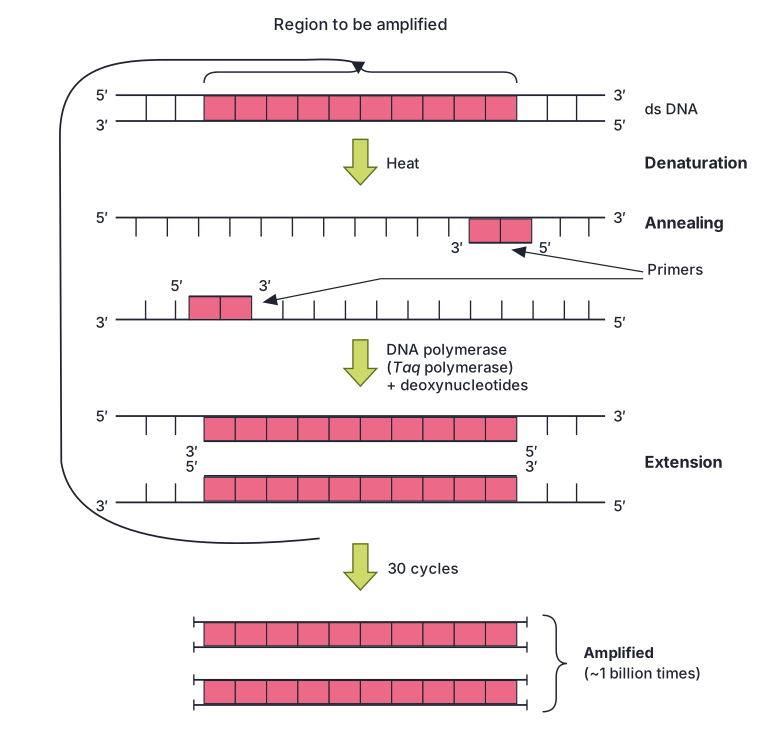
PCR exponentially copies a target DNA sequence through repeated heat-driven cycles; alternatively, the lac operon is a coordinated genetic switch that turns on lactose-digesting genes only when lactose is present.
(a) PCR:
- PCR stands for Polymerase Chain Reaction.
- Mechanism (with reference to a diagram): PCR amplifies a specific target DNA sequence in vitro, using a thermostable DNA polymerase (commonly Taq polymerase, from the heat-tolerant bacterium Thermus aquaticus), through repeated cycles, each consisting of three steps:
- Denaturation — the double-stranded DNA template is heated (to about 94–96°C), separating it into two single strands.
- Annealing — the temperature is lowered (to about 50–65°C), allowing two short, specifically designed primers (complementary to sequences flanking the target DNA region) to bind to their respective single strands.
- Extension — the temperature is raised again (to around 72°C, the optimum for Taq polymerase), and the enzyme extends each primer, synthesising a new complementary DNA strand.
Diagram description: Starting double-stranded DNA → heat (denature) → two single strands → primers anneal to each strand at the flanking sequences → Taq polymerase extends each primer, forming two new double-stranded copies → repeating this three-step cycle doubles the amount of target DNA with every cycle, so that after 'n' cycles, the DNA is amplified roughly -fold, yielding millions of copies of the target sequence within a few hours.
(b) Alternative — Regulation of the lac operon: An operon is a cluster of structural genes, together with their regulatory sequences (promoter and operator), that are transcribed as a single unit, producing one polycistronic mRNA — this arrangement is typical of prokaryotic gene organisation.
The lac operon of E. coli consists of a regulatory gene, i (coding for a repressor protein), and three structural genes: z (β-galactosidase, which breaks down lactose into glucose and galactose), y (permease, increasing membrane permeability to lactose), and a (transacetylase), along with a promoter and an operator region.
…
Unlock everything free for 14 days
- Full step-by-step solutions
- Concept-first explanations
- Methods, shortcuts & mistakes
- PYQ mapping + timed mock tests
Full access for 14 days. No credit card required.