Q.What is oogenesis? With the help of suitable diagram, describe the steps involved in this process. (1+3+1=5) OR Define menstrual cycle. Describe the various phases of menstrual cycle. (1+4=5)
You're viewing a preview — the full solution, concept, methods & PYQ mapping are locked.
Start your 14-day free trial to unlock the full solution →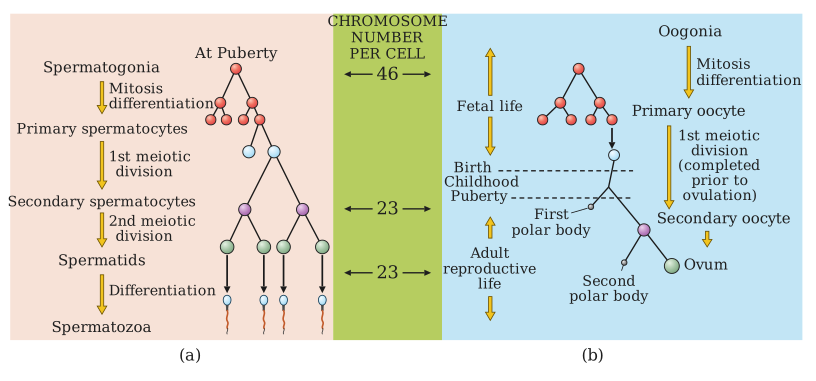
Oogenesis is the process of producing a mature ovum from an oogonium through a series of unequal meiotic divisions that begin before birth but are only completed, one at a time, in the cycles following puberty.
Definition: Oogenesis is the process of formation of a mature, haploid female gamete (ovum) from a diploid oogonium, occurring within the ovary.
Steps of oogenesis
- Diploid oogonia, formed by mitotic multiplication of primordial germ cells during fetal development, undergo growth to become primary oocytes.
- Each primary oocyte begins meiosis-I but becomes arrested in prophase-I, remaining in this dormant state (enclosed within a primary follicle) from before birth until puberty.
- Starting at puberty, in each menstrual cycle, one (or occasionally more) primary oocyte resumes and completes meiosis-I, dividing unequally to produce a large secondary oocyte and a small, non-functional first polar body (most of the cytoplasm is retained by the secondary oocyte).
- The secondary oocyte immediately enters meiosis-II but again arrests, this time at metaphase-II; it is released from the ovary at ovulation, still at this arrested stage.
- Meiosis-II is completed only if fertilisation occurs — fusion with a sperm triggers completion of meiosis-II, producing the mature ovum and a small second polar body.
(A simple diagram would show a branching sequence: oogonium (2n) primary oocyte (2n, arrested in prophase-I) [meiosis-I] secondary oocyte (n) + first polar body (n) [meiosis-II, only on fertilisation] ovum (n) + second polar body (n).)
…
Unlock everything free for 14 days
- Full step-by-step solutions
- Concept-first explanations
- Methods, shortcuts & mistakes
- PYQ mapping + timed mock tests
Full access for 14 days. No credit card required.