Q.A device that converts energy of combustion of fuels like hydrogen and methane directly into electrical energy is known as
🔒You're viewing a preview — the full solution, concept, methods & PYQ mapping are locked.
🔒 Start your 14-day free trial to unlock the full solution →Concept understanding — Fuel Cell Fuels
Fuel Cell Fuels — From Intuition to Precision
Imagine you have a battery that never runs out as long as you keep feeding it a specific fuel. That's the core idea of a fuel cell. But unlike a car engine that burns petrol in a violent explosion, a fuel cell quietly combines a fuel with oxygen to produce electricity, water, and heat — no flames, no moving parts.
The question is: what can you feed it? That's where fuel cell fuels come in.
The Intuition: What Makes a Good Fuel?
A fuel cell works by stripping electrons from a fuel molecule at one electrode (the anode) and passing those electrons through an external circuit to do work. At the other electrode (the cathode), oxygen grabs those electrons and combines with the fuel's leftover ions.
For this to work efficiently, the fuel must:
- Be easy to ionise (give up electrons readily)
- React quickly at the anode (good kinetics)
- Not poison the catalyst (usually platinum or nickel)
- Be storable and transportable in practice
The simplest fuel that satisfies all these? Hydrogen gas (H2). It's the gold standard.
The Precise Statement
Fuel cell fuels are substances that can be oxidised at the anode of a fuel cell to release electrons, producing an electric current. The most common fuel is hydrogen, but other fuels like methanol, ethanol, natural gas (methane), and even ammonia or formic acid are used depending on the application.
The general anode reaction for any fuel is:
Fuel→oxidised products+electrons
And the overall cell reaction combines this with oxygen reduction at the cathode:
Fuel+O2→oxidation products+water+electricity
The Main Fuel Types (Exam-Ready)
| Fuel | Anode Reaction (simplified) | Key Advantage | Key Challenge |
|---|---|---|---|
| Hydrogen (H2) | H2→2H++2e− | Highest energy density by mass; zero carbon emissions | Storage (low density); production cost |
| Methanol (CH3OH) | CH3OH+H2O→CO2+6H++6e− | Liquid at room temp; easy to transport | Lower efficiency; CO2 produced; catalyst poisoning |
| Ethanol (C2H5OH) | C2H5OH+3H2O→2CO2+12H++12e− | Renewable (bioethanol); less toxic than methanol | Slower reaction kinetics; C–C bond breaking is hard |
| Methane (CH4) | CH4+2H2O→CO2+8H++8e− | Abundant (natural gas); existing infrastructure | Requires high temperature (solid oxide fuel cells) |
| Ammonia (NH3) | 2NH3→N2+6H++6e− | Carbon-free; easier to store than H2 | Toxic; requires cracking to H2 first |
A common mistake: thinking any fuel can be used in any fuel cell. Each fuel cell type is designed for a specific fuel. For example, a Proton Exchange Membrane Fuel Cell (PEMFC) runs on pure hydrogen — putting methanol in it would destroy the membrane. Direct methanol fuel cells (DMFCs) are built differently.
Why Not Just Burn the Fuel?
This is the key conceptual leap. In a fuel cell, the fuel's chemical energy is converted directly to electricity, bypassing the heat → mechanical work → generator steps of a thermal power plant. This means:
- Higher efficiency (40–60% vs 30–35% for combustion engines)
- No moving parts (silent, low maintenance)
- No pollutants (if using hydrogen, the only byproduct is water)
For hydrogen fuel cells: 2H2+O2→2H2O — the only exhaust is pure water. This is why hydrogen fuel cells are considered zero-emission.
The Real-World Catch …
Why this formula?
Fuel Cell Fuels: Why the Key Formulas Hold
Fuel cells convert chemical energy directly into electrical energy. The core idea is electrochemical combustion — instead of burning a fuel to make heat, then turning a turbine, you let the fuel react electrochemically with oxygen to produce electricity directly.
The Fundamental Reaction
For a hydrogen–oxygen fuel cell (the simplest and most common):
2H2+O2→2H2O
But this happens in two half-reactions:
- Anode (oxidation):
2H2→4H++4e−
- Cathode (reduction):
O2+4H++4e−→2H2O
The electrons flow through an external circuit — that’s your electricity.
Key Formula 1: Cell Potential from Gibbs Free Energy
The maximum electrical work a fuel cell can do equals the change in Gibbs free energy (ΔG) of the overall reaction:
Wmax=−ΔG
For an electrochemical cell, electrical work is:
Welectrical=nFE
where:
- n = number of electrons transferred per mole of fuel (here n=4 for H2)
- F = Faraday constant (96485 C/mol)
- E = cell potential (volts)
Why this holds:
The Gibbs free energy is the “useful” energy available at constant temperature and pressure. In a fuel cell, that energy is converted into the work of moving electrons through a potential difference. Equating the two gives:
ΔG=−nFE
So the reversible cell voltage is:
E∘=−nFΔG∘
For the H2/O2 fuel cell at standard conditions:
- ΔG∘=−237 kJ/mol (for liquid water product)
- n=4
- F=96485 C/mol
E∘=−4×96485(−237000)≈1.23 V
This is the theoretical maximum voltage — no fuel cell can exceed this because it’s set by thermodynamics.
Key Formula 2: Efficiency Limit
The thermodynamic efficiency of a fuel cell is:
η=ΔHΔG
where ΔH is the enthalpy change (the total chemical energy released).
Why this holds:
- ΔH is the total energy released when the fuel burns (the “heat of combustion”).
- ΔG is the portion of that energy that can be converted to electrical work.
- The rest (TΔS) is lost as heat due to entropy change.
For hydrogen:
- ΔH∘=−286 kJ/mol (higher heating value)
- ΔG∘=−237 kJ/mol
ηmax=286237≈0.83 (83%)
Why this is higher than a heat engine:
A Carnot engine is limited by temperature difference. A fuel cell is not a heat engine — it converts chemical energy directly, so its efficiency limit is set by ΔG/ΔH, not by Carnot. This is why fuel cells can theoretically exceed 50% efficiency while internal combustion engines are stuck below ~40%.
Key Formula 3: Nernst Equation for Real Conditions
In practice, the cell voltage depends on concentrations (or partial pressures) of reactants and products:
E=E∘−nFRTlnQ
where Q is the reaction quotient.
For the hydrogen fuel cell:
Q=PH22⋅PO2PH2O
So: …
A fuel cell is a galvanic (electrochemical) cell that converts the chemical energy released on combustion of a fuel (e.g. H2, CH4) directly and continuously into electrical energy, a …
A fuel cell oxidises a fuel like H2 or CH4 at one electrode and reduces O2 at the other, converting combustion chemical energy directly into electrical energy.
In a fuel cell (e.g. the H2–O2 fuel cell used in spacecraft), hydrogen is oxidised at the anode and oxygen is reduced at the cathode, with an electrolyte (often aqueous KOH) between them:
Anode: 2H2(g)+4OH−(aq)→4H2O(l)+4e−
Cathode: O2(g)+2H2O(l)+4e−→4OH−(aq)
Overall: 2H2(g)+O2(g)→2H2O(l)
This is exactly the combustion reaction of hydrogen, but instead of releasing the energy as heat, the electron transfer is forced through an external circuit, generating electricity directly and with high efficiency (no Carnot-limited heat-engine step) and no pollution (only water is produced).
…
- CBSE 2026Set V11 markMCQQ.Among the following cells, the cell used in the apollo space program for providing electric power is(a) SHE(b) H2-O2 fuel cell(c) Daniel cell(d) Mercury cell
›Reveal solutionSolution
The Apollo space programme was powered by the H2–O2 fuel cell.
A fuel cell converts the energy of combustion of a fuel directly into electrical energy. In the hydrogen–oxygen fuel cell, H2 and O2 are bubbled through porous carbon electrodes in concentrated aqueous NaOH/KOH:
- Anode: 2H2(g)+4OH−(aq)→4H2O(l)+4e−
- Cathode: O2(g)+2H2O(l)+4e−→4OH−(aq)
- Overall: 2H2(g)+O2(g)→2H2O(l) …
- CBSE 2026Set ANNUAL1 markQ.Fill in the blank: Fuel cells produce electricity with an efficiency of about ______ percentage compared to thermal plants whose efficiency is about 40%.
›Reveal solutionSolution
Fuel cells work at about 70% efficiency, versus about 40% for thermal plants.
A fuel cell (e.g. the H2-O2 fuel cell) converts the chemical energy of a fuel directly into electrical energy through controlled electrochemical reactions, avoiding the wasteful heat-to-work steps of a thermal plant. Its efficiency is therefore high, a …
- CBSE 2025Set 56/6/11 markMCQQ.Which of the following cell converts the energy of combustion of fuel into electrical energy ? (A) Mercury cell (B) Fuel cell (C) Dry cell (D) Lead storage cell
›Reveal solutionSolution
A fuel cell directly converts the chemical energy from the combustion of a fuel (like hydrogen) into electrical energy, without burning the fuel in a flame. The correct answer is (B).
The key idea here is the direct conversion of chemical energy to electrical energy. In a fuel cell, the fuel (e.g., hydrogen) and an oxidant (e.g., oxygen) are supplied continuously. The reaction that happens inside the cell is essentially the same as combustion — hydrogen combining with oxygen to form water — but it occurs electrochemically, not as a flame. This means electrons are forced to travel through an external circuit, producing electricity.
Let’s look at each option to see why only one fits.
-
Fuel cell (Option B) — This is the only cell that continuously consumes a fuel and an oxidant from outside. The “combustion of fuel” happens at the electrodes: at the anode, fuel is oxidised (loses electrons), and at the cathode, oxygen is reduced (gains electrons). The overall reaction is the same as burning the fuel, but the energy is released as electrical work, not heat. This is exactly what the question describes.
-
Mercury cell (Option A) — This is a primary (non-rechargeable) battery. It uses a zinc anode and a mercuric oxide cathode. The reaction is not a combustion; it’s a redox reaction between solid chemicals inside the sealed cell. No fuel is burned, and no external fuel is supplied.
-
Dry cell (Option C) — The common Leclanché cell (zinc-carbon) or alkaline cell. Again, it’s a sealed primary battery. The reactants are inside the cell (zinc, manganese dioxide, etc.). There is no combustion of a fuel — the reaction is a one-time conversion of stored chemicals. …
-
- CBSE 2025Set ANNUAL1 markQ.Define the following — Fuel Cells
›Reveal solutionSolution
A fuel cell is a galvanic cell fed continuously with fuel and oxidant to give a steady electric current.
A fuel cell is a galvanic (voltaic) cell in which the chemical energy of combustion of a fuel (such as H2, CH4, CH3OH) is converted directly into electrical energy. Fuel (at the anode) and oxygen/air (at the cathode) are fed continuously, and the products are removed continuously, so the cell keeps working as long as the reactants are supplied. Example: the H2–O2 fuel cell, where
Anode: 2H2+4OH−→4H2O+4e−
Cathode: O2+2H2O+4e−→4OH−
…
- CBSE 2025Set ANNUAL1 markQ.Suggest one material other than hydrogen that can be used as fuel in fuel cell.
›Reveal solutionSolution
Fuel cells can run on other combustible fuels besides hydrogen, with methanol being a commonly cited practical alternative.
A fuel cell converts the chemical energy of a continuously supplied fuel directly into electrical energy through controlled electrochemical oxidation at the anode (paired with reduction of an oxidant, usually oxygen, at the cathode). While hydrogen is the most common fuel used (as in the H2–O2 fuel cell), other fuels can also be oxidised electrochemically at a fuel cell's anode, such as:
…
- CBSE 2024Set ANNUAL1 markMCQQ.A device that converts energy of combustion of fuels like hydrogen and methane directly into electrical energy is known as(a) fuel cell(b) electrolytic cell(c) dynamo(d) Nickel-Cadmium cell
›Reveal solutionSolution
A fuel cell oxidises a fuel like H2 or CH4 at one electrode and reduces O2 at the other, converting combustion chemical energy directly into electrical energy.
In a fuel cell (e.g. the H2–O2 fuel cell used in spacecraft), hydrogen is oxidised at the anode and oxygen is reduced at the cathode, with an electrolyte (often aqueous KOH) between them:
Anode: 2H2(g)+4OH−(aq)→4H2O(l)+4e−
Cathode: O2(g)+2H2O(l)+4e−→4OH−(aq)
Overall: 2H2(g)+O2(g)→2H2O(l)
This is exactly the combustion reaction of hydrogen, but instead of releasing the energy as heat, the electron transfer is forced through an external circuit, generating electricity directly and with high efficiency (no Carnot-limited heat-engine step) and no pollution (only water is produced).
…
- CBSE 2023Set ANNUAL1 markMCQQ.The reaction taking place at cathode of fuel cells is –(a) O2(g)+4H+(aq)+4e−→2H2O(g)(b) 2H2(g)+4OH−(aq)→4H2O(l)+4e−(c) H2(g)→2H+(aq)+2e−(d) 2H2(g)+O2(g)→2H2O(l)
›Reveal solutionSolution
The cathode is where reduction happens; in a hydrogen–oxygen fuel cell, oxygen is reduced there, matching option (a).
In a fuel cell, the cathode is always the electrode where reduction occurs (the electrode that accepts electrons from the external circuit). In an H2–O2 fuel cell operating in an acidic medium, oxygen gas is reduced at the cathode:
O2(g)+4H+(aq)+4e−→2H2O(g)(cathode, reduction)
Checking the other options: …
- CBSE 2022Set E1 markMCQQ.Hydrogen-oxygen cell is which of the following types of cell ?(a) Primary cell(b) Secondary cell(c) Fuel cell(d) Lead storage cell
›Reveal solutionSolution
The hydrogen-oxygen cell is a fuel cell: it produces electricity from a continuously supplied fuel (H2) and oxidant (O2).
A fuel cell is a galvanic cell in which the reactants (a fuel and an oxidiser) are fed continuously to the electrodes, converting the energy of combustion directly into electrical energy.
Electrode reactions (in KOH):
- Anode: H2 + 2OH- -> 2H2O + 2e-
- Cathode: O2 + 2H2O + 4e- -> 4OH- …
- CBSE 2022Set ANNUAL1 markQ.The galvanic cells which are used to convert the energy of combustion of fuels like hydrogen, methane etc into electrical energy are generally called as ______.
›Reveal solutionSolution
Galvanic cells that convert the energy of combustion of fuels like H2, CH4 etc directly into electrical energy are called fuel cells.
In a fuel cell, a fuel (e.g. H2) is oxidised continuously at one electrode and an oxidant (usually O2) is reduced at the other, with the reactants fed in continuously from outside (unlike a normal galvanic cell where reactants are built into the electrodes). This lets the chemical energy of combustion be converted directly and efficiently into electrical energy, without the losses of first burning the fuel and then running a heat engine.
…
- CBSE 2020Set 56/3/11 markQ.Name the cell which was used in the Apollo Space Programme.
›Reveal solutionSolution
The Apollo Space Programme used Hydrogen-Oxygen Fuel Cells — specifically, the Alkaline Fuel Cell (AFC) — to generate electricity and drinking water for the astronauts.
The question asks for the name of the cell used in the Apollo Space Programme. This is a classic exam question that tests your knowledge of real-world applications of electrochemical cells. The key is to connect the specific requirements of a space mission (lightweight, high energy, and production of drinking water) with the type of fuel cell that meets those needs.
Fuel cells are devices that convert chemical energy directly into electrical energy, much like a battery, but they don't run out of charge — they run on a continuous supply of fuel and oxidant. For a space mission, the fuel must be energy-dense and the by-products must be harmless (or even useful). Hydrogen and oxygen are perfect: they react to produce electricity, and the only by-product is pure water, which the astronauts can drink.
The Apollo missions used a specific type of fuel cell called the Alkaline Fuel Cell (AFC). It uses a concentrated potassium hydroxide (KOH) solution as the electrolyte, and operates on hydrogen gas (fuel) and oxygen gas (oxidant). The reactions are:
- Anode (oxidation): 2H2+4OH−→4H2O+4e−
- Cathode (reduction): O2+2H2O+4e−→4OH−
- Overall: 2H2+O2→2H2O (plus electrical energy) …
- CBSE 2019Set ANNUAL1 markQ.Draw a neat labelled diagram of the Hydrogen-Oxygen fuel cell.
›Reveal solutionSolution
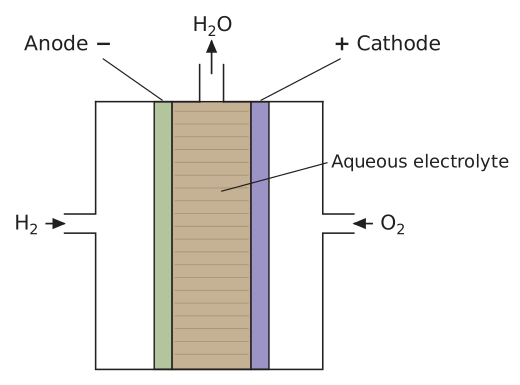
Figure — The stem asks to draw the H2-O2 fuel cell diagram and this catalog figure is exactly the H2-O2 fuel cell produ The H₂–O₂ fuel cell is drawn as two porous carbon (Pt/Pd-catalysed) electrodes standing in an aqueous KOH electrolyte, with H₂ gas fed continuously to the anode and O₂ gas fed continuously to the cathode; the external wire connecting the electrodes carries the current produced.
Description of the labelled diagram (since a diagram itself can't be rendered here, every element you need to draw and label is described):
- A rectangular cell (container) filled with concentrated aqueous KOH electrolyte.
- Two porous carbon electrodes, coated/impregnated with a catalyst (finely divided Pt or Pd), dipping into the electrolyte from either side — label the left one Anode (−) and the right one Cathode (+).
- H₂ gas is bubbled in continuously at the anode side (label the inlet arrow "H₂ in").
- O₂ gas is bubbled in continuously at the cathode side (label the inlet arrow "O₂ in").
- An external circuit (a wire with a load/bulb or ammeter) connects the two electrodes above the cell, with the electron flow arrow shown going from anode → external circuit → cathode.
- Water outlet shown near the electrolyte, since H2O is the only product formed and is continuously removed to keep the KOH concentration constant.
Electrode reactions (label these next to the diagram):
Anode (oxidation): 2H2(g)+4OH−(aq)→4H2O(l)+4e−
…
🎓Unlock everything free for 14 days
- ✓Full step-by-step solutions
- ✓Concept-first explanations
- ✓Methods, shortcuts & mistakes
- ✓PYQ mapping + timed mock tests
Full access for 14 days. No credit card required.